
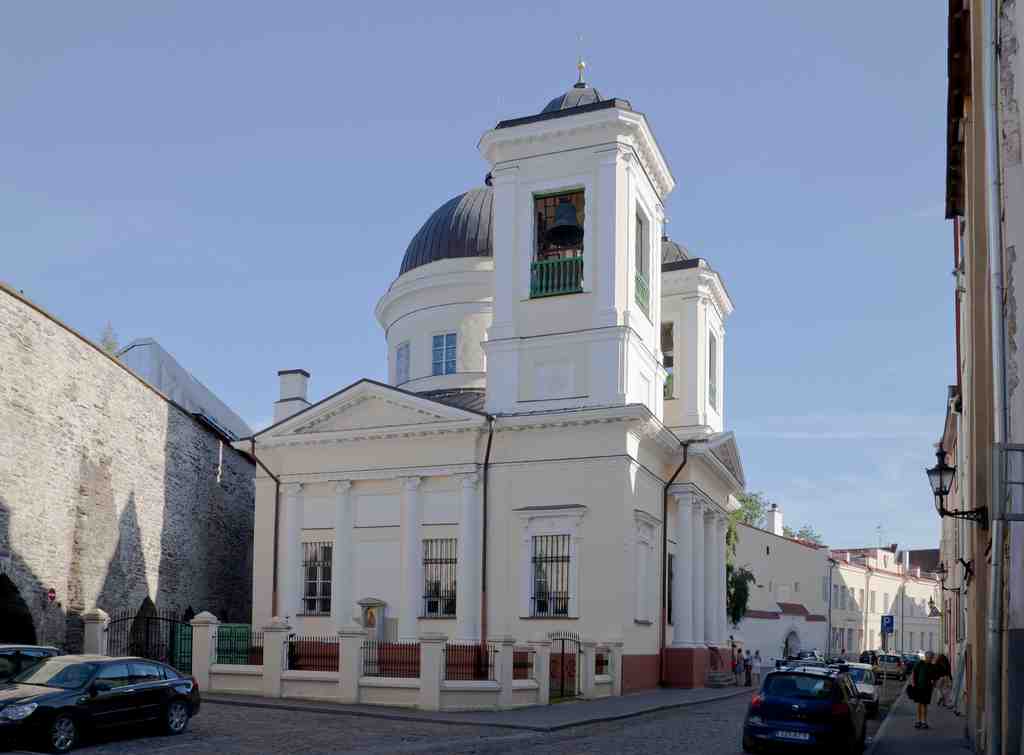
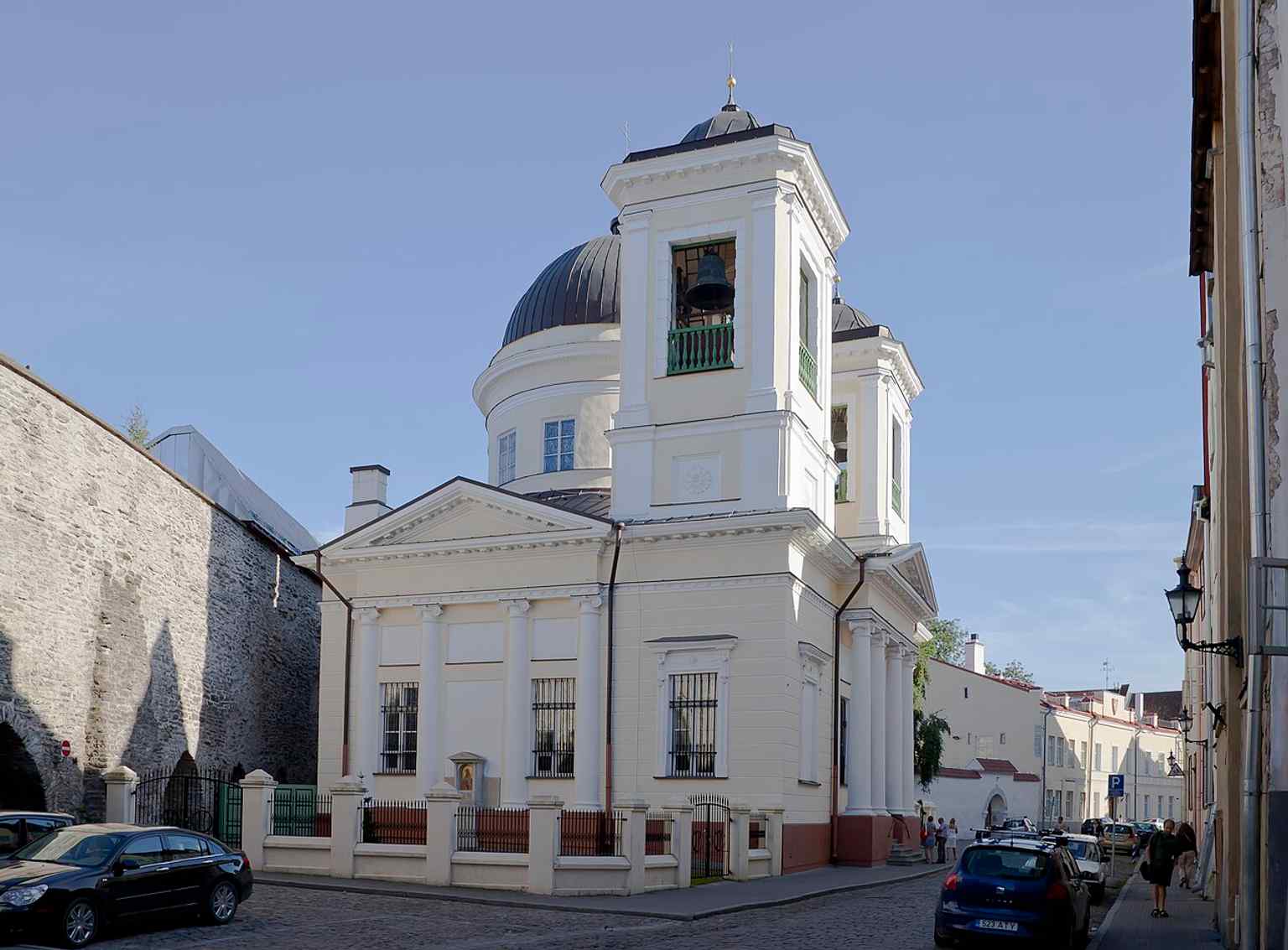
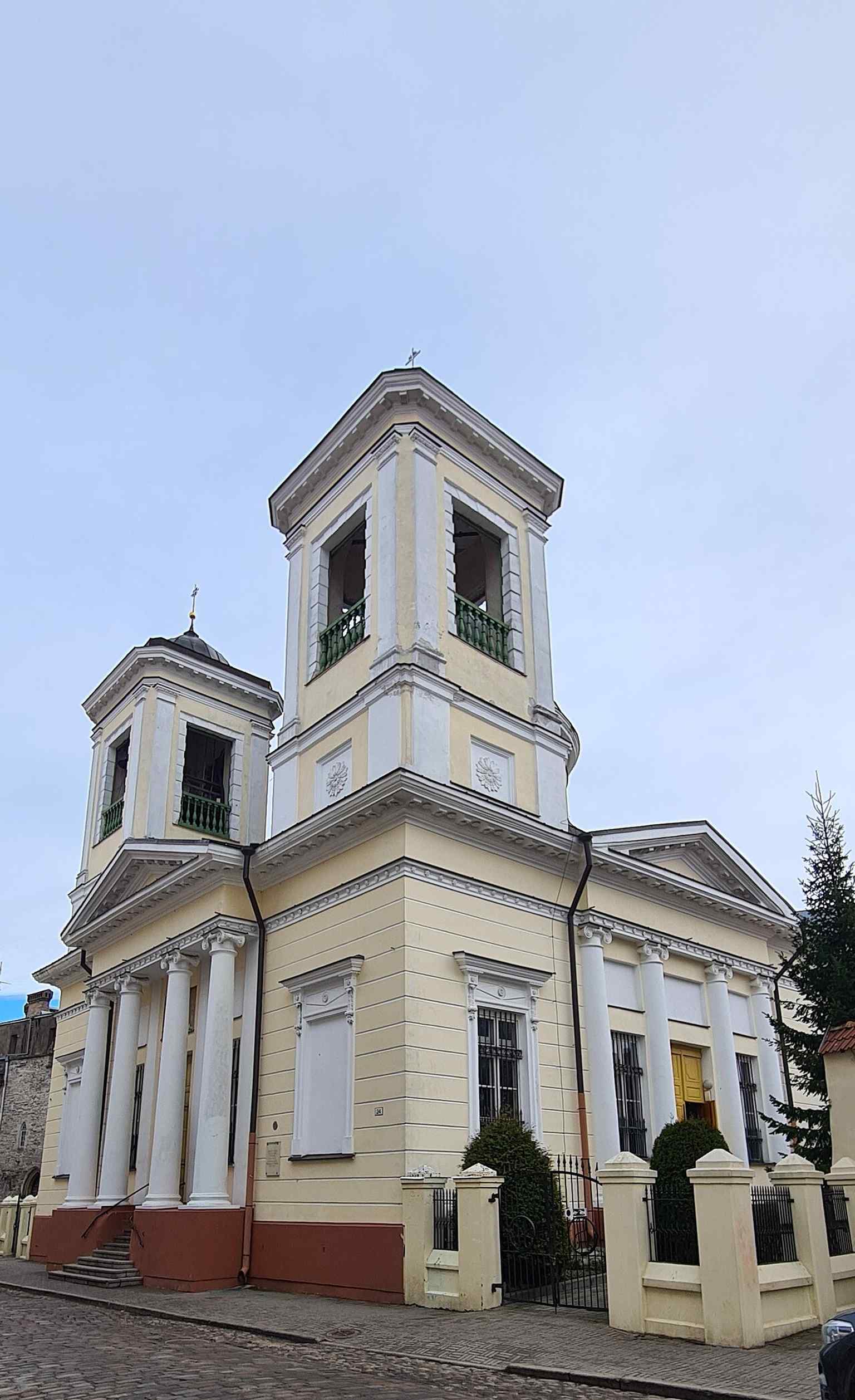
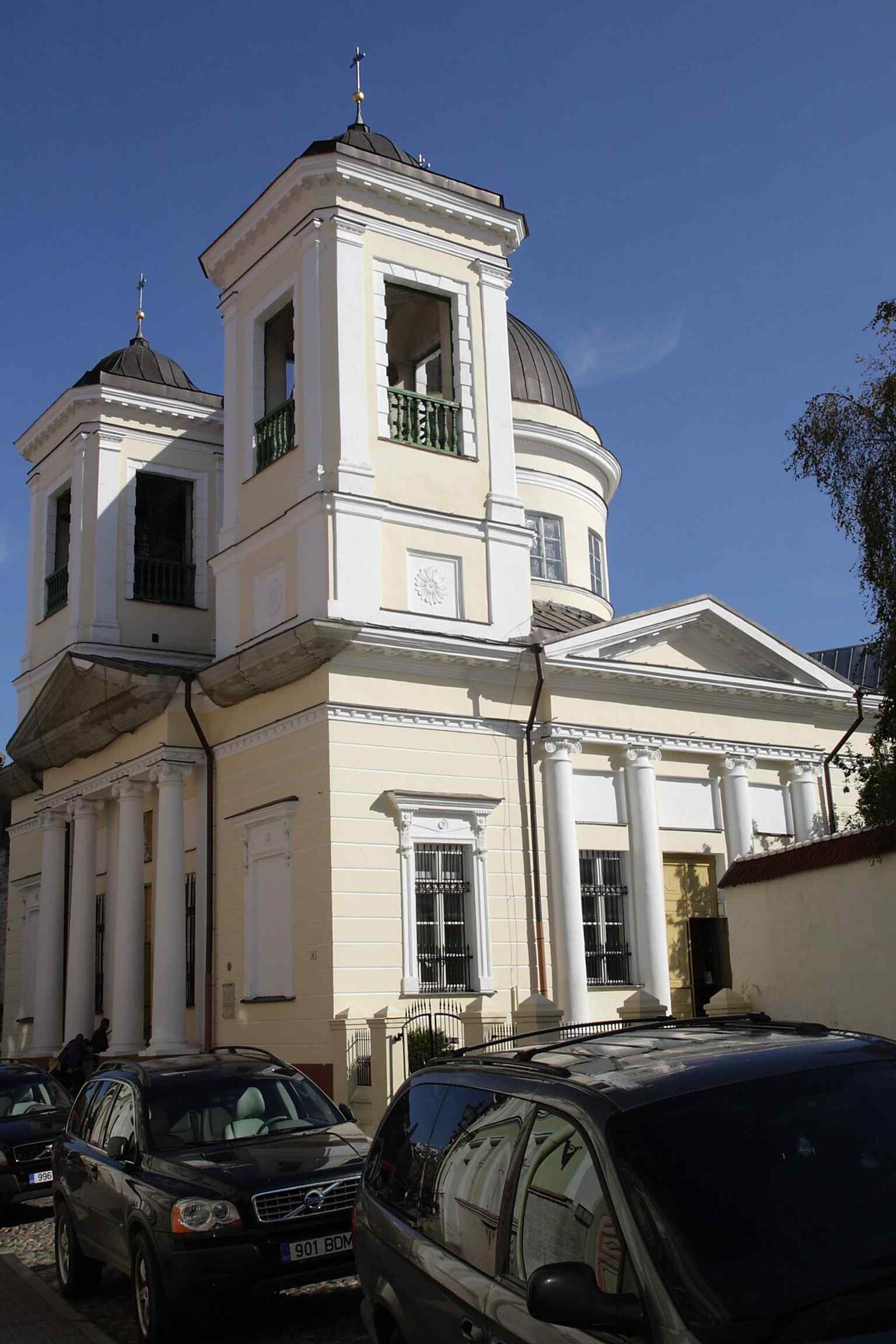
On your left, look for the pale stone church with a rounded central dome and twin square corner towers, its calm neoclassical front standing a little apart from the sharper medieval rooflines around it.
This church tells a quieter Tallinn story... and a stubborn one. Long before the grand Orthodox statement of Alexander Nevsky rose on Toompea, there was a Russian merchant parish on Vene Street here in the lower town, woven into trade, prayer, and daily business. Russian merchants had a presence in Tallinn from very early on, and this parish grew out of that world: a commercial courtyard, a congregation, and a church dedicated to Saint Nicholas, the patron saint of travelers and traders. Very practical choice, really. If your livelihood depends on ships, roads, and other people keeping their promises, you want Nicholas on your side.
The parish stood here from the fourteen twenties, when this street was still called Monastery Street. After the Reformation changed the neighborhood in the sixteenth century, the street itself changed identity and became Vene Street, meaning Russian Street. That rename says a lot. In this part of town, the map kept score.
The church survived badly, which is often how old buildings survive at all. During the Reformation it was likely plundered. In fifteen forty-two the city turned it into a hospital. During the Livonian War, it closed. During the Northern War, it became a hospital again. For stretches in the early seventeenth century, the keys sat in the town hall and the church opened only when Russian merchants arrived. Imagine that: a living parish reduced to something like a seasonal institution, waiting for trade winds and familiar footsteps.
If you glance at the image on your screen, you can see the present building’s ordered, classical shape. That form belongs to the nineteenth-century rebuilding, after the old church had become dangerously worn out. One of the men who pushed the rescue forward was Father Ioann Nedeshev, an energetic priest who realized the parish would never get the huge imperial budget people hoped for. So he backed a more affordable plan, kept the project moving, and helped make this the Tallinn you see now: the city’s first domed building and first classical church with two towers.
Most people passing outside never guess what lies beneath the altar. Metropolitan Arseny Matseyevich, a senior Orthodox churchman who opposed Catherine the Great’s seizure of church lands, died in imprisonment here in Tallinn in seventeen seventy-two. Church tradition holds that his remains rest beneath the main altar. So this is not only a parish church. It is also a burial place for a man punished by the state for defiance... which reminds us, once again, that sacred space here has rarely been only about devotion.
Inside, the real treasure is the iconostasis, the wall of icons that separates the altar from the main worship space in Orthodox churches. Parts of an older royal gift from the sixteen eighties survived into the rebuilt church, and later additions gave the interior its layered character. If you want a peek, check the interior image in the app.
From here, step into the adjoining lane where another religious community left its mark in stone and memory... Katariina-Käik is about a three-minute walk away. If you want to come back inside later, the church is generally open every day, usually from ten to three, with longer hours on Friday and Saturday and an earlier start on Sunday.






.jpg)