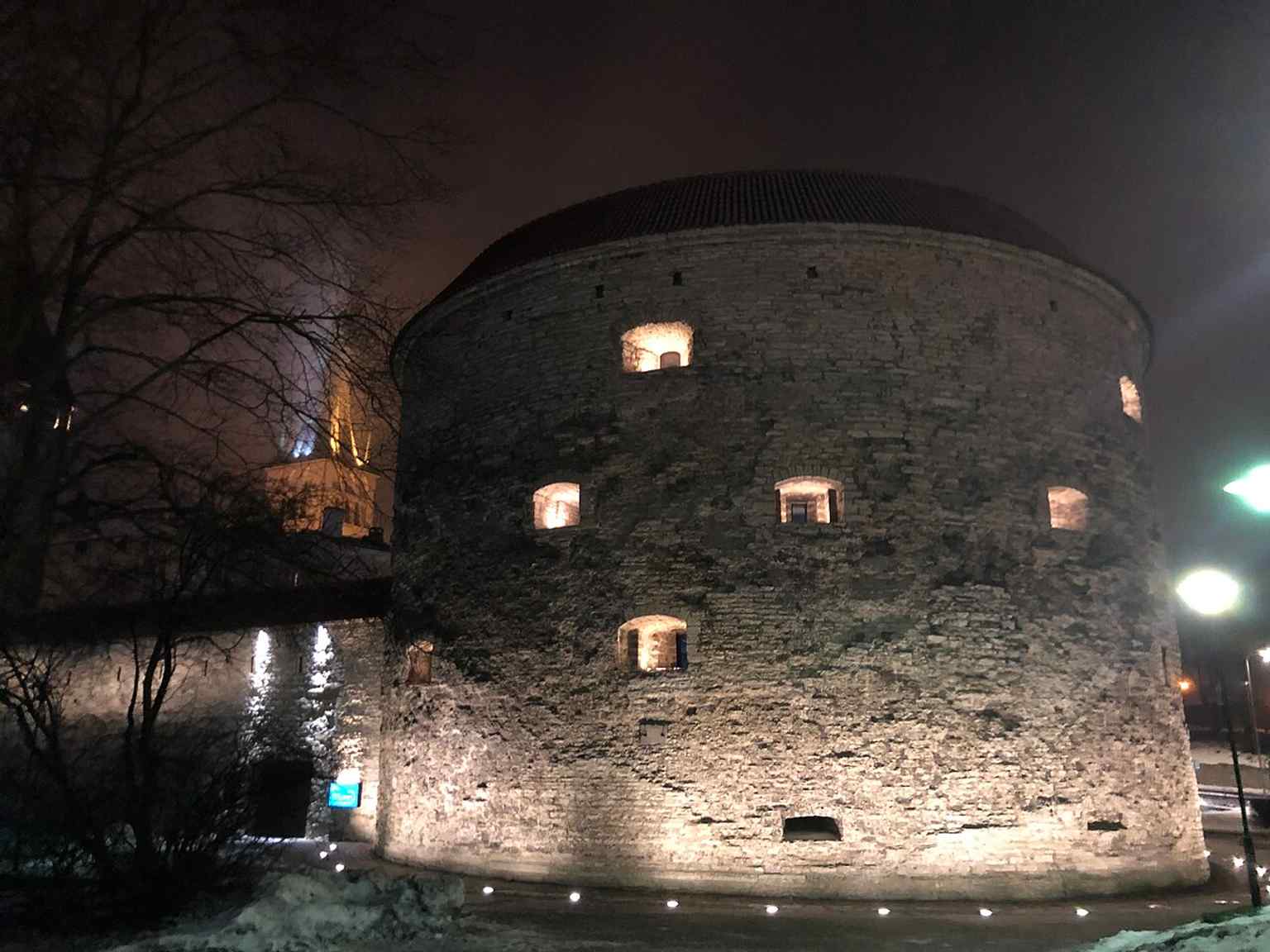
On your right rises a massive round limestone tower, its thick tapering walls capped by a red conical roof and punctured with small rows of windows.
For a building called Fat Margaret, it makes a very disciplined first impression. This was Tallinn’s harbor gate and coastal defense, the fortified threshold between the city and the wider maritime world. If you arrived by sea in the early sixteen hundreds, this hulking three-quarter-circle tower told you, before anyone spoke, that Tallinn intended to inspect you, tax you, and if necessary shoot at you.
Construction began in fifteen ten during the rebuilding of the Great Coastal Gate. The design probably came from Clemens Pale, and from the fifteen twenties the work was led by Gert Koningk of Munster, the same master craftsman who also worked on St. Olaf’s Church. After Oleviste’s spire stretched upward like ambition itself, this tower answers with pure muscle. The main building work finished in fifteen twenty-nine, and the full complex wrapped up by fifteen thirty-one.
And it kept changing. Between sixteen oh three and sixteen oh nine, Tallinn added another barbican, meaning an outer defensive barrier, with a drawbridge and Renaissance portals. Then, in the sixteen forties, Hornbastion rose near the northeast corner. This place was never one neat medieval postcard... it was an argument in stone, updated whenever power felt nervous.
Then came the reversal. In the nineteenth century, after the fortifications lost military status in eighteen fifty-seven, the defenses were stripped back, the fourth barbican came down in the eighteen seventies, and this tower became a prison. By eighteen eighty-four, a multistory prison building stood by its southwest corner. Most visitors never hear the darkest part: in nineteen seventeen, during the revolution, prisoners were freed, the prison burned, and the prison warden was shot dead right in front of this tower.
Later, Tallinn pulled the site back from ruin. The city restored it for a museum in nineteen thirty-eight to nineteen forty, and from nineteen seventy-eight to nineteen eighty-one architects rebuilt the complex again for the Estonian Maritime Museum. If you like, tap the before-and-after image in the app; you can see how this old harbor bruiser has been reintroduced to the city.
Even the latest renovation, from twenty seventeen to twenty nineteen, uncovered older walls and channels from the fourteenth and fifteenth centuries, proof that this stern face stood on an even older line of control.
From this guarded gateway, we’ll head next to the Orthodox church on Vene Street, where Tallinn’s Russian trading community left quieter, but no less revealing, marks.