
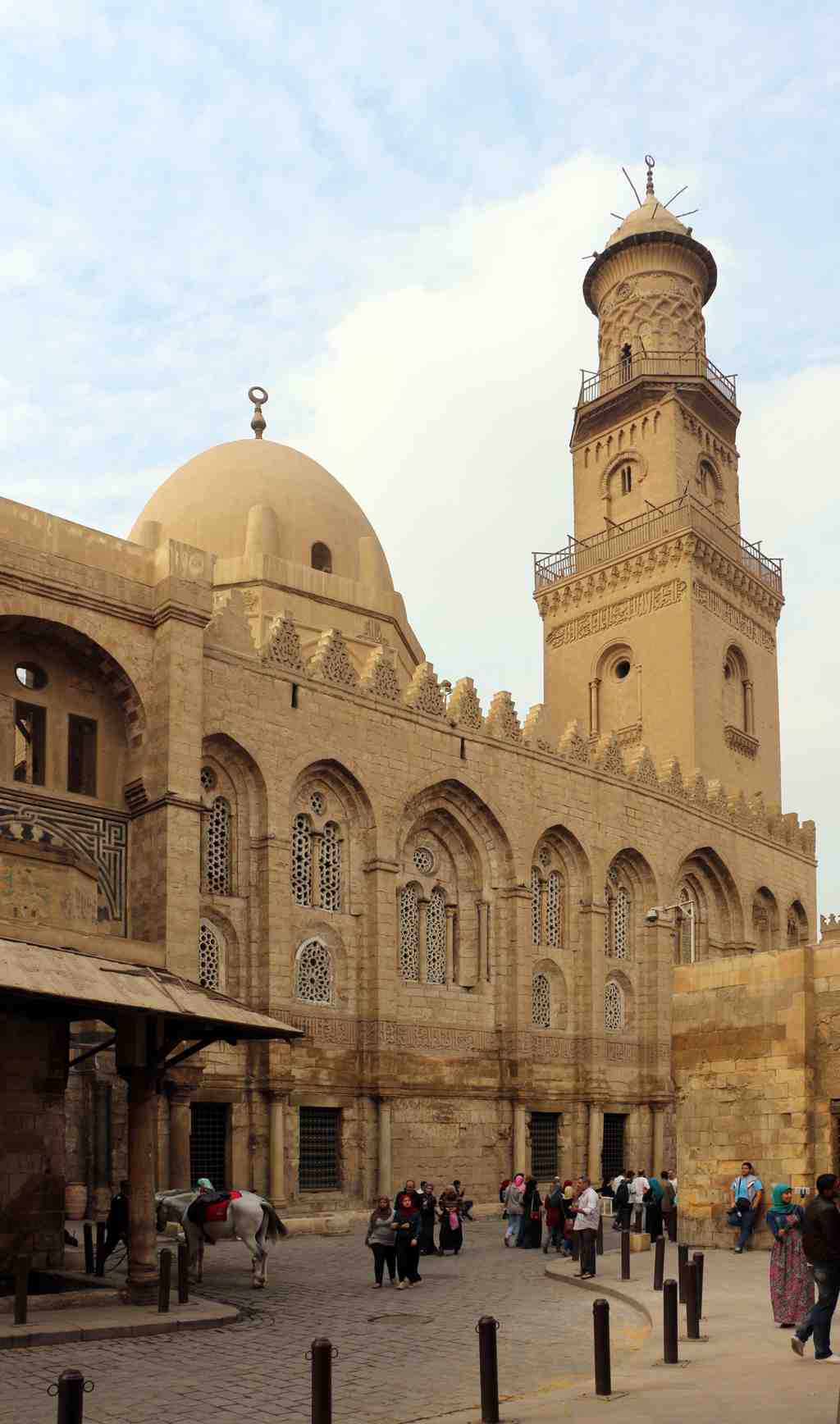
To spot the Qalawun Complex, look to your right for an impressive long stone façade featuring rows of pointed arches, ornate windows, a large dome, and a tall, intricate minaret rising above the busy street-like a sandcastle fit for a sultan but on a much grander scale!
Now, let me carry you back to Cairo in the late 1200s. Picture this street alive with the shouts of merchants, the clip-clop of horses, the clatter of carts, and right in the middle of it all, Sultan Qalawun deciding he was going to build something to stun the city-and well, you’re standing right in front of it! This colossus of a building popped up in record time, just over a year for the mausoleum, mosque, and madrasa, and six months for its grand hospital. Qalawun had a knack for fast work. Or rather, his supervisor emir Sanjar did-which got Sanjar quite the reputation, too, believe me! Sanjar was a man in a hurry who, rumor had it, got hands-on with people’s property and wasn’t shy about using a little “persuasion”-okay, a lot of persuasion-to get the job done. He made builders, passersby, and even unlucky Mongol prisoners all pitch in, voluntarily or not! The word on the street was if you so much as paused near this construction site, you might be handed a hammer or a pile of bricks.
Despite all the drama, though, when the first prayers echoed through the halls and the hospital opened its doors to the sick and the poor, all of Cairo gazed in awe. This wasn’t just a tomb-it was a center of learning, healing, and religious life that bustled day and night for hundreds of years. In fact, legend says Qalawun himself was inspired to build the hospital after recovering from an illness in Damascus. He made a vow to God that if he ever got better, he’d build a place just as grand for the sick back home. That’s one way to keep your New Year’s resolution, right?
Now, the Qalawun Complex is no ordinary piece of architecture. Its 67-meter stretch of honey-colored stone is covered in elegant stripes, pointed-arched windows, and a trio of arches that frame the main entrance. Look up, and you’ll see the unusually tall minaret with its papyrus-shaped crown-a wink to the days of the Pharaohs, as if the sultan was saying, “Hey, don’t forget I rule here now!” The grand dome you see covers the mausoleum, and when it was first built, it quickly became the stage for investing new emirs-imagine serious men in silks and turbans, all under that same roof, listening to the recitation of power.
Step inside (in your imagination for now), and you’d find a maze of marble mosaics beneath your feet, walls glittering with painted and gilded wood, glass, and mother-of-pearl. The central corridor runs right through, dividing the complex: on your left, the madrasa with its open courtyard and burbling pool, the sound of students recalling verses and legal scholars debating. On the other end, hidden from the street, the bimaristan-the hospital-once a place where the destitute could find not just medicine, but a hot meal, shelter, and even new clothes. The sounds of the sick mingling with the soft tread of sandaled feet and the clink of apothecary jars would drift through the air.
The mausoleum itself is a masterpiece-imagine an octagonal space with soaring columns, bands of script swirling overhead, and a lavish mihrab lined with marble and glinting glass. Qalawun and his son, al-Nasir Muhammad, both rest here, surrounded by the splendor they built. Not everything survived the centuries unscathed: an earthquake in 1302 toppled parts of the structure, but al-Nasir, determined to keep his father’s legacy alive, rebuilt what was lost. Even later, when the Ottomans strolled through, a governor named Abdul-Rahman Katkhuda couldn’t resist adding his own flourish-a new dome and a water fountain across the street. Restoration after restoration, every generation made its mark.
And let’s not forget the sounds-ancient windows grilled to let prayers spill out onto the street, as if the building itself wanted the world to join in. Once, you could even hear calls for medical help, history lessons, children running, and the deep, resonant chime of devotion.
So as you stand here gazing up at this old stone giant, imagine all those stories embedded in the walls. It’s not just a place for the wealthy or the pious. For centuries, the Qalawun Complex was a piece of everyone’s Cairo-a palace, a school, a hospital, and a resting place for the ages. And if you listen closely, maybe you’ll still catch whispers of its lively past just around the corner.




