
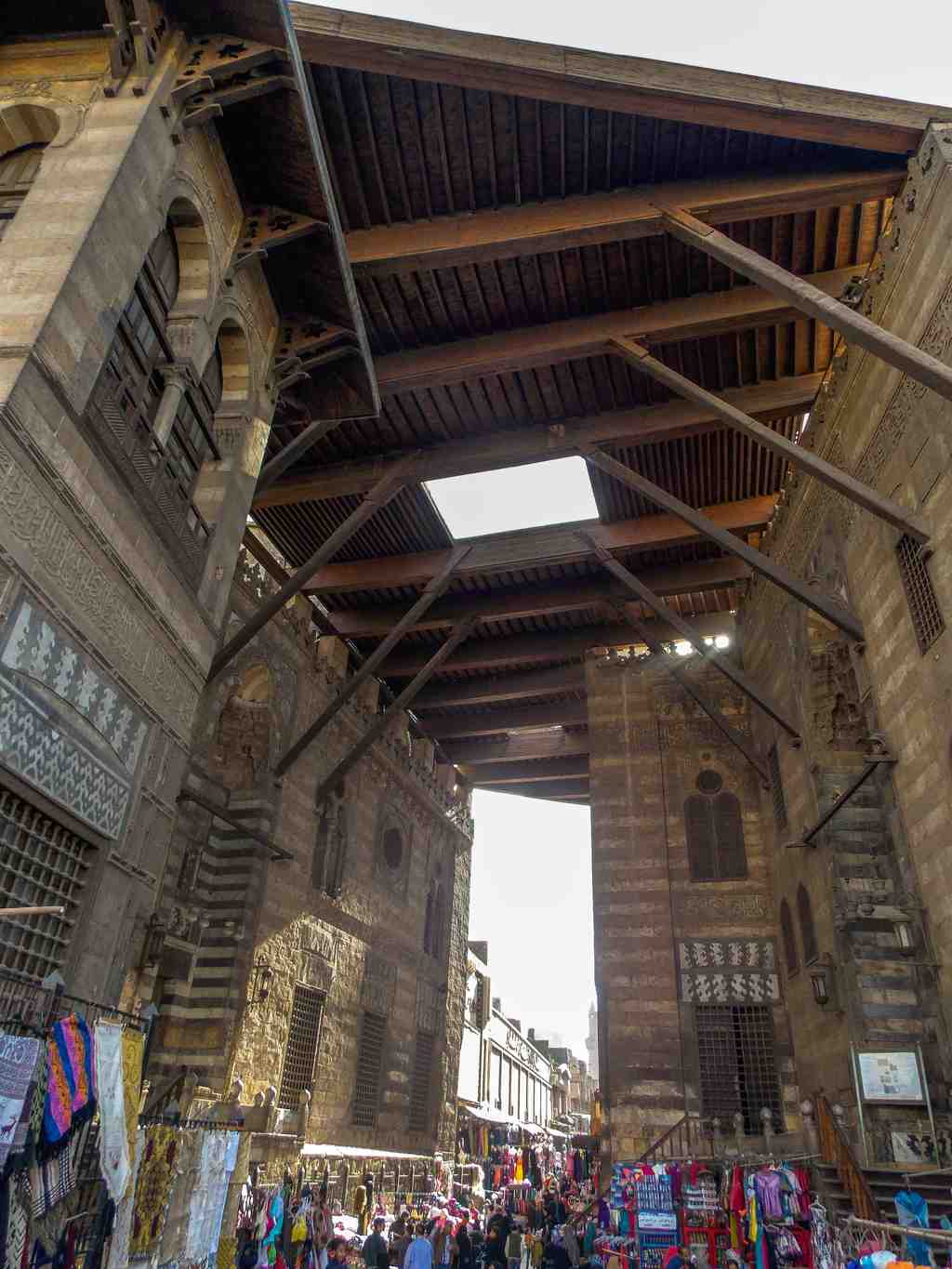
Look up and ahead-you’ll spot the Sultan al-Ghuri Complex by its two grand stone buildings facing each other across the narrow market street, their intricate windows, striped stonework, and a huge wooden roof stretching above, shading the bustling crowds and stalls below.
Now, as you stand right in the heart of Cairo's old town, close your eyes for just a second and imagine the sights, sounds, and even a few intriguing smells swirling around you. The Sultan al-Ghuri Complex isn’t just a building-it’s a whole slice of lively history wedged into the soul of Cairo’s busiest street. The story begins over 500 years ago, when the formidable Mamluk sultan, Qansuh al-Ghuri, decided he needed a legacy that would outshine anything Cairo had ever seen. He didn’t just build a mosque or a mausoleum-oh no, he went all out and built two magnificent buildings, one on each side of this crazy-busy street, connecting them with what was then a wooden roof lined with blue tiles that shimmered in the sunlight. The sort of bling that says, “Yes, that’s right, I was here.”
Al-Ghuri was quite the character-a sultan with wild swings between regal grandeur and harsh deeds. He could be as passionate about poetry, music, and flowers as he was about, let’s say, punishing tax dodgers…severely. People feared him, but they also flocked to see his parades and processions. In 1503, as he started construction, he cleared out whatever stood in his way, including shops, homes, and even another school, just to make space. You can almost hear the grumbling of angry shopkeepers echoing through time, mixed with the clatter and chaos of carpenters, masons, and ceramists.
On your left, the eastern block holds what was meant to be al-Ghuri’s own mausoleum (more on that little twist of fate in a second!), a khanqah for Sufi ceremonies, a sabil where water was given out to passersby, and an upstairs kuttab where children would learn to read the Qur’an. On your right, the western wing is a stately mosque and madrasa, filled with marble, black and white stone, and whispering corridors where the devout still tiptoe to pray.
In al-Ghuri’s wickedly ambitious mind, the dome and minaret across the street were destined to appear as one harmonious masterpiece if you approached from the south. Shoppers and worshippers alike walked beneath sparkling tilework and through recessed portals lined with black and white marble, facing off as if the stones themselves were ready for a royal parade.
Now, here’s where mystery and a little Cairo drama come in. As a ruler, al-Ghuri was tough as nails, leading campaigns against the Ottomans and ruling with an iron hand. But his end came suddenly and shockingly-he died of a heart attack in the heat of battle near Aleppo, after one of his trusted allies betrayed him. His body was never found. The kind of mystery that would make even the best detective novels jealous! So, that grand mausoleum he spent a fortune on? Never even used for his own burial. Instead, relics connected to the Prophet Muhammad were paraded into it, giving this place a sacred aura, and in time, al-Ghuri’s family members found their final rest here-even another sultan.
The Sultan al-Ghuri Complex became the grand centerpiece of Cairo’s textile market, so imagine this street filled with the rustling of silks, flashes of colorful cloth, and the juicy shouts of merchants hawking the latest fashion. The rents from all those stalls below your feet actually helped pay for the upkeep of the whole complex! If you look closely at the buildings-especially at the windows and arches-you’ll see hints of Coptic and Byzantine designs, as Mamluk craftsmen pinched designs from all over to show off their skills.
But there’s more: the sabil-kuttab you see here is like a two-for-one history deal-a water station below, and a school above. And if you trace your fingers along the ablaq-stone walls, you might even catch a little echo of how those blue tiles gleamed when the complex was new.
Sometimes grandeur has a shaky side-literally. The big dome, built to be one of Cairo’s largest, was so unstable it had to be rebuilt twice before finally being replaced with a plain wooden roof. And let’s not forget when sultans changed: the Ottomans, after conquering Cairo, took some of the fancy marble decoration back to Istanbul. Even a massive earthquake in 1992 couldn’t bring this place down for good, and after careful restoration, the complex still stands as a theater of Cairo’s story-full of ambition, beauty, turmoil, and the endless hustle of the surrounding market.
So next time you stroll beneath this roof, with sunlight sneaking through, just remember: it’s not only traders and shoppers swirling around you-it’s the ghosts and glories of sultans, soldiers, poets, and dreamers. And if you listen carefully, you might even catch the faintest echoes of celebration and intrigue, mixed with the sweet call of adventure.




