
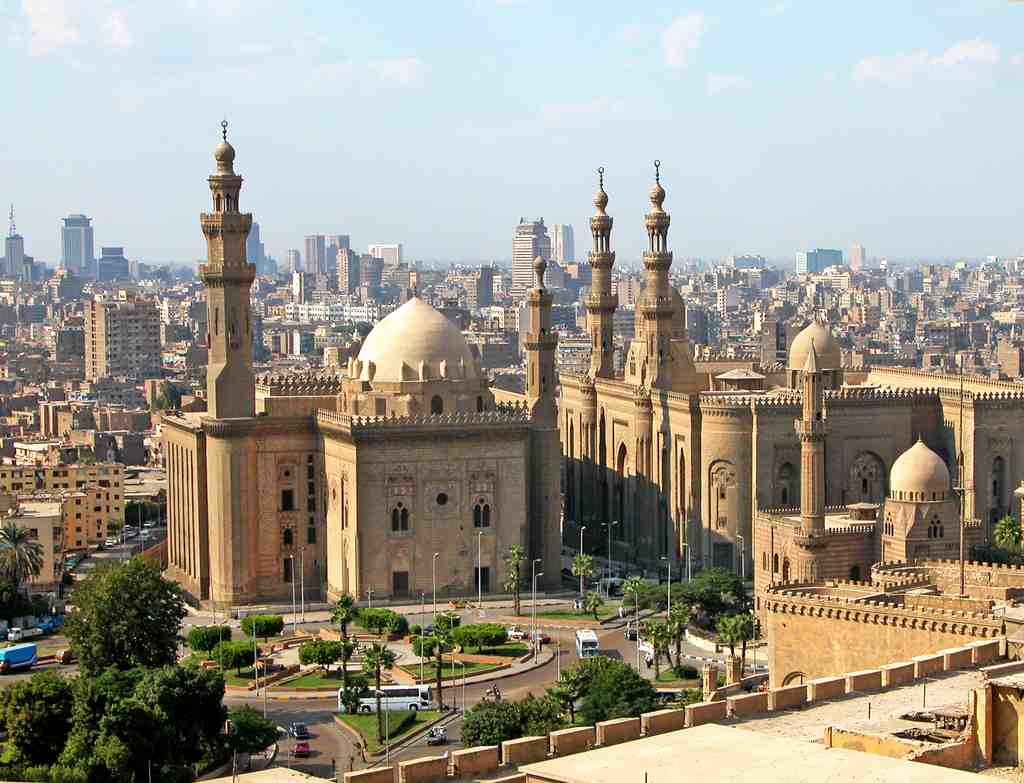
In front of you, you’ll see a maze of beige and sand-colored buildings, dotted with a wild constellation of minarets and domes-just look ahead and up for the tall, slender towers reaching for the sky, and you’ll know you’re gazing into the very heart of Islamic Cairo.
Step right up-I hope you’re feeling adventurous! You’re now standing at the threshold of one of the world’s most spellbinding historical districts: Islamic Cairo. Close your eyes for a moment and listen-can you hear the hum of life centuries in the making? Now, open your eyes and imagine what it must have been like in 641 CE, when the very first footsteps of conquerors echoed off these dusty stones.
Picture this: Alexandria, glorious and ancient, was Egypt’s capital-until the Muslim Arabs, led by the legendary ‘Amr ibn al-‘As, decided they needed a brand-new headquarters. They didn’t want to be anywhere near sea-faring Byzantine counterattacks or the lingering ghost of Rome, so they built Fustat, a city nestled by the Nile and shielded by the hulking Babylon fortress. With that move, the fate of Cairo was set in motion-all at the intersection of Egypt’s north and south, just like those clever Ancient Egyptians had done with Memphis so long ago.
Fast forward a bit and you’d notice a parade of new cities popping up, each with grand mosques and opulent palaces. Some lasted only a few decades-like al-Qata’i, built by Ibn Tulun who, in a twist worthy of a political drama, became his own boss and ruled independently from the Abbasids. The only thing left today from that era is the magnificent Mosque of Ibn Tulun, still standing, still awe-inspiring.
But nothing would compare to the arrival of the Fatimids in 969. Picture Jawhar the general, on orders from Caliph al-Mu’izz, mapping out al-Qahira-the “Victorious City.” They built it as an exclusive palace-town, baking its mudbrick walls under the sun, with two grand palaces and the now legendary al-Azhar Mosque right at the center. Ordinary folks? Sorry, they had to stay outside! Cairo was for the ruling Fatimid family and their well-guarded secrets. Only much later did the city burst out of its shell, swallowing up neighboring towns, stretching beyond its walls, and inviting the rest of Egypt inside.
Here in Islamic Cairo, the change of the guard was a noisy affair! The Ayyubid dynasty took over when Saladin-yes, that famous foe of the Crusaders-ended the party for the Fatimids, tore down what was left of their glory, and built the mighty Citadel to watch over the city. It wasn’t long before Cairo swung open its doors to the world. Traders, scholars, and travelers from the farthest corners of the earth filled these streets-sometimes they brought silks and spices, other times, they brought trouble!
Then came the Mamluks, legendary warrior-slaves who ended up running the show, ruling with both ambition and, let’s be honest, a little bit of drama. Under Sultan al-Nasir Muhammad, Cairo became the largest city outside China, a metropolis of half a million souls, stacked with high-rise buildings centuries before “luxury condos” were a thing. If you listen closely, maybe you’ll hear a ghostly merchant haggling over a caravan of spices! This was a city of mosques, madrasas, markets, and monuments-more per square meter than almost anywhere in the Islamic world.
But, as with all stories, there were dark chapters. The plague swept through the cramped streets, the Black Death whispering in from far-off lands. The city’s population shrank, but its spirit never really weakened. Cairo always found a way to rebuild, to welcome the next wave of rulers. First the Ottomans-who couldn’t quite stop the old Mamluk traditions from shining through-and then the French, marching their boots and cannons through these lanes for a blink in time. Even Muhammad Ali Pasha, the ambitious Albanian, couldn’t resist tearing down and adding a bit of his own style, with palaces and mosques fit for sultans and sultanas alike.
By the 19th century, Cairo swung toward the modern with boulevards and city planning straight out of Paris. But here, in Islamic Cairo, it’s the ancient that lingers-the crowded alleys, grand gates, and the whispers of sultans, scholars, and shopkeepers past. Today, as part of a UNESCO World Heritage site, every archway, every door, and every minaret tells a tale-if you’re willing to listen. And if you peer down any busy street, you just might stumble onto a little magic-or at least a market selling the world’s tastiest falafel.
So, while you stand here, surrounded by centuries of history, take a deep breath. The pulse of Islamic Cairo is still alive, still full of stories-and you, lucky traveler, are now part of its never-ending adventure.
Intrigued by the history, historical sites and monuments or the preservation status? Make your way to the chat section and I'll be happy to provide further details.




