
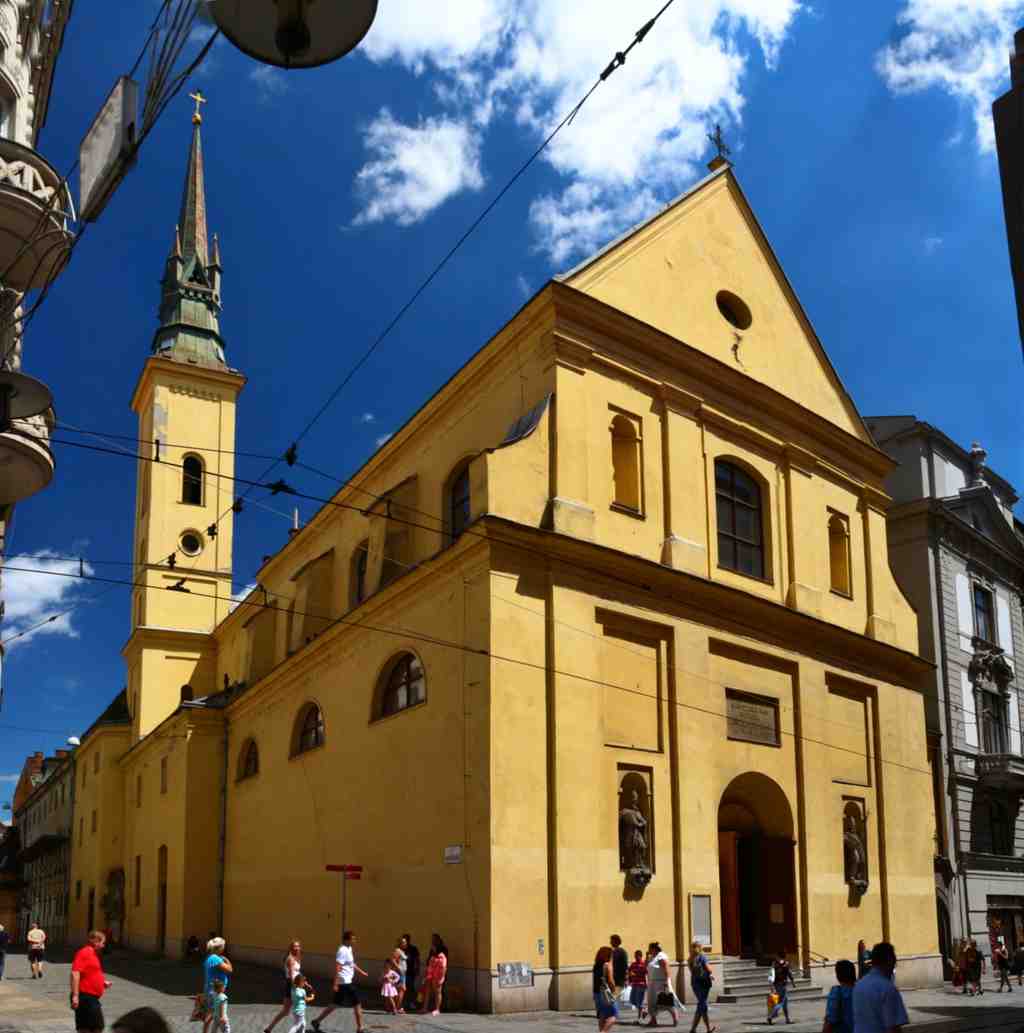
You’re looking for a tall, yellow church with a triangular roof and a slender tower-just look for the building with statues flanking its front entrance right at the corner of Masarykova and Františkánská streets!
Let’s paint a lively picture here: It’s Brno in the middle of the 17th century. Imagine the echoes of footsteps from the crowds shuffling through a tightly packed Jewish quarter, the air buzzing with merchants’ calls and children’s laughter. On this very spot stood a synagogue, the heart of a vibrant Jewish community that, by order of King Ladislaus the Posthumous in 1454, was forced to leave the city. Suddenly, a silence fell where song and conversation once filled the streets.
But as history tends to do, the story took another turn. The Franciscan monks-thanks in part to a fiery Italian preacher named Jan Kapistrán-transformed the synagogue into a humble chapel dedicated to Mary Magdalene. Then, after Brno’s old Franciscan monastery was torn down in 1643 because city defenders feared the Swedes, the monks took over the chapel here and set about rebuilding it. Imagine the sound of stone being stacked, hammers striking, plans unfurling as Italian builder Ondřej Erna, fresh from Milan, laid its foundation in 1651. By 1654, the church was ready-a new chapter, standing atop centuries of layered stories.
Drama followed drama. The church was decorated through generous donations from local nobility. Yet, there were neighborly squabbles-a grand palace next door started to cast a literal shadow, sparking an argument so big that it finally took cash compensation and an extra floor on the monastery to put everyone at peace. You can almost imagine the friars and aristocrats crossing arms, bargaining like today’s reality show contestants.
And that’s not the end of the surprises! In 1852, a devastating fire broke out in an inn by the gate. Flames leapt and smoke billowed-imagine the crackle as the church’s tower and five nearby houses got battered by fire. The tower you see today, with its sharp lines and neo-Romanesque touches, was built when they restored the church after the fire. Later, during the upheavals of the twentieth century, the church watched armies come and go, monks and priests shifting in and out as governments changed hands. At one point, even communists gave the religious folk the boot!
Of course, no great landmark is complete without some mechanical mishaps. Not long ago in 2019, an underground water leak caused cracks to streak through the church, the walls literally groaning as they were shored up. For a while, the doors closed-hardly anyone inside except for construction crews patching the wounds, and the great altar painting was taken down, hanging limply beneath the balcony. Even churches need a spa day from time to time.
As you look up at those statues flanking the door-St. Nicholas on the left, St. Martin on the right-don’t miss the little details, from the patchwork of simple side windows to the imposing yet welcoming entryway, crowned by a stone plaque with ancient Latin. Peek around the corner, and you’ll spot a limestone statue of St. Florian with two adorable angels: one angel pours water on a burning house, the other clutches a mill wheel.
Inside is a world of artistic treasures: carved altars, twisted cherubs, swirling angels, grand baroque pulpit, and a main altar painting by Josef Stern, who was inspired by Rubens. If you think church renovations are a twenty-first-century headache, just remember-this place has seen everything from fire to lawsuits to water disasters. No wonder the pews look so seasoned.
So as you stand here, you’re not just next to a church-you’re at a crossroads of cultures, faiths, wrangling neighbors, and dazzling artists. Quite a history lesson, right? And it all began on a unique city corner, where each block whispers a story and sometimes even the statues look like they’re eavesdropping.




