
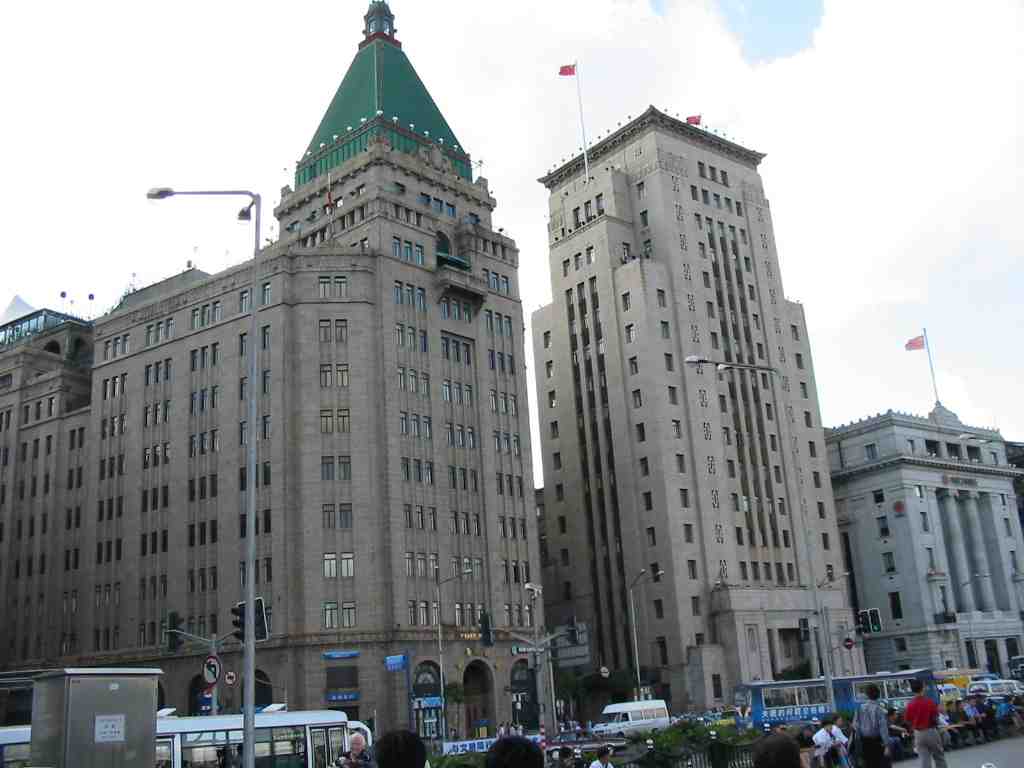
You’re looking for a tall, stone-clad tower with subtle Art Deco style and a flat top, just to the right of the green-pyramid-roofed Peace Hotel, so keep your eyes peeled straight ahead for a building that looks like it’s standing proud but maybe a little envious of its next-door neighbor’s flashy hat!
Ah, welcome to the Bank of China Building-one of the Bund’s giants with a big story (and, honestly, a little height envy). If you listen closely, you might just hear the old walls whispering tales of ambition, rivalry, and the occasional architectural heartbreak.
Once upon a Bund evening, this very spot was the site of the raucous German Club, filled with laughter, clinking beer steins, and the kind of gossip that could make even a stone statue raise an eyebrow. But then came World War I, and with the echo of marching boots, the Chinese government took over the German Club as "enemy assets." After the war, the Bank of China swooped in, purchasing the place for what would have been a mountain of silver yuan-630,000 to be exact!
By 1928, the Bank of China had had enough of Beijing’s thin air-they moved their headquarters right here to Shanghai’s bustling waterfront. Each year, the Shanghai branch would tuck away a cool half-million yuan, like a squirrel hoarding nuts, waiting for the day they’d build a new headquarters that would show the world: Chinese banks belonged in the big leagues. "We’ve endured. We’ve thrived. Now give us a skyscraper!” they declared.
The dream? A soaring, 34-story marvel that would scrape the skies and become the tallest building in the Far East-take that, neighbors! They built the foundations strong enough to support a giant. But then, the plot thickened. Enter Sir Victor Sassoon, owner of the flashy Sassoon House next door (which, by the way, you can spot easily with its green, pointy hat). Sassoon was not a man to be outdone at anything-especially at real estate. He insisted, with the sort of stubbornness only found in the rich and famous, that no building beside his could rise higher than his spire. The British municipal council, always ready with a polite excuse, claimed “Chinese were poor in designing ability” and that the weight would shake neighboring buildings apart. But we know a turf war when we see one!
Cut down almost by half, the Bank of China Building was finished just a foot lower than its neighbor. The great dream of Shanghai's highest tower became the story of Shanghai's greatest compromise-but also a tale of determination, because even a “stunted” building could command respect on the world stage.
On October 10, 1936, the city buzzed as the foundation stone was laid, and the Shanghai Times covered it in minute detail. Construction moved quickly, but Shanghai’s story is never straightforward. By 1937, with the building nearly done, the Second Sino-Japanese War broke out, and progress slowed to the drip, drip, drip of uncertainty.
During these troubled years, the building was commandeered for government banking, and it wasn’t until New Year’s Day of 1946-a whole decade after those first bricks were laid-that the Bank of China finally moved into their long-awaited home. If patience is a virtue, then this must be one of the most virtuous buildings in Shanghai!
Now, picture the scene: bankers in crisp suits hustling under the stone eaves, paperwork fluttering, the sounds of typewriters and business deals mixing with the rumble of trams outside. You’re standing at the very center of Shanghai’s see-sawing fortunes, where colonial grandeur, wartime struggle, and Chinese ambition all collided-just one foot shy of greatness, and a world above ordinary.
Take your time, soak in the history around you, and say hi to the ghost of Victor Sassoon for me-he’s probably still measuring the roofline.


