
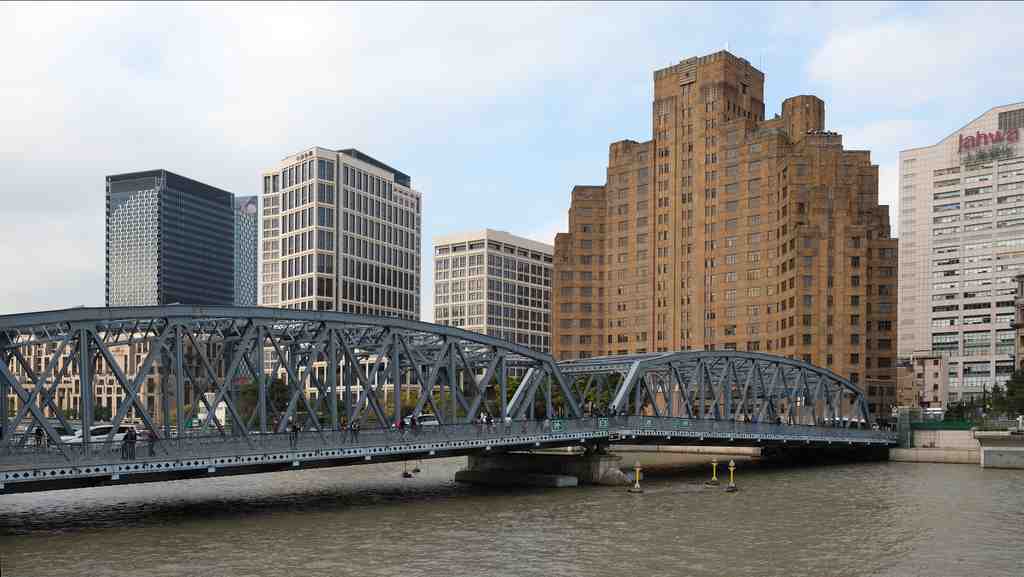
Ahead of you is the Waibaidu Bridge, a sturdy silver-gray web of crisscrossed steel stretching gracefully over the water, easy to spot as it connects both banks just in front of tall, modern buildings-simply look for the arched, industrial lattice right over Suzhou Creek.
Now, take a moment to imagine the sounds of busy traffic, the hum of voices, and maybe a distant boat horn -because this bridge has been at the heart of Shanghai’s story for over a century. Welcome to the Waibaidu Bridge, or as it’s sometimes called, the Garden Bridge. You’re looking at the very first all-steel bridge in China and the only camelback truss left standing in the whole country! Let’s step back in time: it all began in 1856, when a wooden bridge built by a British businessman named Charles Wills stretched across this same spot, but crossing it wasn’t free-a toll collected from locals, and that made plenty of people grumble. In fact, locals disliked paying so much there was a boycott, and soon after, angry Cantonese merchants started a rival free ferry service just to prove a point!
Don’t worry, that toll didn’t last long. The city replaced the old bridge and axed the fee, leading to the quirky name “Waibaidu”-which, in the local dialect, hints at “crossing for free”-so you can stroll over without fear of getting charged, unless you count dodging selfie sticks.
But the bridge you see today, finished in 1907, was a marvel-made of steel from England and assembled with more than 160,000 rivets, many hammered red-hot into place at night, their sparks making the sky glow like fireworks. It weighed almost 1,000 tons and quickly became more than just steel and rivets. This bridge was a silent witness to love, war, disaster, and the everyday crossing of millions.
During the 1930s and the Second Sino-Japanese War, Waibaidu Bridge was practically a border between two worlds-on one side, safety; on the other, fear and unrest. Imagine desperate crowds surging across as bombs fell, the echo of hurried footsteps on the wooden planks, rickshaw bells clanging and sharp Japanese commands slicing through the air. At times, the bridge was so packed with fleeing civilians, it seemed to groan under the burden of Shanghai’s wounded spirit.
But Waibaidu wasn’t just about drama and tension-it became legendary in local culture. Nicknamed “the Beggars’ Bridge” or “the Bridge of Sighs,” it was a gathering place for the city’s poorest as well as an inspiration for poets, filmmakers, and novelists. Countless tales, romances, and even a few tears have been shed right here. In fact, if bridges could talk, Waibaidu would probably ask for a cup of tea and a good long lie down, given everything it’s seen!
Of course, being constantly battered by traffic and time meant the bridge needed regular facelifts. There were repairs big and small-wood replaced with concrete, thorough checks for sinking, rust scraped clean, and a paintjob every now and then to keep it looking handsome. The most dramatic moment came in 2008, when Waibaidu was carefully sliced in two and floated downriver to a shipyard for restoration-like a giant, metallic patient getting open-heart surgery. It came back sturdier than ever, with its original wooden sidewalks lovingly restored and a dazzling LED lighting system, so it’s as much a beauty at night as by day.
Today, as you stand here, you’re walking in the footsteps of everyone from refugees and revolutionaries to Hollywood film crews and ordinary dreamers. Whether it’s painted by sunset, ablaze with colored lights, or shimmering in winter mist, the Waibaidu Bridge remains the city’s quiet, unshakeable witness-always ready for the next chapter in Shanghai’s tale. So go ahead, give it a gentle pat as you cross-it’s earned every single one of its rivets!
Intrigued by the etymology, in the media or the places nearby? Explore further by joining me in the chat section below.


