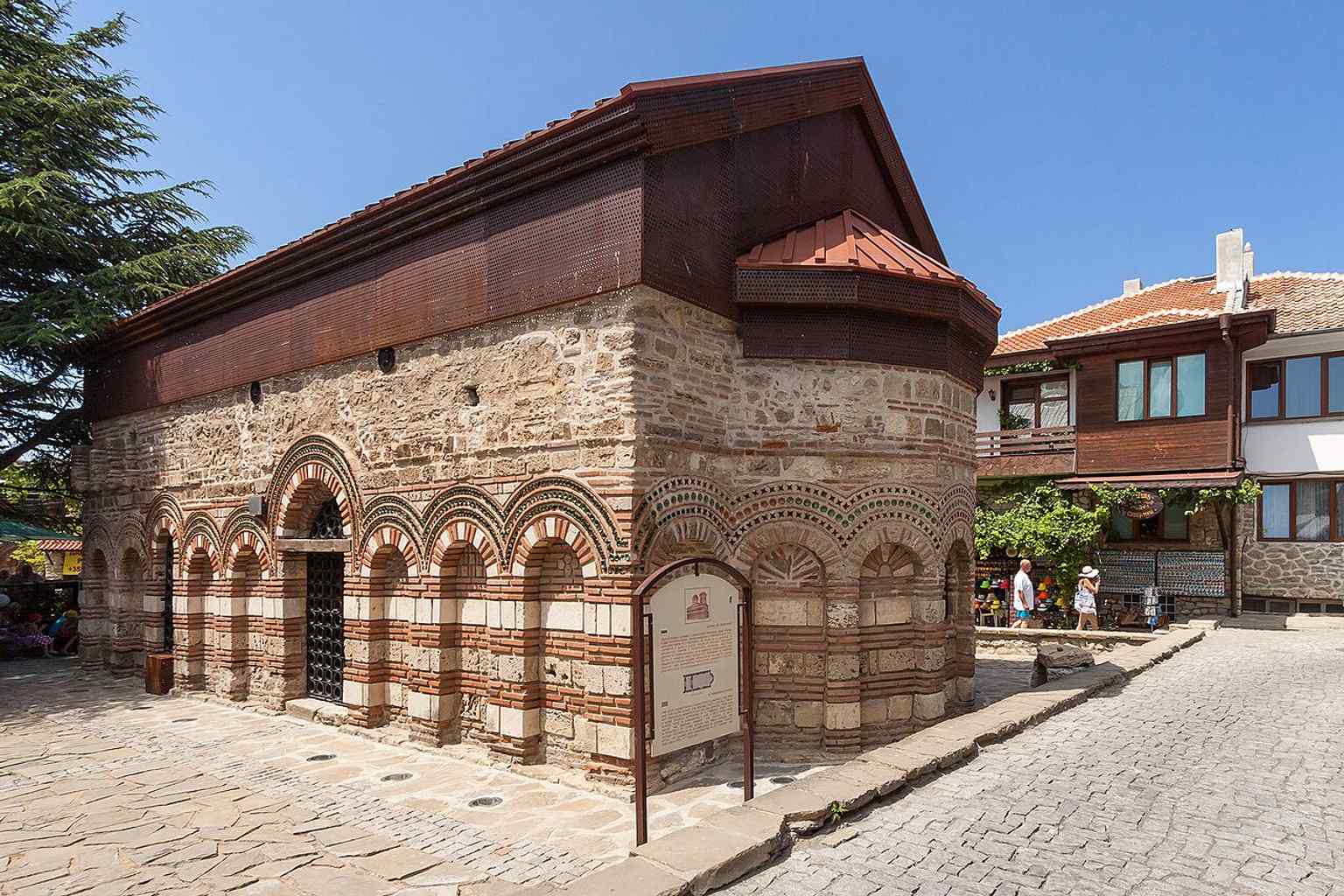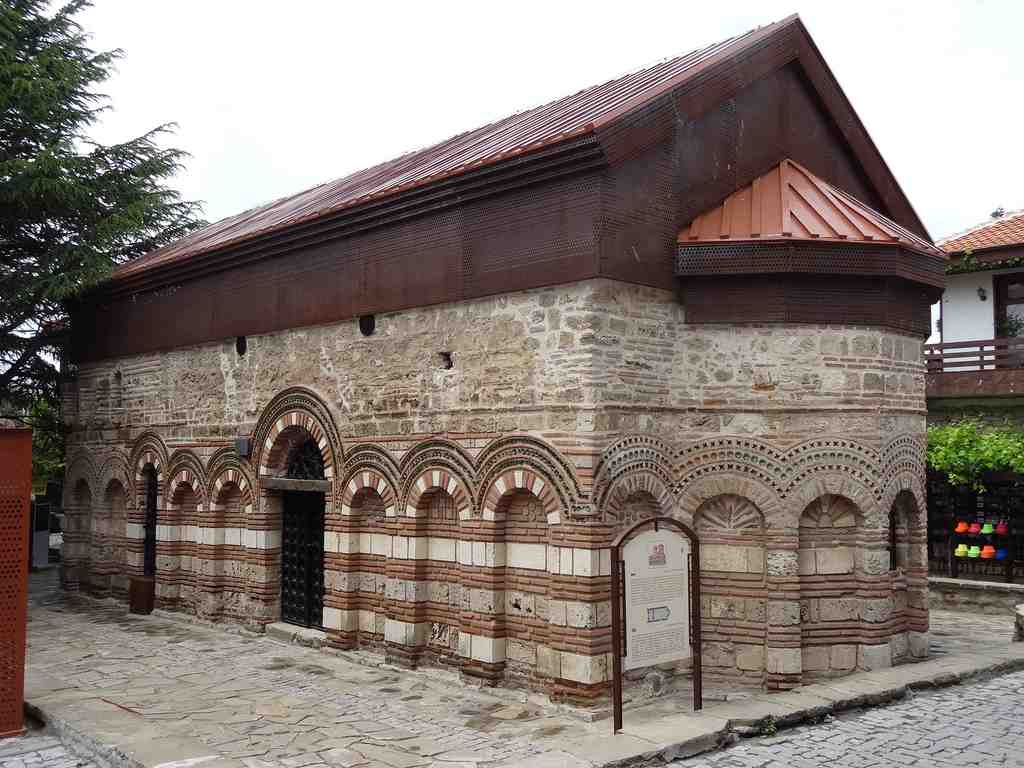
On your right, look for a small brick-and-stone church with a simple pitched roof, a five-sided apse at the far end, and rows of shallow decorative arches pressed into its walls.
Saint Paraskevi keeps part of her story hidden. Some scholars place this church as early as the tenth century, but most date it to the thirteenth or fourteenth century, because its shape and details resemble churches in Veliko Tarnovo, the medieval Bulgarian capital. Writer Jonathan Bousfield even links it to the reign of Tsar Ivan Alexander, from the thirteen thirties into the thirteen seventies, when Nesebar passed back and forth between Bulgarian and Byzantine rule. Even the dedication remains uncertain: nobody can say for sure which Saint Paraskevi this church honored. So before you even step into its meaning, you meet uncertainty... not a gap in the story, but part of it.
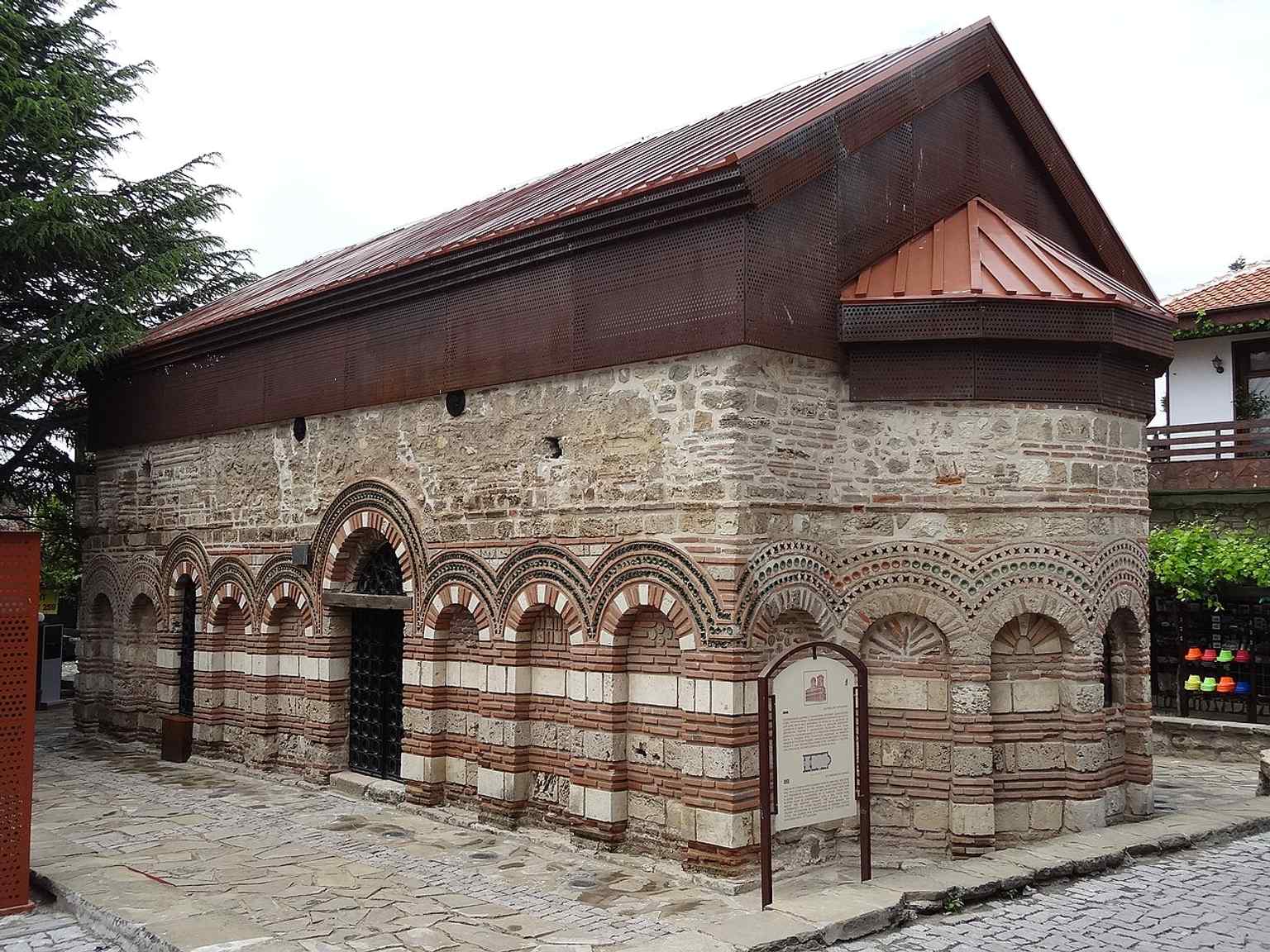
What survives still speaks clearly. This was a single-hall church, with a five-sided altar end and a western entry space. It once carried a dome, and a bell tower rose above the front section, but both are gone now. The walls, though, still remember how richly dressed the building used to be. Two tiers of blind arches - shallow arches made for beauty, not for passage - ran across the outside. Their borders held little colored ceramic rosettes, and the brickwork formed playful patterns: fish bones, suns, checks, zigzags. If you open the detail image in the app, you can catch that handmade rhythm more closely.
But this stop matters most because it learned how to hold loss. In nineteen fifty-eight, people demolished the Church of Saint George the Elder elsewhere in old Nesebar. Pieces of its painted walls survived. Instead of letting those fragments disappear into storage or silence, curators brought them here. Saint Paraskevi became the first public home for an exhibit called “Surviving murals from lost Nesebar churches,” and it also took in rescued paintings from Saint Clement. That changed the meaning of this place. It stopped being only a wounded medieval church and became a keeper of other churches’ last voices.
You can feel that in the building itself. It is not an active church now; it serves as an art gallery and museum space. In two thousand fourteen, Todor Mihaylov, Elitsa Andreeva, Emilia Kaleva, and Aleksandra Vadinska helped restore it with visible modern steel and weathered metal details instead of pretending to rebuild a perfect medieval original. Some people welcomed that honesty. Others thought the new roof intruded too much. Even repair, here, became part of the argument about how memory should look.
If you glance at the exterior photo on your screen, you can see that tension for yourself: ancient masonry below, modern intervention above. And maybe that is fitting. This church has never offered a neat ending.
When a mural leaves its own church so it can survive somewhere else, what deserves our loyalty most deeply: the painting itself, or the vanished walls that once held it?
Saint Paraskevi is not only a church to admire. It is a shelter for the voices of churches already lost. From here, continue to the Church of Saint Theodore, about a five-minute walk away. If you want to return inside Saint Paraskevi another time, it generally opens daily from ten thirty A-M to two P-M, then from two thirty to seven P-M.