
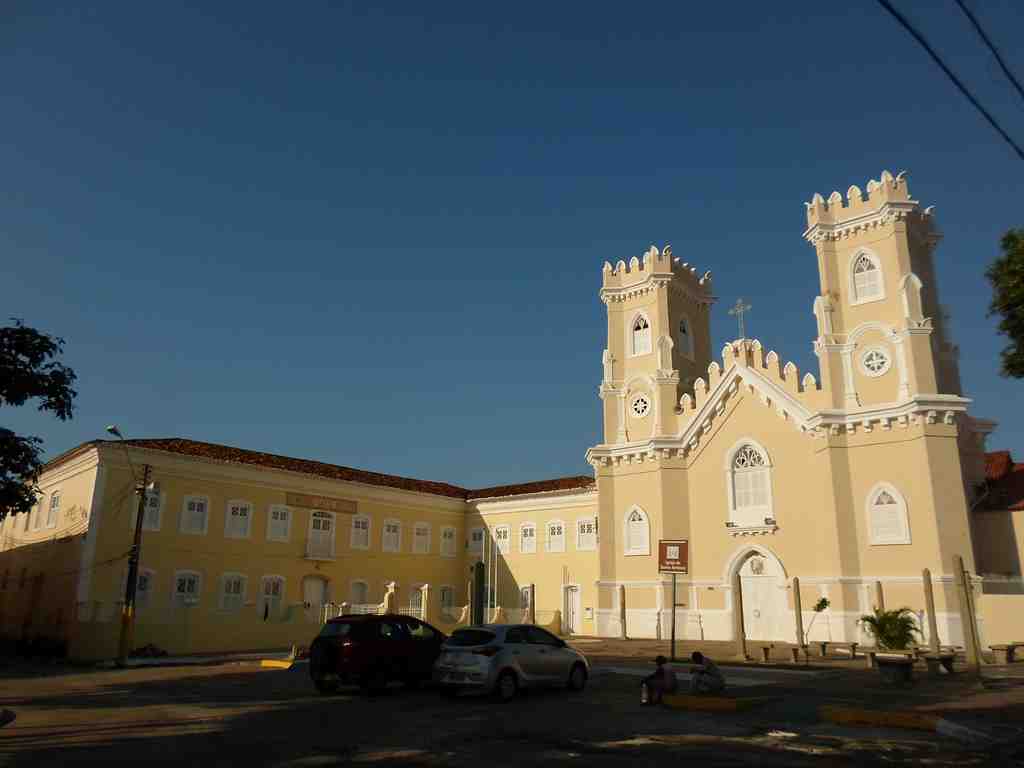
In front of you stands a grand, pale-yellow building with two thick, castle-like towers topped by white battlements-a wide, low wing stretches to the left, while the church’s imposing façade and towers rise up directly ahead for you to spot.
Now, as you stand in the shadow of these thick walls, let yourself drift back across the centuries to when this place was still a story in the making. Imagine the year is 1624. Around you, the clatter of construction fills the humid air. The original convent and the small Bom Jesus dos Navegantes chapel are just beginning to take shape, set beside each other on this very square-Praça Antônio Lobo. The city itself is little more than a patchwork of red clay and rumor, marshland and ambition.
A Franciscan friar named Cristóvão de Lisboa steers this vision. When he leaves for the distant, wild lands of Pará, another friar, Antônio da Trindade, keeps watch. The air here has always been thick, not just with the heat of Maranhão, but with secrets, resistance, and faith. Over time, this convent offers more than prayer. It serves as a clandestine refuge; its thick walls hide those fleeing persecution, those who have defied the governor or broken with the church. Imagine, for instance, in 1720, the city’s highest judge, Dr. Vicente Leite Ripado, racing through the streets at dusk to throw himself into the sanctuary of the convent-the only safe haven after he dared to jail a powerful captain.
The convent was even the birthplace of something less peaceful-the Beckman Revolt. Picture February 24th, 1684, a moonlit night. On the shadowed steps by the convent doors, Manuel Beckman stands tall before a secretive crowd. In his voice, suspicion and fury. He calls for rebellion, railing against monopolies and the Jesuits’ iron hold over the local people and land. It is here, right where you are standing, that the seeds of revolt are sown.
But even sanctuaries sometimes shape the fates of the powerful. In the mid-1800s, with the convent abandoned and quiet, the walls echo only with the dreams of Frei Vicente de Jesus. He sets to restoring what is nearly lost-yet resources are scarce, and by his death the work stands unfinished. It takes another friar, Ricardo do Sepulcro, to marshal new funds, and in 1867, the city witnesses a resplendent celebration-the arrival of a new image of St. Anthony, greeted by cannon salutes and a grand procession.
The church also holds quieter tales. The Bom Jesus dos Navegantes chapel, joined to the church, is among the oldest in São Luís, built by French Capuchins in 1613. Its walls cradle a vast mortuary, with those from the city’s highest ranks laid to rest beneath your feet. Imagine the crypts still whispering with old secrets, the air cool and heavy with memory.
From this very pulpit, Father Antônio Vieira once thundered his famous “Sermon of St. Anthony to the Fish,” a sermon whose sharp wit echoed accusations at the elite, veiled beneath parable and prayer. Laughter, tension, perhaps even fear, vibrated beneath the chapel’s ancient woodwork as the city’s most powerful listened, unsure whether they were the fish or the fishermen.
This place evolves, always adapting-becoming, at one point, the first police barracks for the province, and centuries later, a host to history: in 1991, Pope John Paul II rested here during his visit, his presence drawing half a million souls to the city’s shore for a mass that pulsed with hope, faith, and celebration.
As you stand in front of these resolute walls, the air shimmers with echoes. Here, faith has always mingled with courage, struggle, and transformation. In São Luís, no stone is silent.


