
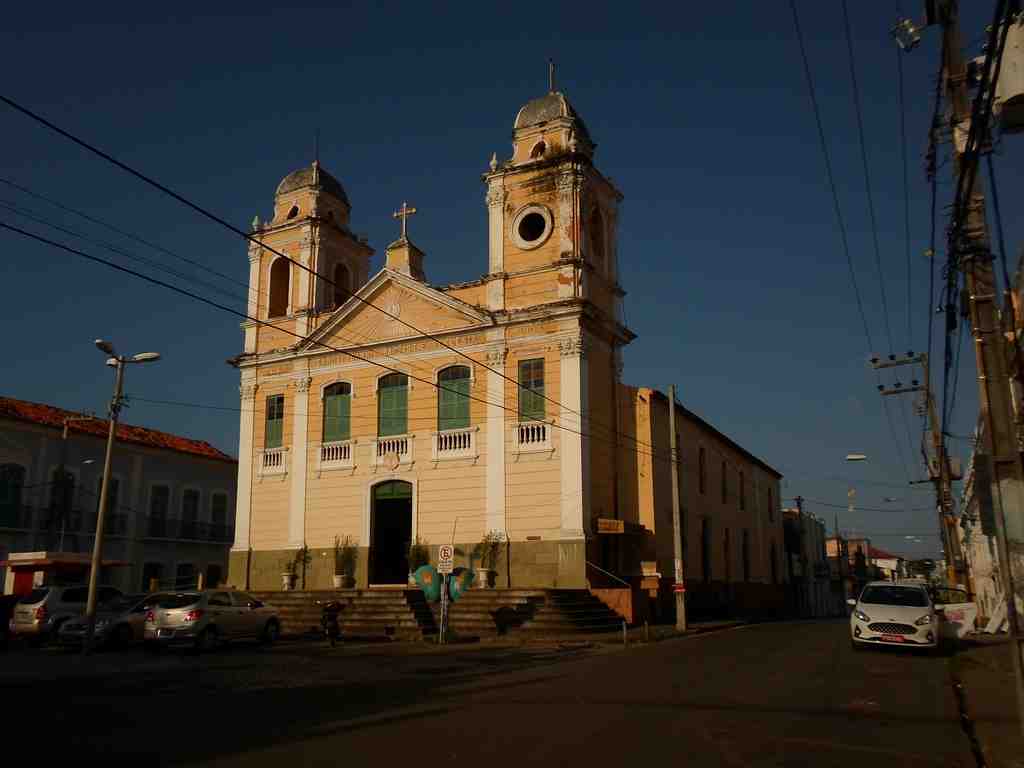
You are now facing the Church of St. John the Baptist-look directly ahead for a pale yellow neoclassical facade with two towers, each slightly different, and green shuttered windows above a wide stone staircase.
As you stand in the heart of old São Luís with the afternoon sunlight casting long shadows across the street, imagine the footsteps echoing along Rua de São João and Rua da Paz, leading your gaze straight to this remarkable church. The Church of St. John the Baptist isn’t just another landmark-it’s the fourth oldest church in the city, watching over this crossroads for centuries.
But its origins are as dramatic as any story from the city’s past. Picture the year 1665. The governor of Maranhão, Ruy Vaz de Siqueira, walks these same cobbled streets, anxious and whispered about. Legend tells us a secret-he was entangled in a forbidden romance with a married aristocrat. Fearing scandal, desperate to keep his reputation intact, he made a silent pact with St. John the Baptist: if his secret stayed safe, he’d build a church in the saint’s honor. When his secret never came to light, construction began. Some say an even older chapel may have stood here before the Dutch invaded in 1641, but what you see now grew from that old promise, blending sorrow and redemption.
Upon completion, the church was protected by sturdy Portuguese soldiers, and soon after, in 1673, their sacred brotherhood received official approval. Over the years, this place grew-by 1857, it was a parish sheltering souls from neighboring churches. Governors contributed, the square outside was paved, and in 1934, a major restoration swept through, reshaping the church’s face, but never its spirit.
Stand before its unusual front: four Corinthian columns, a cross above, Latin letters inscribed beneath-the name Sancti Joannis Baptistæ Ecclesia. Notice how its two towers are not quite twins, breaking with strict neoclassical rules and giving the church a personality all its own. Look up and see the dates-1665 for its founding, and 1934 for its renewal-etched into history.
One of its secrets, however, is darker. For many years, the ossuary just inside held the remains of Joaquim Silvério dos Reis, a man forever marked as the traitor of the Inconfidência Mineira. His tomb stood as a controversial testimony until it was lost to time and renovations.
Here, each stone and inscription whispers of love, secrecy, and betrayal-a living memory for the city’s oldest streets.


