
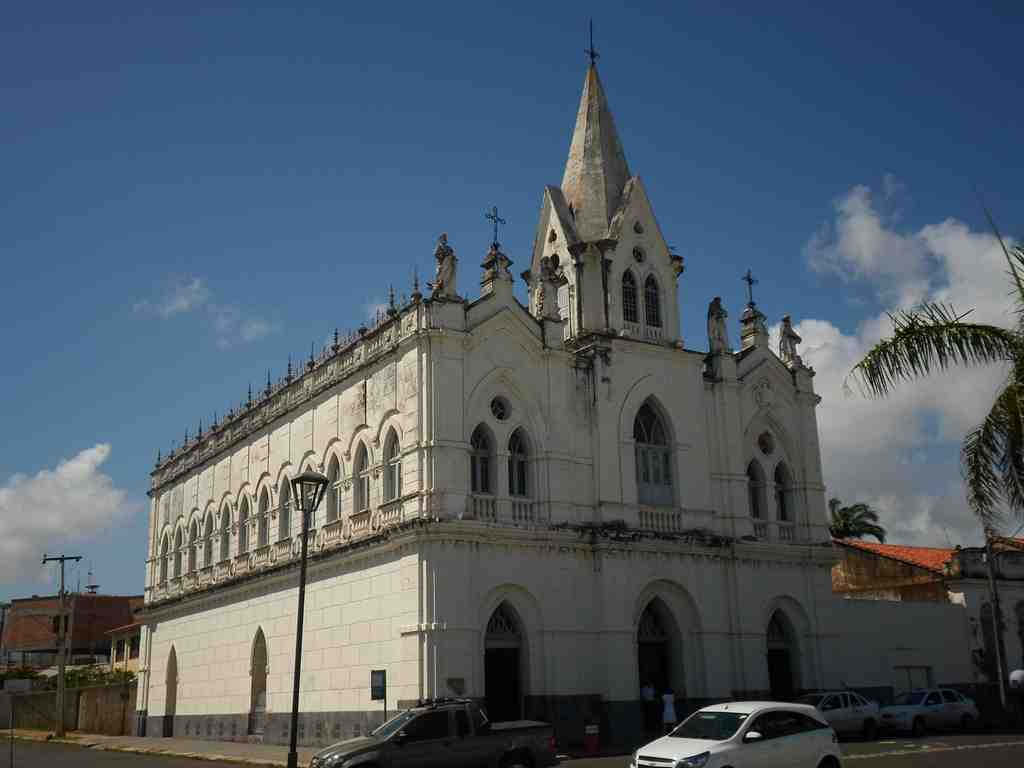
Looking ahead, you will see a striking white Gothic church with pointed arches, a single central tower crowned by a tall octagonal spire, and statues perched at the edges of its roofline-this is the Igreja de Nossa Senhora dos Remédios, located right across from the Gonçalves Dias Square.
As you stand before this grand church, imagine yourself transported back to 1719, when all that existed here was dense brushland and open sky. Picture a small group of men, led by the Franciscan João da Silva Cutrim, handing a square of untamed land to Captain Manoel Monteiro de Carvalho. With determination, Manuel sets the first stones, marking the beginning of a humble ermida-a tiny chapel built for prayer at the tip of what was then called Romeu’s Point. The sun is hot, the insects buzz, and the only sounds are hammers and voices mixing with birdsong. The little chapel was raised quickly, welcoming people hungry for hope, their feet crunching on wild grass as they approached its doors.
But this sanctuary, meant for peace, would soon be shadowed by a dark tale. One fateful day, a slave, hiding inside the chapel, struck down his master who’d come searching for him. The tragic echo of that moment spread through the community, making the devout wary-many were afraid to return.
For decades, the chapel sat lonely and somewhat forgotten. Then, in 1775, Governor Joaquim de Mello e Póvoas cut a new road through the wilderness, connecting this spot with what is now Rua Grande. Suddenly, the bustle of the city inched closer. You can almost hear the clatter of carts and the shuffle of feet as people return to worship, the haunting silence of the place replaced by the gentle roar of life.
Time is never gentle on old buildings. By the end of the 18th century, the small chapel crumbled into ruin. It would only come back to life thanks to a persistent hermit named Francisco Xavier, who persuaded local merchants and ship captains to fund a new, grander church-dedicated now to Nossa Senhora dos Remédios, the patroness they believed watched over their fortunes. In the early 1800s, this church truly thrived, its marble altar and fine glass catching the late sun, a reward from grateful traders whose ships were braving the tides.
By 1860, another major change arrives. The governor himself pays for a magnificent staircase leading from the church down to the sea, offering worshippers a dramatic view-and easy access even by boat. Picture the clang of workers’ tools, iron railings being set, and the scents of sea spray wafting over the square. The church became a landmark for commerce and faith alike.
With its unique Gothic style-pointed arches, striking windows, and a single powerful bell tower-it stands unlike any other church in São Luís. If you look up, you’ll see statues of the four Evangelists, positioned in 1907 and gazing out over the city as silent sentinels. Colored light spills in through German stained glass, added in the 20th century, transforming the interior with every sunrise and sunset. Inside, three altars await; the main one is solid marble, cool and eternal beneath your hand.
Generations of people have gathered here, not just for worship but for the annual celebration, the Festejo de Nossa Senhora dos Remédios-one of Maranhão’s most celebrated festivals, alive with music, hope, and gratitude.
So as you stand in front of this Gothic masterpiece, think of all the stories layered into these walls: whispers of struggle, rescue, renewal, and unwavering faith that stretch across three centuries.


