
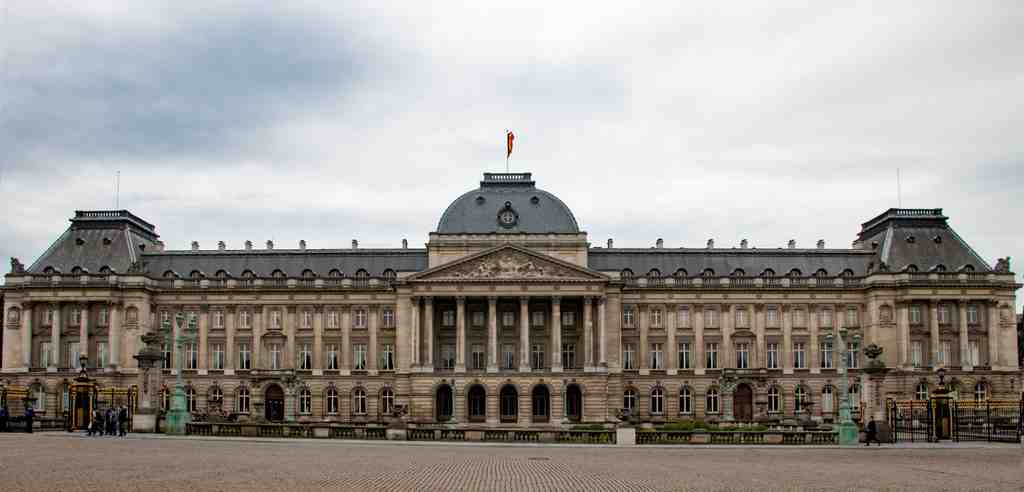
Right in front of you is a grand, symmetrical palace with a stately, columned central entrance and an impressive Belgian flag flying high on top-just look for the enormous stone building with its perfectly balanced wings and formal gardens separated from the square by elegant iron railings.
Welcome to the Royal Palace of Brussels, the king's official palace-though, let's be honest, it feels like it’s showing off a bit for a monarch who doesn’t even live here! Don’t be fooled by those royal windows; the Belgian king and queen actually reside at the Palace of Laeken. This splendid palace is where the king handles affairs of state, hosts magnificent receptions, and sometimes offers foreign heads of state a royal overnight stay. Imagine diplomats and ambassadors sweeping in while officials fuss around, every button gleaming, not a hair out of place, and state matters buzzing in the air.
Now, let’s unravel its past-if these grounds could tell their own story, they’d need a history book as thick as Belgian waffles are sweet. Before this neoclassical masterpiece stood here, these grounds were home to the enormous, medieval Palace of Coudenberg, where dukes, emperors, and governors plotted and partied since the 12th century. It was a fortress, a playground, and even the venue for Charles V’s dramatic abdication in favor of his son, Philip II of Spain-and you can picture the hush and tension in that great hall as he gave up the crown. Unfortunately, the palace had a complicated relationship with fire: a giant blaze in 1731 left most of the medieval glory in ruins, and eventually a new face was needed for Brussels’ royal heart. If you’re curious, some ancient vaults and mysterious remnants still lie beneath nearby squares, and you can even visit them if you’re feeling adventurous!
Fast-forward to after 1815, when Brussels became joint capital of the new United Kingdom of the Netherlands. Two grand town mansions were stitched together for King William I, who added a posh colonnaded façade and let the new “Royal Palace” stretch regally along the street. Later, King Leopold II, who genuinely believed a king’s pad should be anything but modest, doubled the palace’s size and added a new, dazzlingly formal garden-someone really wanted to outshine Buckingham Palace! The grand staircase, the mirror hall (don’t miss those million beetle wings in the ceiling art!), the stately Throne Room-every corner is designed to impress. Leopold II, by the way, was so set on splendor, he tried to make the façade 50% longer than London’s Buckingham Palace-though the floor plan is a little, shall we say, cosier inside.
Throughout its life, the palace has been more of a stage than a home. While only one king was born here-Leopold II-many royal weddings, receptions, abdications, and banquets have unfolded beneath those sparkling chandeliers. During World War I, the palace turned from glitter to grit, transforming into a Red Cross military hospital thanks to Queen Elisabeth. And today, from July to September, you can even walk the halls the royals tread-unless, of course, a head of state has booked the presidential suite!
Right now, as you glance up at the intricate stonework, you might notice the golden, regal fences and the pediment above the central entrance with Belgium’s allegorical figure flanked by symbols of industry and agriculture. The gardens out front are French and formal, but there’s an English twist out back, just in case the pigeons like variety. Whenever the king’s in, his flag flies high over that central dome-and if you’re here on Belgian National Day, you’ll join curious crowds hoping for a peek inside these grand walls.
So, as you stand before this palace, you’re looking not just at bricks and mortar, but at centuries of drama, parties, politics, and just a hint of royal rivalry-because in Brussels, even the buildings have a sense of grandeur... with just a little bit of Belgian modesty tucked in.
For further insights on the exterior, interior or the functions, feel free to navigate to the chat section below and inquire.


