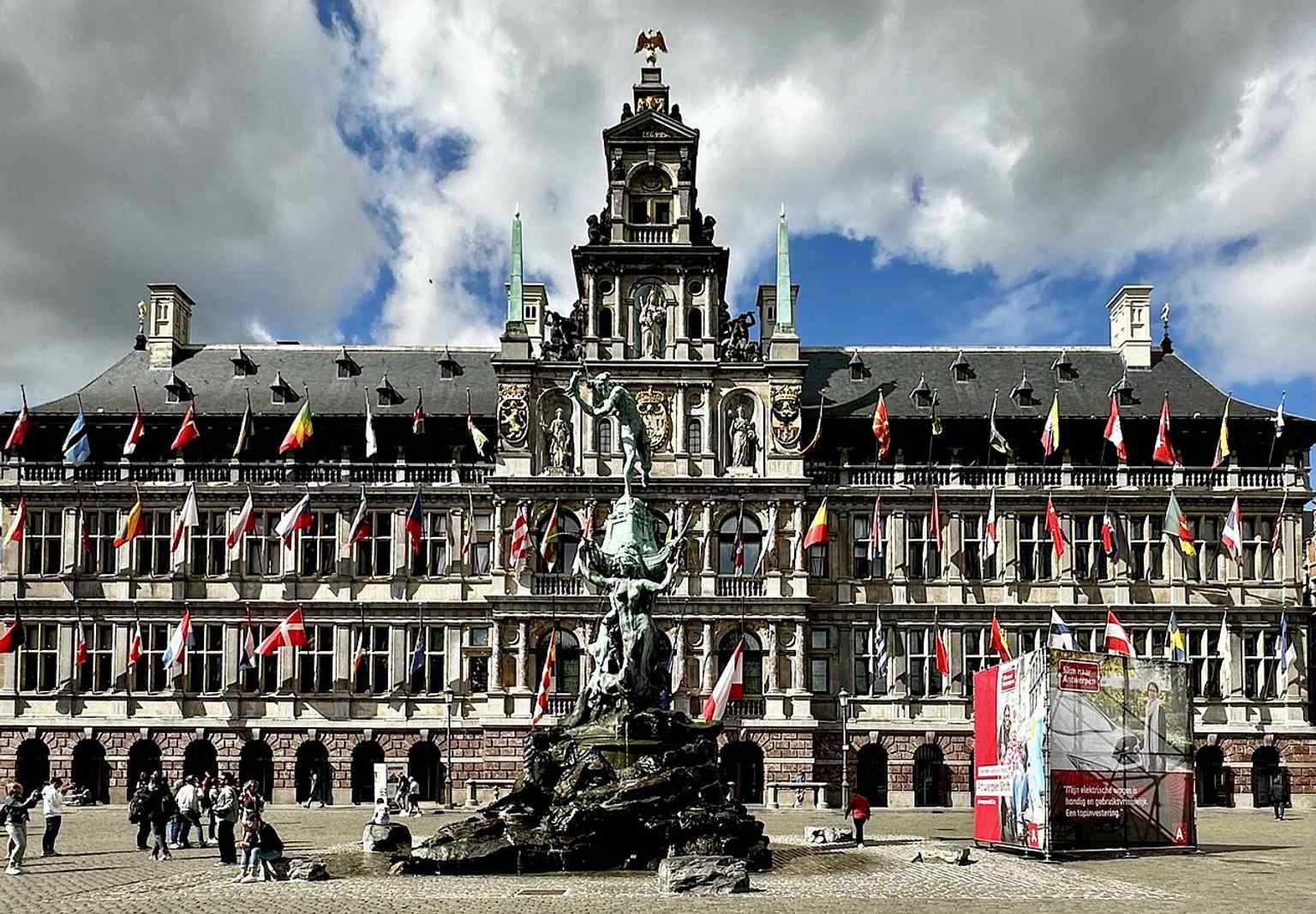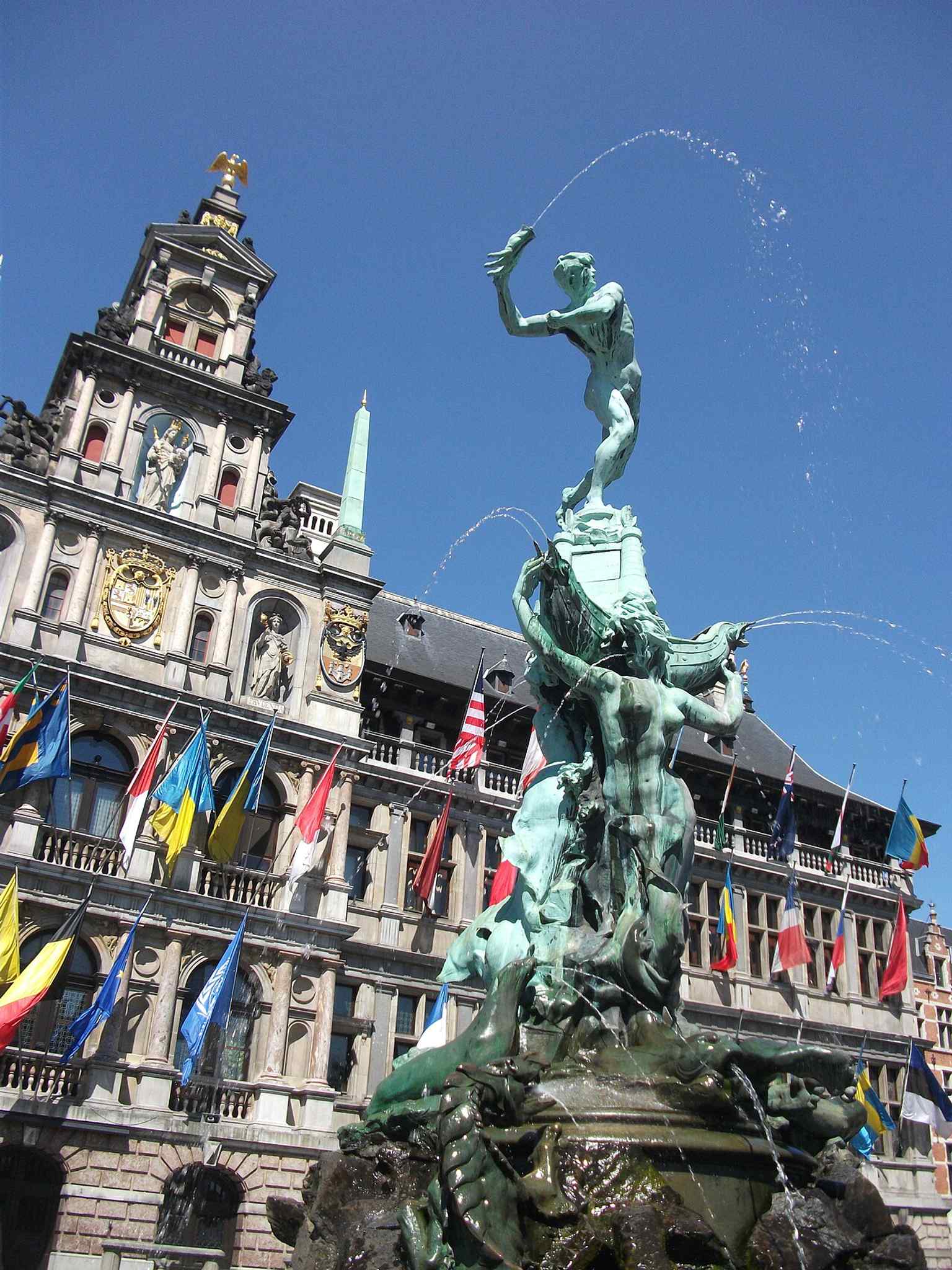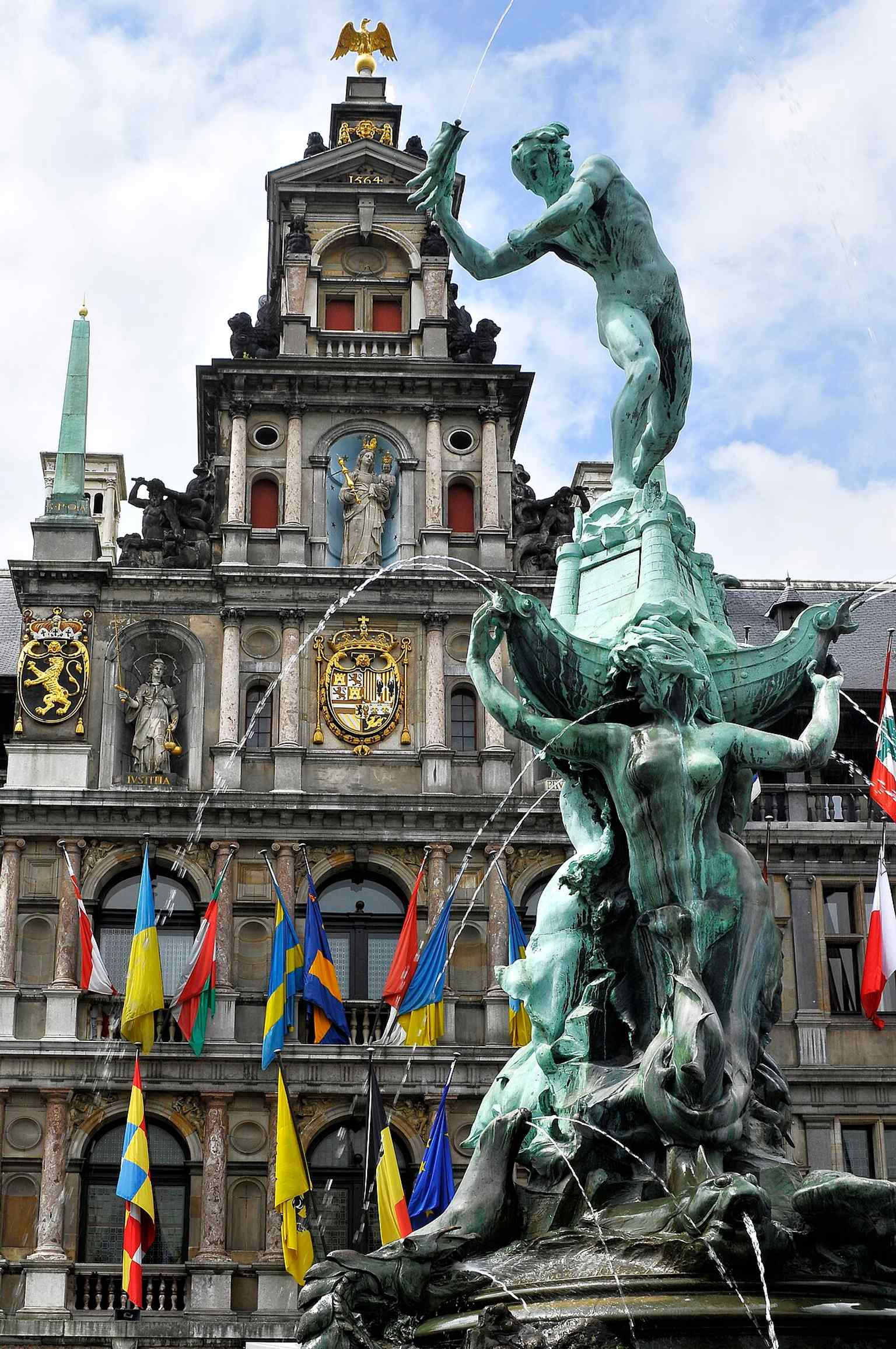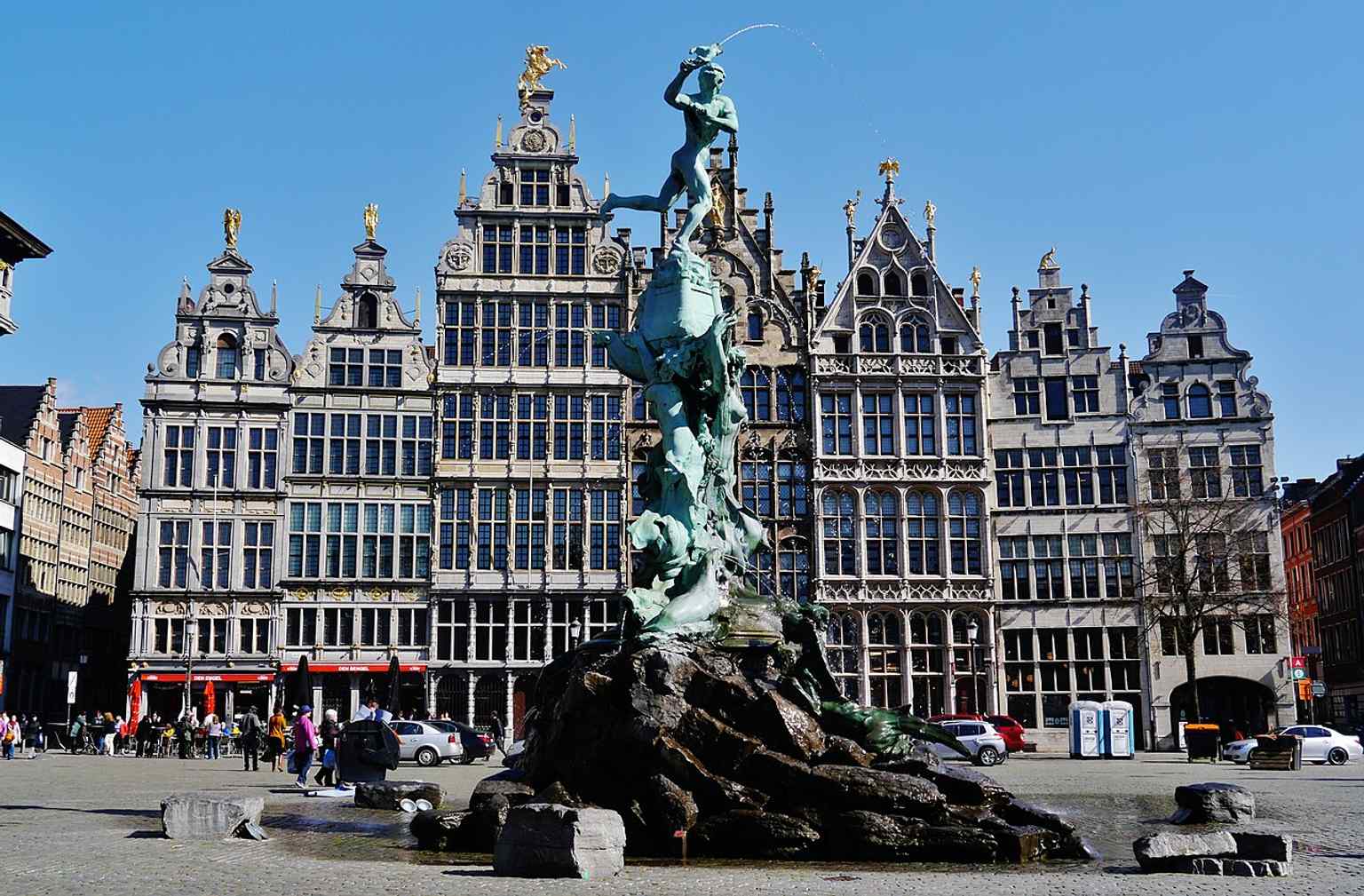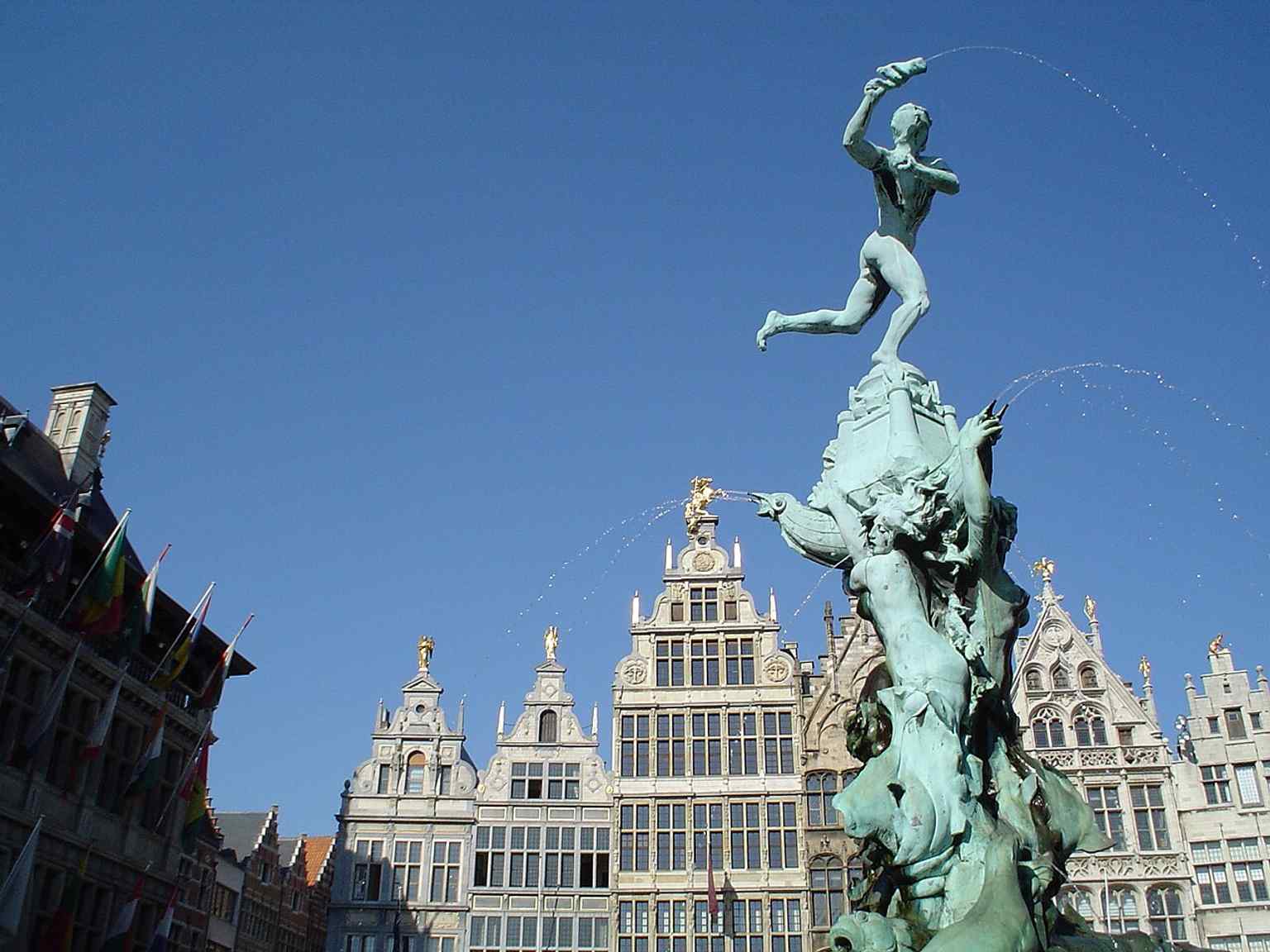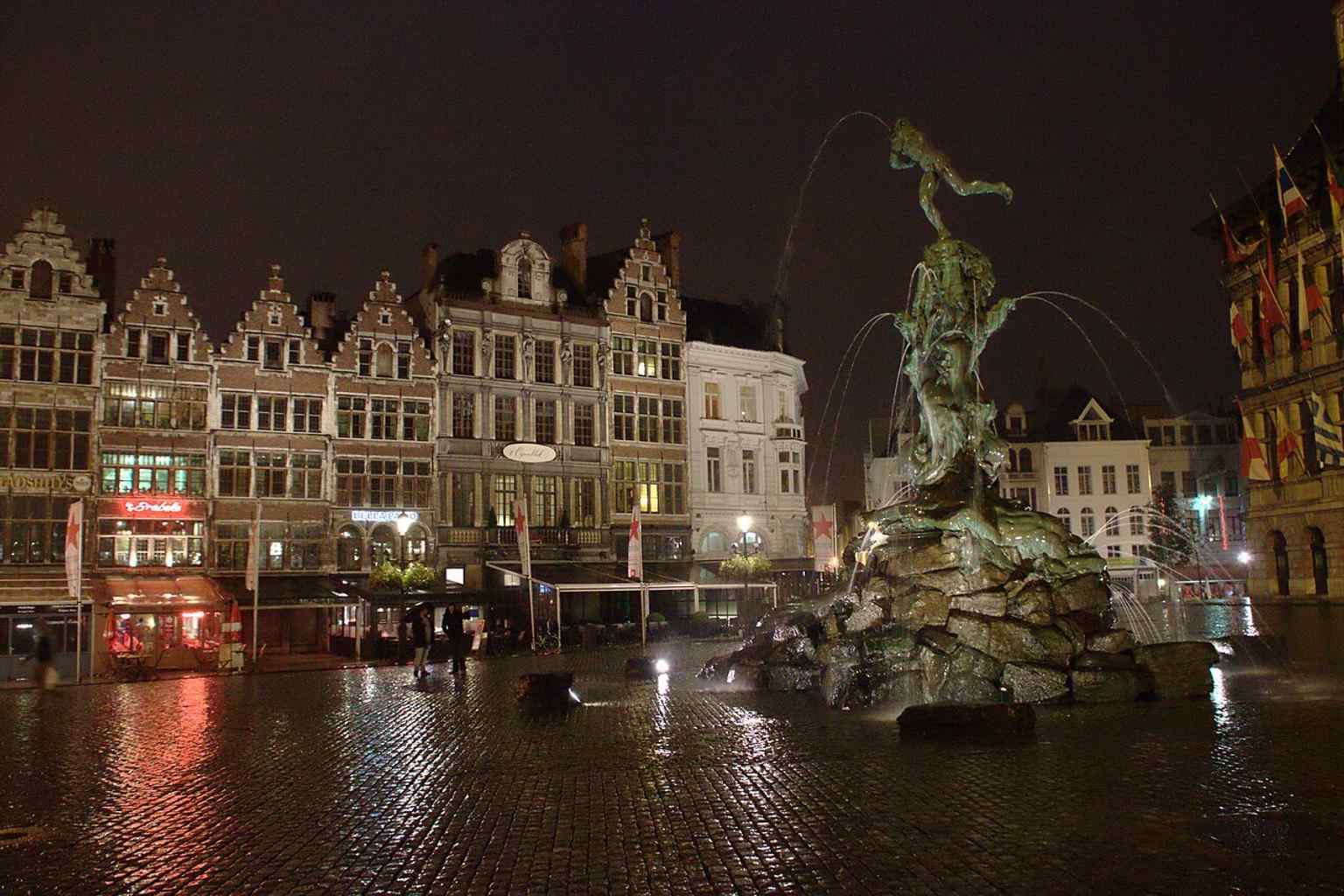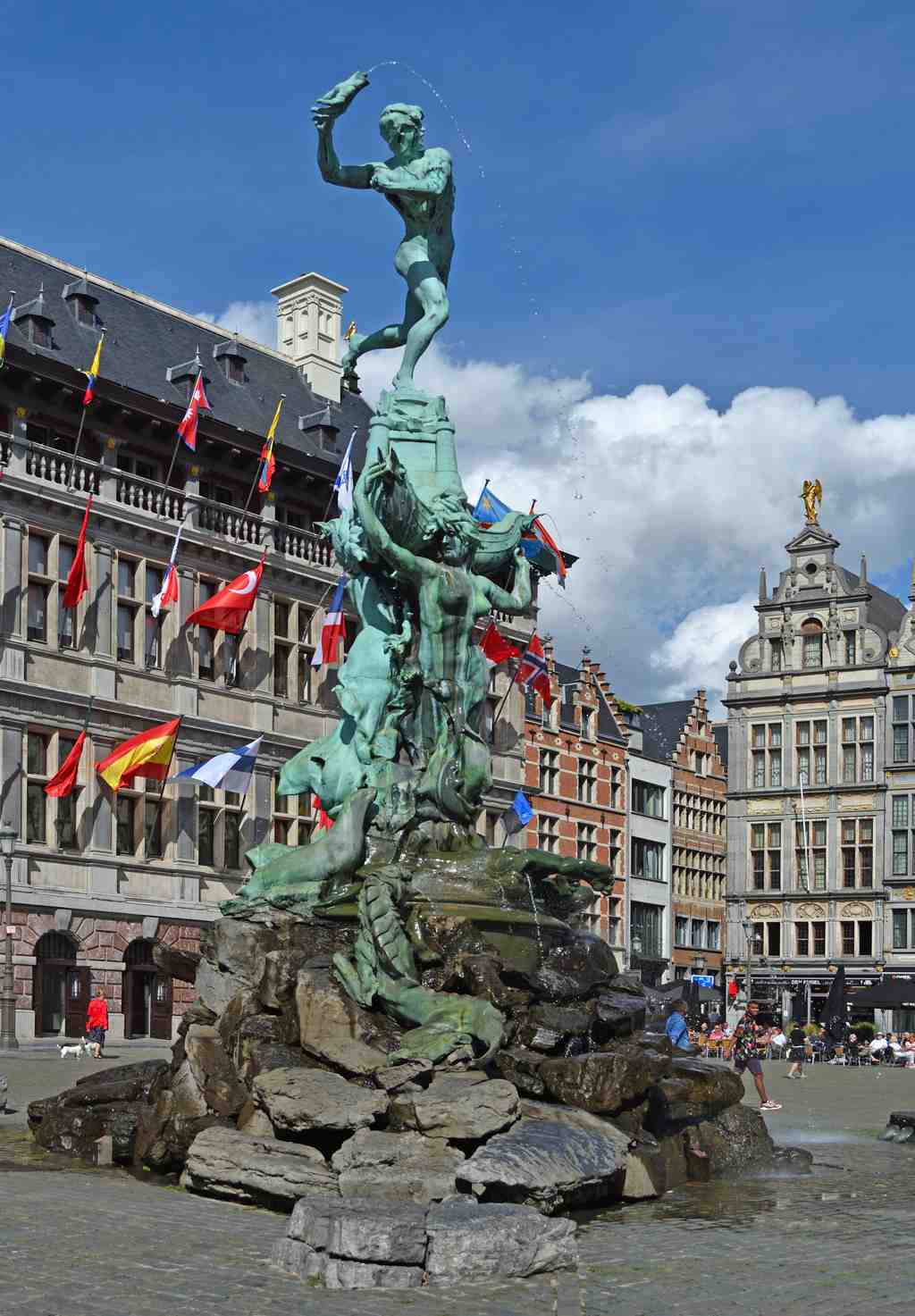
On your left, look for a dark bronze figure poised above a jagged stone mound, one arm flung outward over mermaids and a severed hand.
This is the Brabo Fountain, unveiled in eighteen eighty-seven in the middle of the Grote Markt, right before the City Hall. It tells Antwerp’s favourite origin story with absolutely no restraint. According to the legend, a giant named Druon Antigoon controlled the Scheldt nearby and demanded a toll from boatmen. If they refused, he cut off their hand and threw it into the river. Then along came Silvius Brabo, a young Roman soldier, who killed the giant, cut off his hand in return, and hurled it away.
Jef Lambeaux, the sculptor, chose the most dramatic instant possible: not the fight, not the victory, but the throw itself. Brabo balances high above you, almost airborne. Beneath him, Lambeaux piles up a whole unruly world: the giant’s naked, decapitated body, mermaids leaning into one another, and sea creatures including a turtle, a dragon, a sea lion and fish. The mermaids lift a little fortress with three towers, a nod to Antwerp’s coat of arms. And the fountain’s water plays its own grim part, spouting from the giant’s severed wrist as if the wound were still fresh. It is myth turned into civic theatre.
If you compare the old and new images in the app, you can see that in nineteen thirteen the square felt more like a formal civic stage, while today it has become the polished postcard heart of the city, with Brabo still firmly in command. There is a lovely layer of politics under all this legend. Before Brabo arrived, this exact spot held a series of Liberty Trees, planted from the seventeen nineties onward during the French revolutionary occupation. They symbolised freedom from Austrian rule. By eighteen eighty-two, the last tree had withered. Antwerp then made a rather telling choice: instead of replacing one more imported political symbol, the city planted its own folklore here in bronze and stone. A local myth took over from a revolutionary emblem.
Lambeaux first showed a plaster model in eighteen eighty-three, and public enthusiasm helped secure the commission. A bequest from August Nottebohm helped pay for it, and the Brussels foundry called the Compagnie des Bronzes cast the final figures. Lambeaux spent nearly three years on the monument, and you can feel that effort in its energy. He loved motion, muscle and provocation; later, critics would attack one of his works as a “marble brothel.” Here, that same physical force is already visible, though perhaps dressed a little more respectably for the town square.
One more local wrinkle: Brabo seems to throw the hand toward the city, not toward the river. That was deliberate. If the sculptor had aimed him at the Scheldt, he might have seemed to turn his back on the City Hall, or worse, to fling the hand straight at it. No one wanted that particular misunderstanding.
Locals still link Antwerp’s name to hand werpen, “to throw a hand,” though historians suspect the real name may come from older words for a wharf or raised river ground. Legend, naturally, has proved far more memorable, and you will find the hand everywhere in Antwerp, even in the little hand-shaped chocolates and biscuits sold across the city.
As a public monument in the square, you can visit the fountain at any hour.
Brabo turns a bloody legend into the city’s proud signature.
When you are ready, continue on toward the Cathedral of Our Lady.