
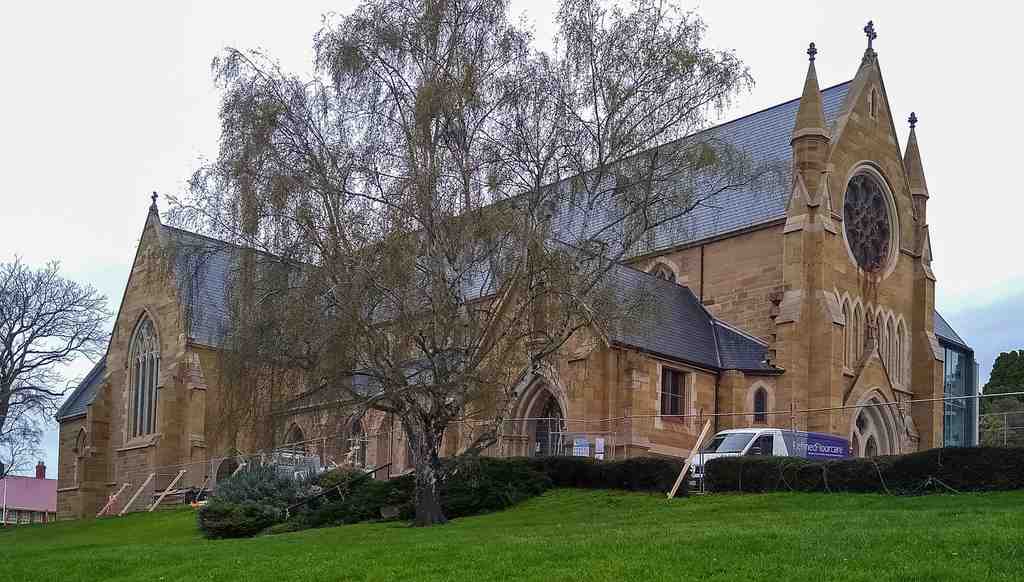
As you approach St. Mary's Cathedral, keep your eyes slightly to the left. You're looking for a striking Gothic Revival structure with a golden-tan sandstone facade, intricate arch detailing around the doors and windows, and a picturesque, spired roof. The building’s imposing size and stunning architecture make it hard to miss! Plus, if you spot the beautiful rose window on the front facing you, you're definitely in the right place.
Now for a bit of history. St Mary's Cathedral in Hobart, Tasmania, Australia, is the Roman Catholic cathedral here and is where the Archbishop of Hobart, currently Julian Porteous, carries out his duties. Its origins trace back to 1822 when the first permanent Tasmanian priest, Philip Conolly, built a wooden chapel dedicated to St. Virgilius, an Irish Saint, near this very site.
Located on Harrington Street, the cathedral's first foundation stone was laid in 1860, designed by William Wardell, a student of the famous architect Augustus Pugin. The building was consecrated in 1866 but due to some construction hiccups, it had to be largely dismantled and re-constructed by architect Henry Hunter in 1878.
You've got to love old buildings with character, right? The cathedral boasts a Norman-era baptismal font believed to be from the period of about 1170 to 1200. The first organ here was relocated, but worry not, as the present organ was installed in 1895 after winning first prize at the 1894 International Exhibition of Industry, Science, and Art in Hobart.
Pay close attention to the exquisite Hardman Studio window from 1869, a Gothic beauty featuring five lance windows depicting pivotal scenes from the Gospels and heavenly images in the tracery. Marvel at the rose window on the west end and don't miss the other splendid windows like the Pentecost window and the Heroic and Saintly Women window.
St. Mary's is not just a cathedral but a repository of history and craftsmanship. Enjoy exploring this architectural marvel!


