
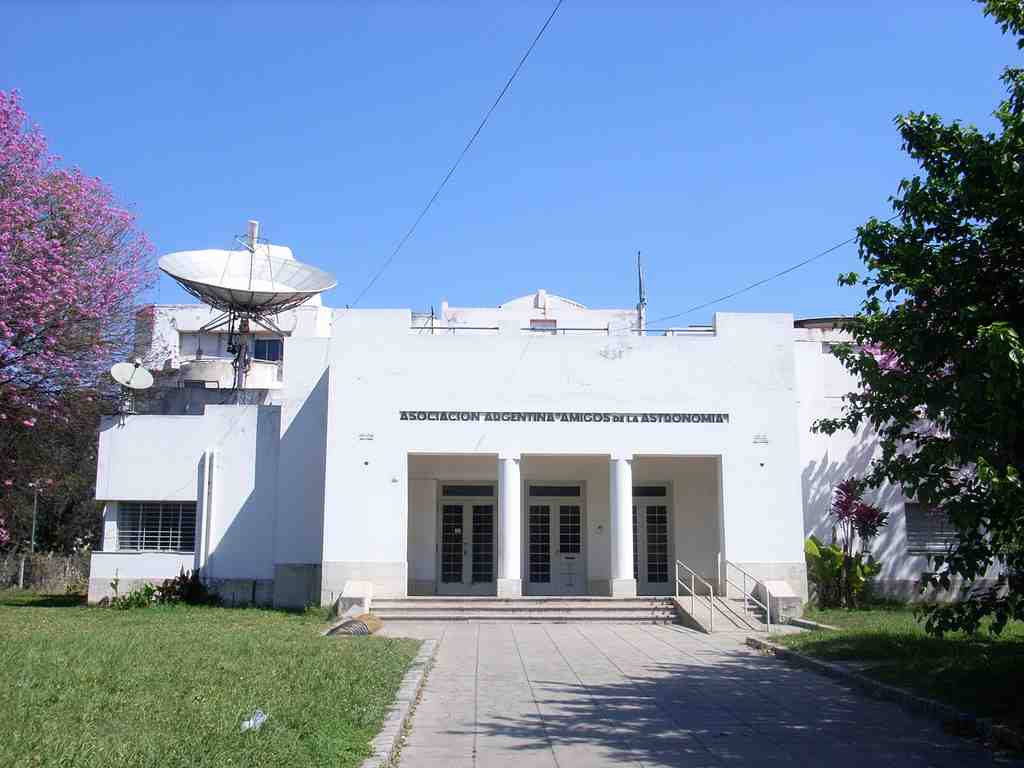
On your left stands a stark white flat roofed building defined by a recessed entrance with prominent square columns and a large unmistakable satellite dish mounted on its left side.
We explored the natural sciences museum earlier, a place largely shaped by the rigid formal academic vision of Germán Burmeister. But the building in front of you represents a completely different approach to the pursuit of science. This is the Argentine Association of Friends of Astronomy, a place that proves how everyday citizens, armed with curiosity and a vision for their community, can physically transform city spaces into democratic hubs of learning. By securing this land, these amateurs ensured that anyone could come off the street and look up at the rings of Saturn, democratizing the universe for everyone.
It is the oldest amateur astronomy institution in Argentina, founded in 1929, but its origins are wonderfully poetic. Many of the first members were actually professional musicians playing in the Wagnerian Orchestra at the famous Teatro Colón. After spending their days enveloped in the sweeping thunderous symphonies of Richard Wagner, these musicians sought refuge in the absolute silence of the cosmos.
During the early years, they met in private homes or at the orchestra headquarters. They were so devoted that in 1930, when the club faced a financial crisis, their secretary, Carlos Cardalda, saved it with a personal loan of 950 pesos, a sum roughly equivalent to a few thousand dollars today. His quiet dedication kept the doors open.
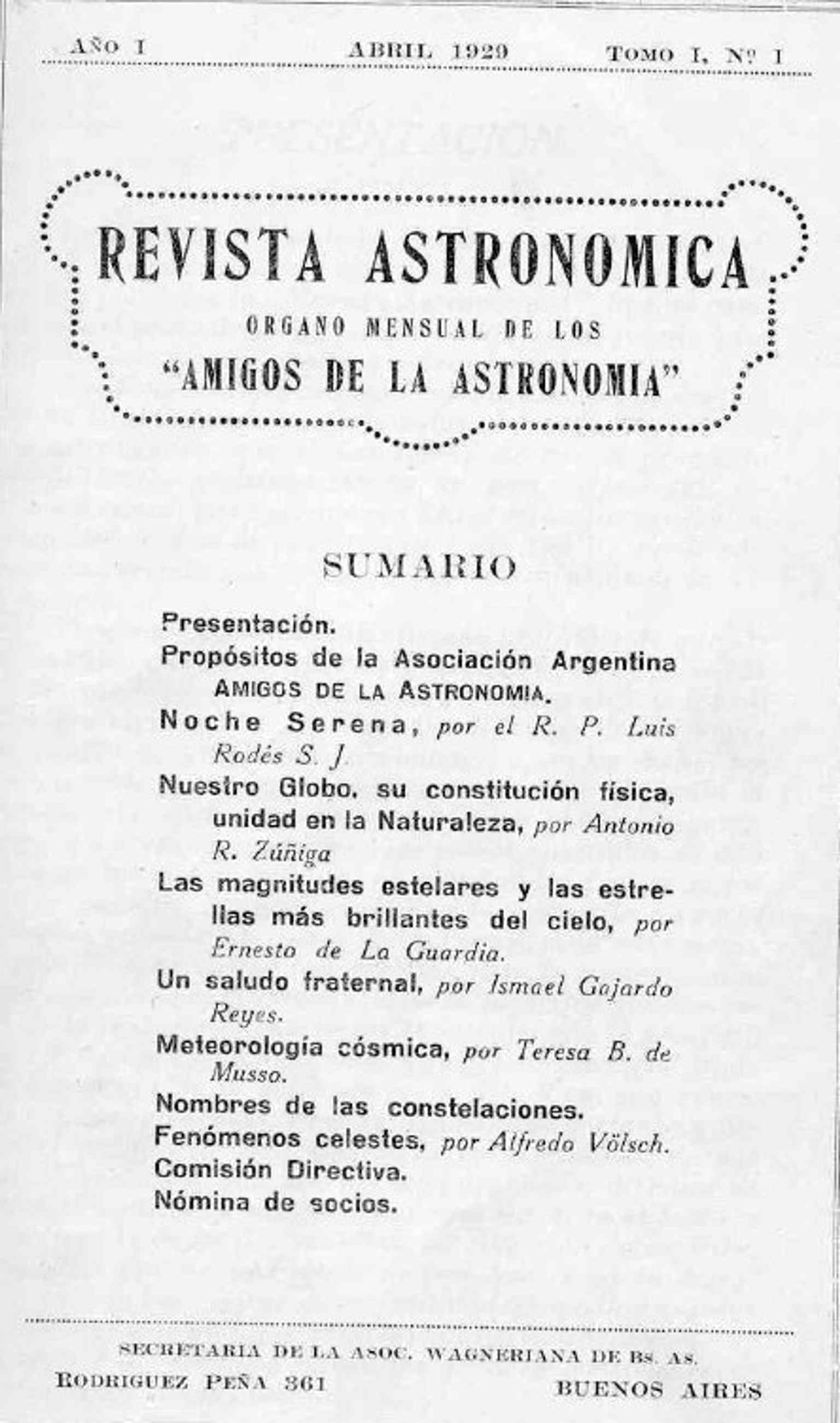
Take a look at your screen to see the cover of their very first magazine from 1929. This publication became an essential space for amateur scientists. A young Ernesto Sabato, years before he became one of Argentina's most famous literary novelists, used this magazine to publish step by step guides on how to build homemade reflecting telescopes. The club even published his very first book on the subject.
In 1944, the club moved into this purpose built headquarters. Their prized possession is the Gautier telescope, a massive instrument brought to Argentina by the French in 1882 for a highly critical mission. The goal was to observe the transit of Venus, watching the silhouette of the planet cross the face of the sun in order to calculate the exact distance between the Earth and the Sun. It was a stressful international effort where a single cloudy day would have ruined a chance that would not come again for over a century. The telescope succeeded, eventually finding a permanent home right under the dome here, still running on its original mechanical clockwork.
If you want to look through those historic lenses yourself, the observatory is open Monday through Saturday evenings from 7 to 11 PM.
As we leave this temple of grassroots knowledge behind, it leaves me wondering. Why do you think musicians, whose lives were filled with overwhelming sound, were so deeply drawn to the silent visual beauty of the night sky? Keep that in mind as we walk about three minutes to our final stop, the Hospital Naval Buenos Aires, where we will trade a dedication to the stars for a reflection on institutions built for duty and care.






.jpeg)
