
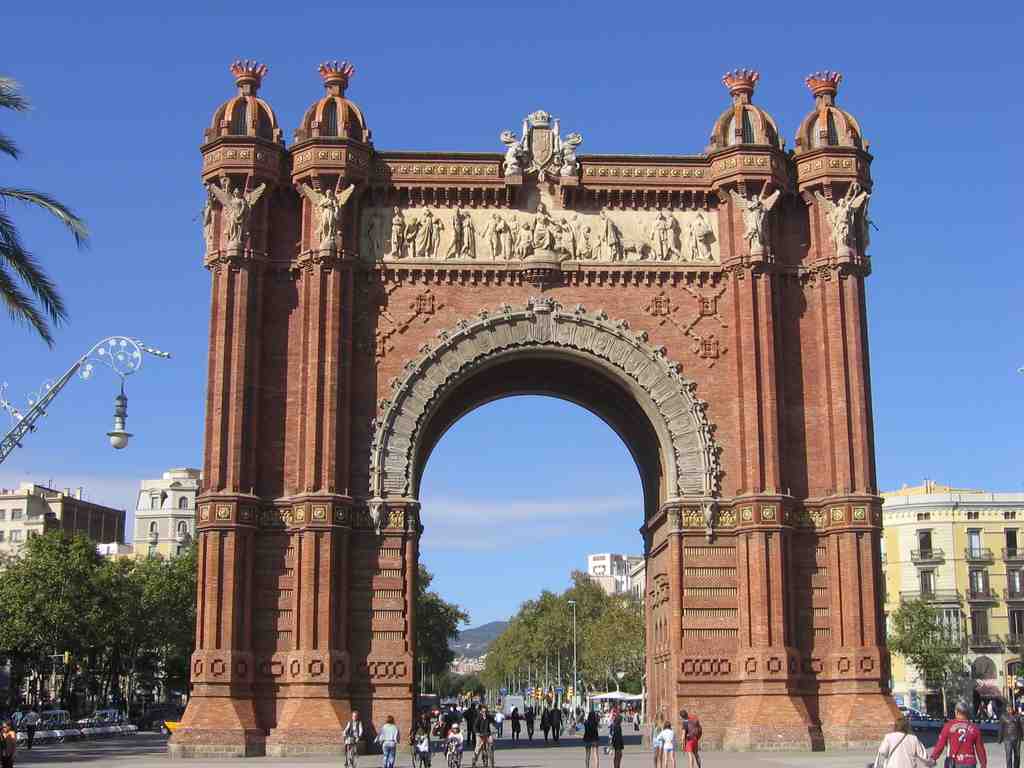
Straight ahead stands a massive arch made of striking red brick, crowned with intricate white stone friezes and flanked by tall, decorative corner towers.
Unlike the cold marble monuments scattered across Europe that were built to celebrate military conquests and bloody battlefield victories, this gateway was designed to honor a purely civic triumph. It was built as the grand, welcoming entrance for the 1888 Universal Exposition. The 1888 Universal Exposition was a massive global fair that forced the city to modernize rapidly, serving as a glittering stage to show off Barcelona's soaring industrial might to the rest of the world. It fit perfectly into the progressive spirit of Cerda's Ensanche Plan, which was actively pulling Barcelona out of its cramped medieval history and into a bold, expansive new era.
The design of this arch perfectly captures the friction of that changing world. You might hear a very persistent urban legend that a French engineer named Gustave Eiffel actually pitched his famous iron tower for this exact spot, and the city rejected it for being a monstrous, expensive eyesore. While historians have completely debunked that myth, the story survives because it illustrates the real architectural anxiety of the time. It highlights the cultural tug of war between cold, ultra-modern iron structures and the warm, historically rooted brickwork that ultimately won out here.
The architect, Josep Vilaseca, designed this in the neo-Mudejar style, a revival architectural movement that blended traditional Moorish and European elements. Using exposed red brick instead of noble stone was also a brilliant economic move. The arch cost a mere one hundred and fifty four thousand pesetas to build, which equates to just a few thousand dollars today. But more importantly, the humble material connected this grand monument directly to the local working class and the booming regional brick industry.
If you look closely at the columns, you will spot stone bats carved into the structure. The bat was the emblem of King James the First of Aragon, and became a powerful symbol of good fortune in Catalan design.
Yet, the wide avenue leading up to the arch hides a darker tale of how the past is often forcibly erased by new visions of the future. The promenade used to be lined with eight grand bronze statues of Catalan heroes. During the turbulent years of the Spanish Civil War, most were yanked from their pedestals. Then, in 1950, authorities melted down five of those historic bronzes to forge a giant religious statue of the Virgin Mary for a local basilica. The old secular heroes were quite literally consumed to build the new regime's cultural vision. Luckily, as with the monument to Rafael Casanova, one statue was secretly hidden in a dark warehouse, surviving the ideological purge before finally being rescued.
This magnificent gateway is open twenty four hours a day, standing as a permanent welcome to anyone who wanders by. Let us pass straight through the arch now and follow the wide promenade toward the park, where the Castle of the Three Dragons is just a six minute walk away.




