
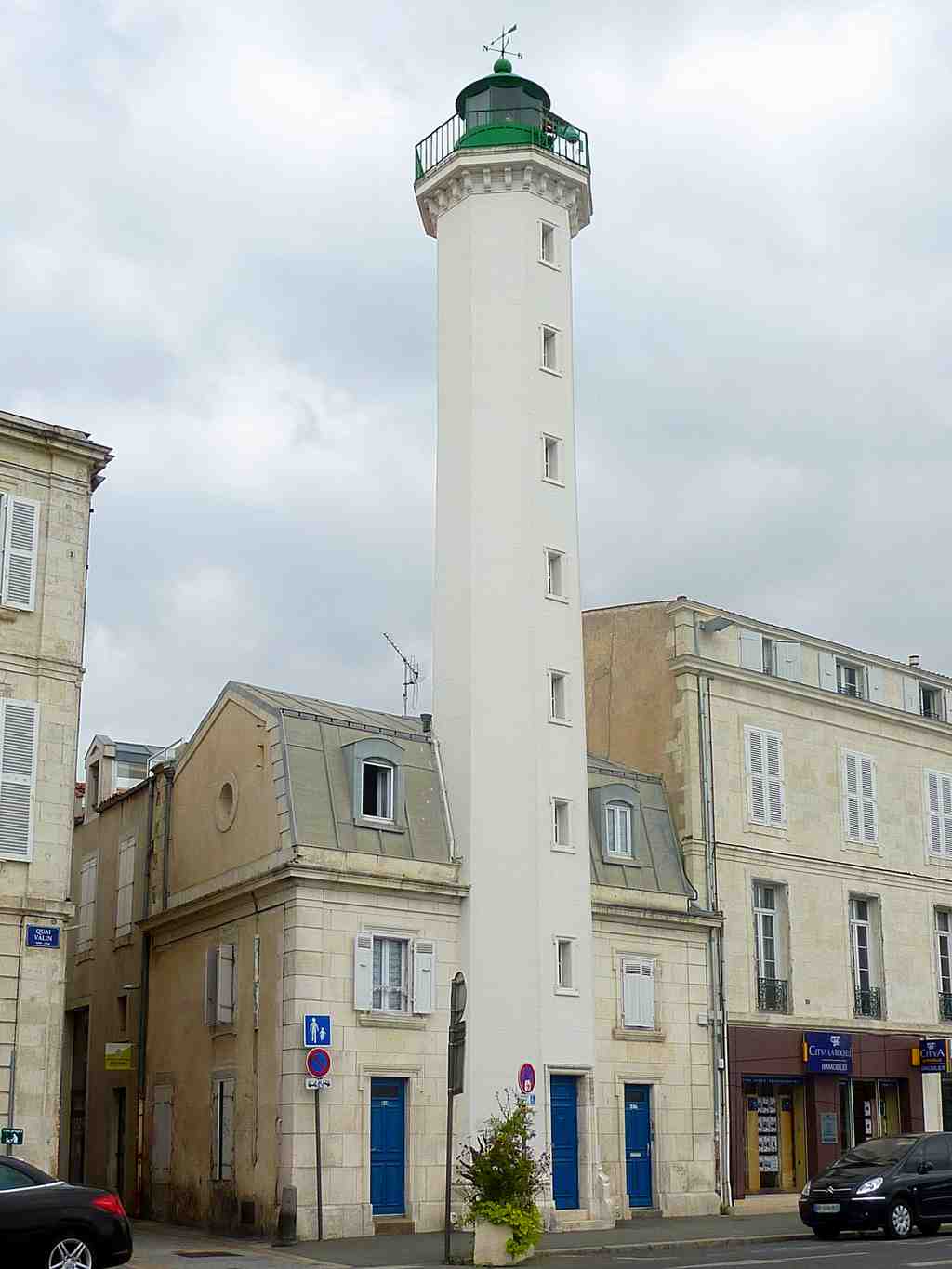
Look for a slim white-stone octagonal tower with a lantern on top, built right into the facade of a two-story house with a mansard roof.
This little lighthouse is easy to miss... which is mildly ironic, since its entire job is to be noticed at exactly the right moment. The Phare du quai Valin stands at the edge of the yacht basin, one of the three basins of La Rochelle’s historic port, and it belongs to a system of guidance more precise than dramatic. An alignment light works in pairs: a sailor lines up one light with another, and when the two sit in the right visual line, the boat is on the safe course into harbor. If the lights drift apart, so has the boat. Simple in principle, unforgiving in practice.
Here, the local trick is to imagine its partner across the water. Most people stroll past and see a neat little urban lighthouse. Sailors saw a pair: the green Quai Valin beacon here and the red Gabut light near Saint Nicholas Tower. Together they marked the approach into the old port channel, the one framed by the Chain Tower and Saint Nicholas Tower. For a city that lived by trade, that kind of precision mattered as much as walls or cannons.
The name Valin carries its own kind of authority. René-Josué Valin was an eighteenth-century Rochelais jurist whose commentary on the Great Ordinance of the Navy of sixteen eighty-one made him a major authority on maritime law, which is why this spot honors not just navigation but the rules that made seafaring legible to courts, merchants, and captains alike.
La Rochelle had long relied on an earlier harbor light, a reminder that precise guidance has always mattered here. So in eighteen fifty-two, the city created this quieter, smarter pair of harbor lights. In eighteen fifty-five, workers raised this one higher so its white beam would not get lost among the city’s growing lights. In nineteen thirty-seven, engineers electrified it and gave it a white light with two occultations every six seconds - two brief disappearances, like a measured blink.
It still works, automated and unstaffed, with its optic set about twenty-three point three meters above the sea. No grand keeper, no museum staging, no theatrics... just accuracy.
And now we leave that world of measured movement for something sturdier on land: Saint-Sauveur, a church La Rochelle kept rebuilding whenever disaster tried to settle the argument.




