
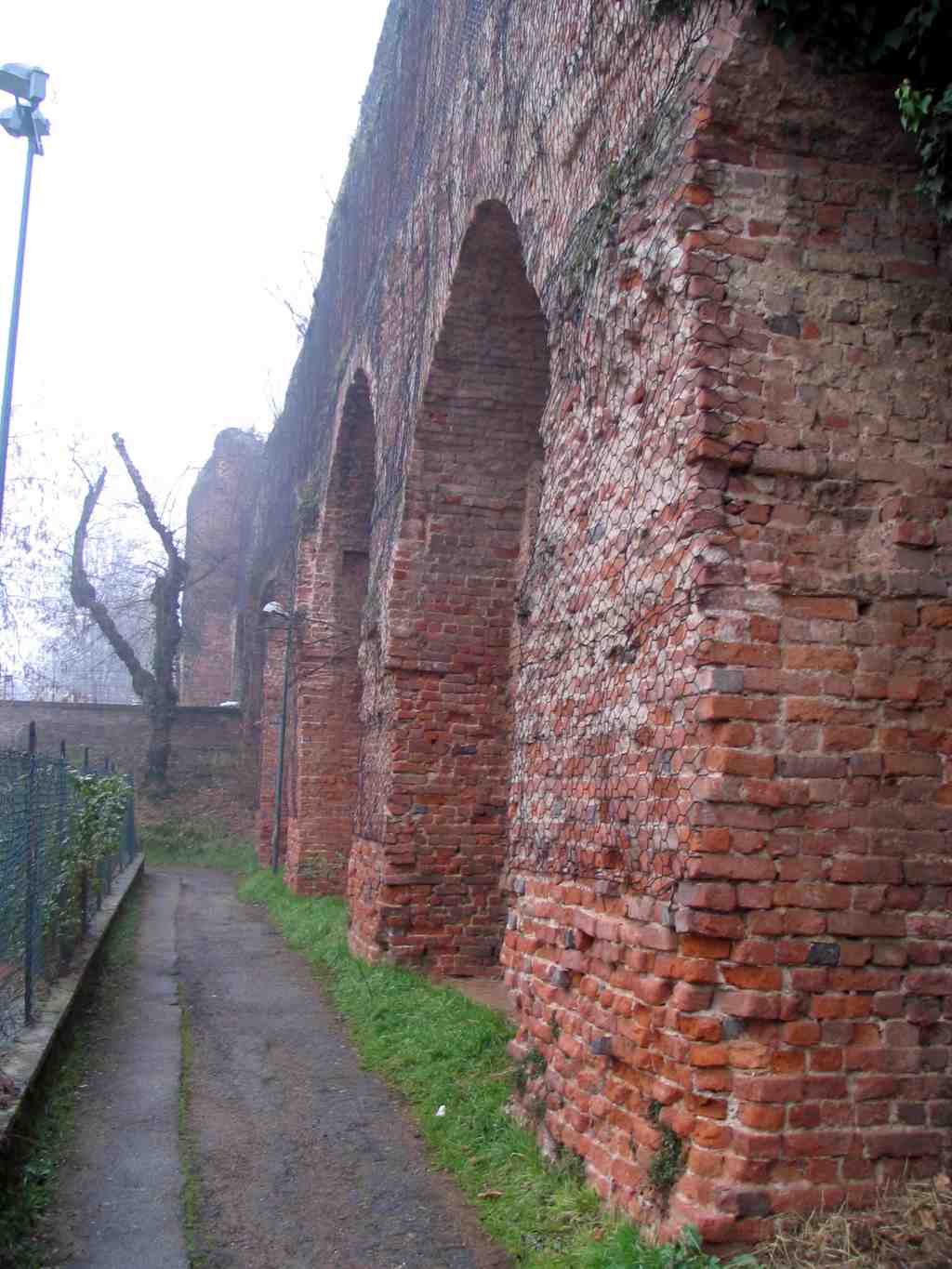
To your left, directly next to the path, you'll see a long, red brick wall with arched passages-those are the famous medieval walls of Asti, hard to miss!
Imagine: it's the twelfth century, and life in Asti is anything but boring. Here, where you stand now, an impressive fortification system once rose from red brick-a kind of medieval 'super castle'-protecting the city from enemies, who might have pounded on the gates as hard as an Italian on a coffee machine on a Monday morning.
But let's start at the beginning, with the ancient Celts and Ligurians. A long time ago, they built a walled hillfort here, the famous 'oppidum'. “Strategy!” they would say, “And a view of the neighbors!” Then came the Romans and-of course-everything had to be bigger and more systematic. Asti got straight streets, Via Maestra (now Corso Alfieri) as its main artery, and the city increasingly exuded Roman self-confidence.
But the glory years took a break when the Roman Empire collapsed. Asti shrank, inhabitants drifted away, and a modest wall was hastily built to protect against barbarian invaders. These walls probably went up as fast as espresso prices do today! During this time, around the fourth century, the focus was mainly on the prestigious neighborhood around the decumano, where buildings proudly stood. And those walls, though smaller than before, were built so sturdily that they are still visible in certain places today, nestled among modern houses.
Jumping a few centuries ahead, we see that power increasingly shifted to the church and government. In the Castel Vecchio, then a kind of medieval 'headquarters', lay the center of power for the city and bishop. And all of this surrounded by walls that were sometimes up to ten meters high! These walls were reinforced and expanded again and again over time. And with expansion comes bragging: if you couldn't see your city walls from the other side of the city, you were clearly doing something wrong.
In Asti's golden age, the twelfth and thirteenth centuries, builders worked tirelessly until more than seven kilometers of wall stood, divided into two rings. The inner ring-“the nobles' enclosure”-protected the wealthy elite, their towers, and palaces. Everything neatly in brick, arches like jaws, and towers like teeth. The gates were decorated; those entering would see statues of Mary above the doors, flanked by St. Secondo and the patron saints of the district. Today, only Porta di San Giuliano remains, hidden within the Santuario della Madonna del Portone.
But there was an even greater ambition: a second, outer wall to give the growing suburbs (and their markets and artisans) a sense of protection. As if Asti was putting on a second, thicker coat against the cold of war and chaos. The outer wall had lower towers and fewer gates but was essential during the frequent sieges and skirmishes-not infrequently, residents had to seek the nearest gate for shelter or trade.
In the fourteenth and fifteenth centuries, with the arrival of the Visconti and the Savoia, the game changed again. New citadels, forts, and bastions arose near the Tanaro river, while other parts of the walls crumbled under the force of cannons or were repurposed for reinforcement. But then came Napoleon-and he thought: “Away with that old-fashioned stuff!” Entire fortifications were torn down, and later, in the nineteenth century, several sections of the wall were transformed into leafy promenades.
Today, a part of that once impregnable fortress can still be admired on this side of the city. The brick sometimes smells a bit of history, with green ivy fighting its own battle. It feels like you're walking on a timeline: the echoes of struggle, power, daily worries, and perhaps even sleeping guards who missed the sunrise-something that surely happened here now and then.
So look closely, listen to the silence that was once filled with hoofbeats, loud laughter, and perhaps a curse from a failed defender… Because behind every piece of wall lies a story that even the thickest brick cannot hold back!
Intrigued by the Celtic-Ligurian oppidum and Roman expansion, from the late empire to the early Middle Ages, or the municipality? Go to the chat section and I'll gladly give you more information.




