
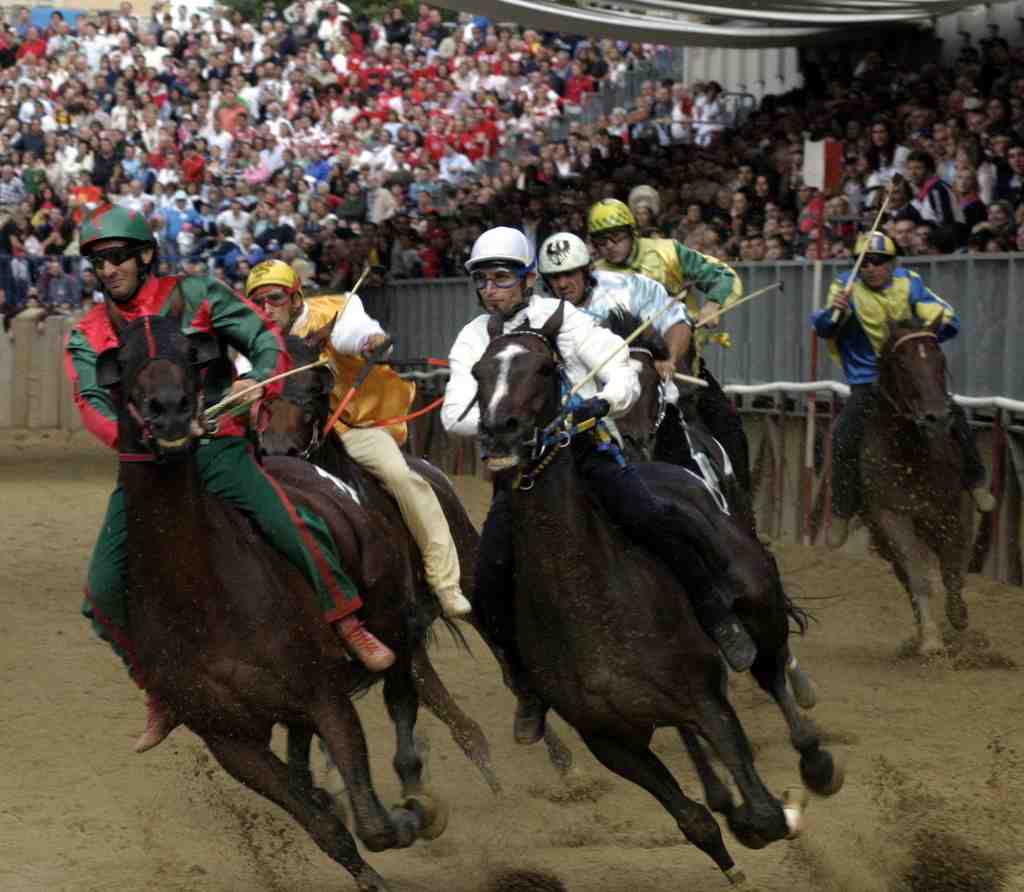
Straight ahead, you see an explosion of energy: riders in colorful outfits lean tensely over their galloping horses, tearing across the sand bareback; if you pay attention at the edge of the square, between the stands and the cloud of swirling dust, you can practically hear and smell the spectacle of the Palio di Asti.
Imagine: you're standing here in the beating heart of Asti, where the air vibrates with tension and the crowd is so full of anticipation that it seems the whole city is holding its breath... The Palio di Asti, or as the Astigiani used to call it, the Palio Astese, is not just a horse race - no, this is an ancient festival with roots that pierce through medieval dust. Once started as an exuberant celebration for patron saint San Secondo - quite a while ago, around the year 1000 - this race has grown into the moment when every district, village, and neighborhood can show who has the fastest legs and the loudest mouth.
The sound of thousands of spectators swells, and imagine: - the roar of hooves on the sand has echoed for centuries between Asti's buildings. And proud they are, those Astigiani! Unlike Siena - where they only see their Palio as a horse party - the people of Asti have fought for generations to hold their Palio, with a passage about their sacred race in every treaty. Because whoever doesn't participate, doesn't belong!
It all began outside the city walls, on the “curriculum,” the old, circular course over what is now Piazza Alfieri. Then came Gian Galeazzo Visconti, the great builder, who thought the city could use a fortification in that spot. A Dutchman would say: “what a shame about that beautiful racetrack,” but the Astigiani thought: “then we'll just race through the city!” And so it happened that the Palio was run across the Contrada Maestra - today's Corso Alfieri - until the 19th century, past houses, markets, and astonished donkeys.
What makes this Palio in Asti so special? First of all, the riders gallop bareback - that requires quite a bit of courage, balance, and, let's be honest, a good dose of craziness. The winner? They receive a palio: a long, dark red velvet cloth, originally intended as a kind of Roman “mantle,” but eventually growing into the coveted symbol of honor, courage, and neighborhood pride. In the Middle Ages, for second place, you got... a live rooster! Yes, a real one. Fancy coming home with feathers on your head and chickens in your arms? In the sixteenth century, prizes like silver coins and, for third place, a pair of shiny spurs were added. For the very last - the most unfortunate “loser” - there is only a salted anchovy. Yes, you heard right: whoever finishes last gets “the inchioda,” a symbol of dishonor and a hearty laugh from the neighbors.
But the festival is so much more than just that crazy race. Days in advance, the city is in an uproar: grand historical parades wind over the cobblestones, flag-wavers, music, children dressed as little knights and damsels. On the day itself, drums beat, trumpets blare, and everyone processes towards Piazza Alfieri. There, before your eyes, the battle begins: three heats of seven participants, all buzzing with nerves, each horse gleaming in the morning sun, each rider wearing the colors of their district.
The mayor can only officially open the race - and believe me, he does so solemnly, with a puffed-out chest, because this is serious business here. Then the starting signal sounds - “Mossa!” - and moments later, the first clumps of sand fly into the air, the cheering rises, everyone rooting for their own district.
And oh, that Palio lives! So lively, in fact, that besides the horse race, there's a separate show for the flag-wavers every year - the “Paliotto.” And if you're lucky, you might even spot the medieval sendallo, the hand-painted banner depicting San Secondo proudly on horseback: a symbol of hope, freedom, and perseverance.
Not everything is always rosy - sometimes there are discussions about animal welfare and fair play, but the city now provides thick layers of sand, strict veterinarians, and safe corners in the course. All for the horses, all for the heart of Asti!
So look around you, taste the energy of the crowd, feel the sand of the racetrack under your feet. Here, where tradition, competition, and popular enjoyment come together, the Palio di Asti is still very much alive. Who knows, you might soon be shouting “Viva il Palio!” just like the rest. But beware: if you cheer too loudly and your district doesn't win, you might get that funny salted anchovy with your salad at home...
For a better understanding of the etymology, the Palio di Asti in detail, or the “Paliotto,” contact me in the chat section below.




