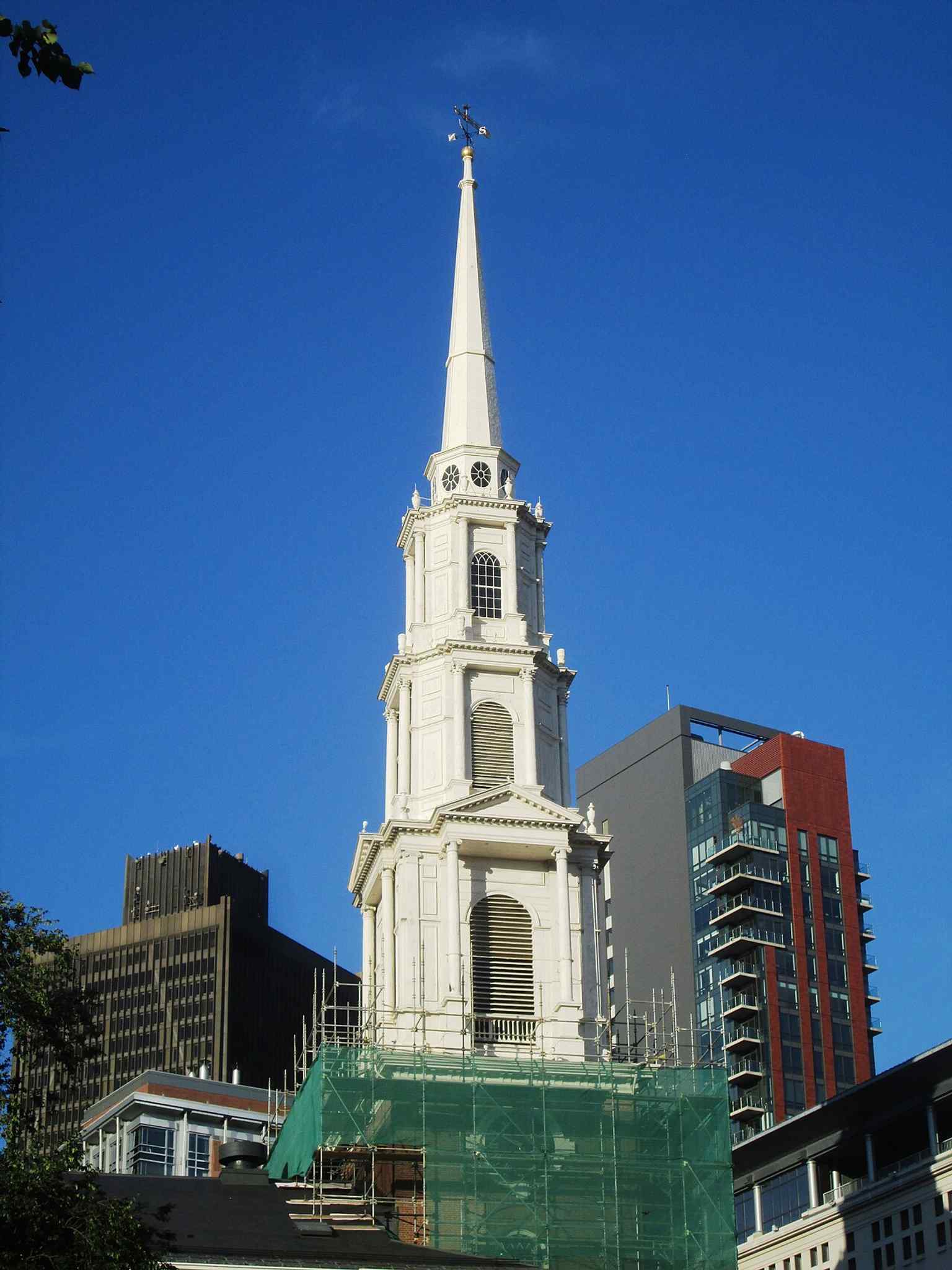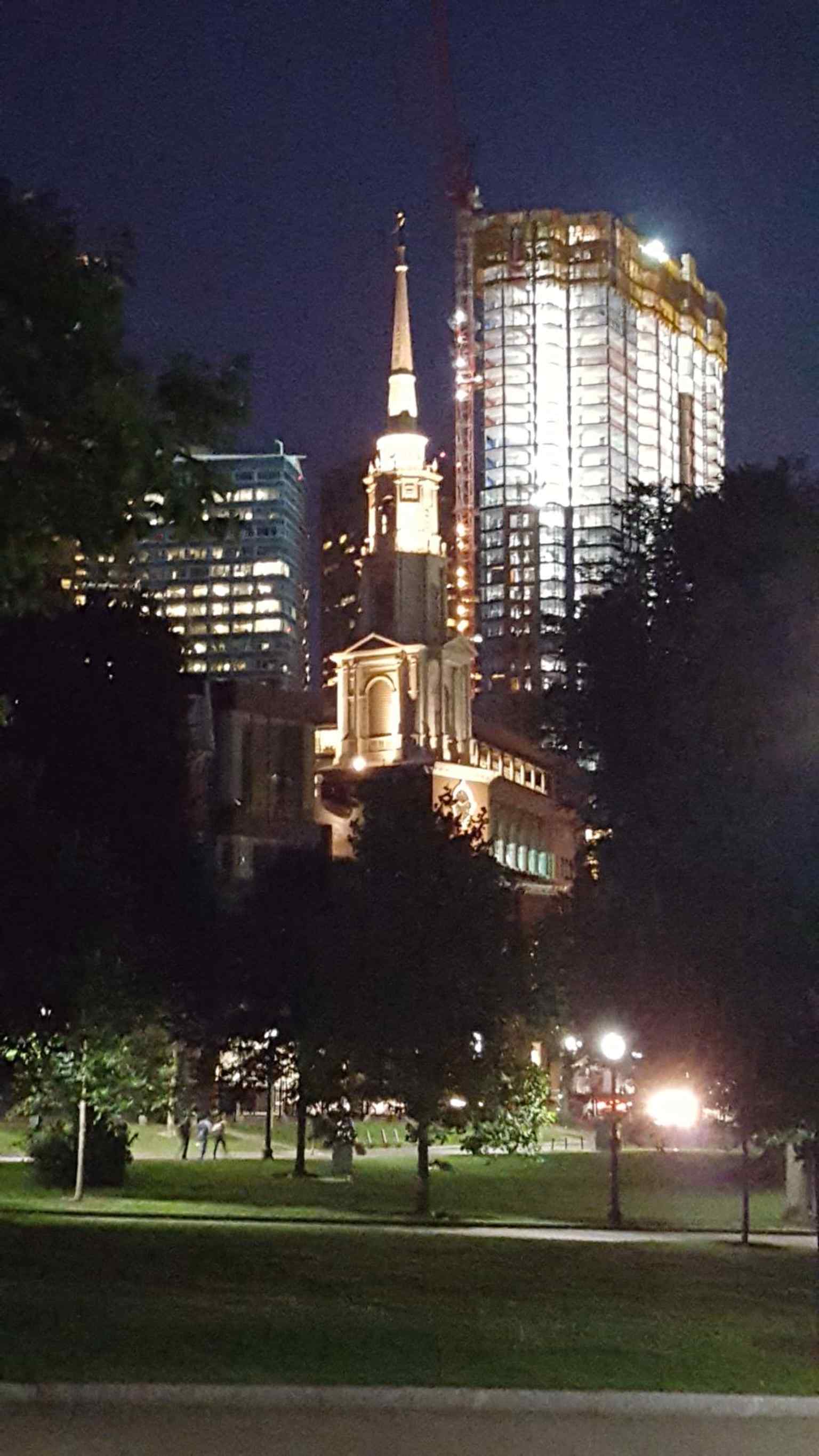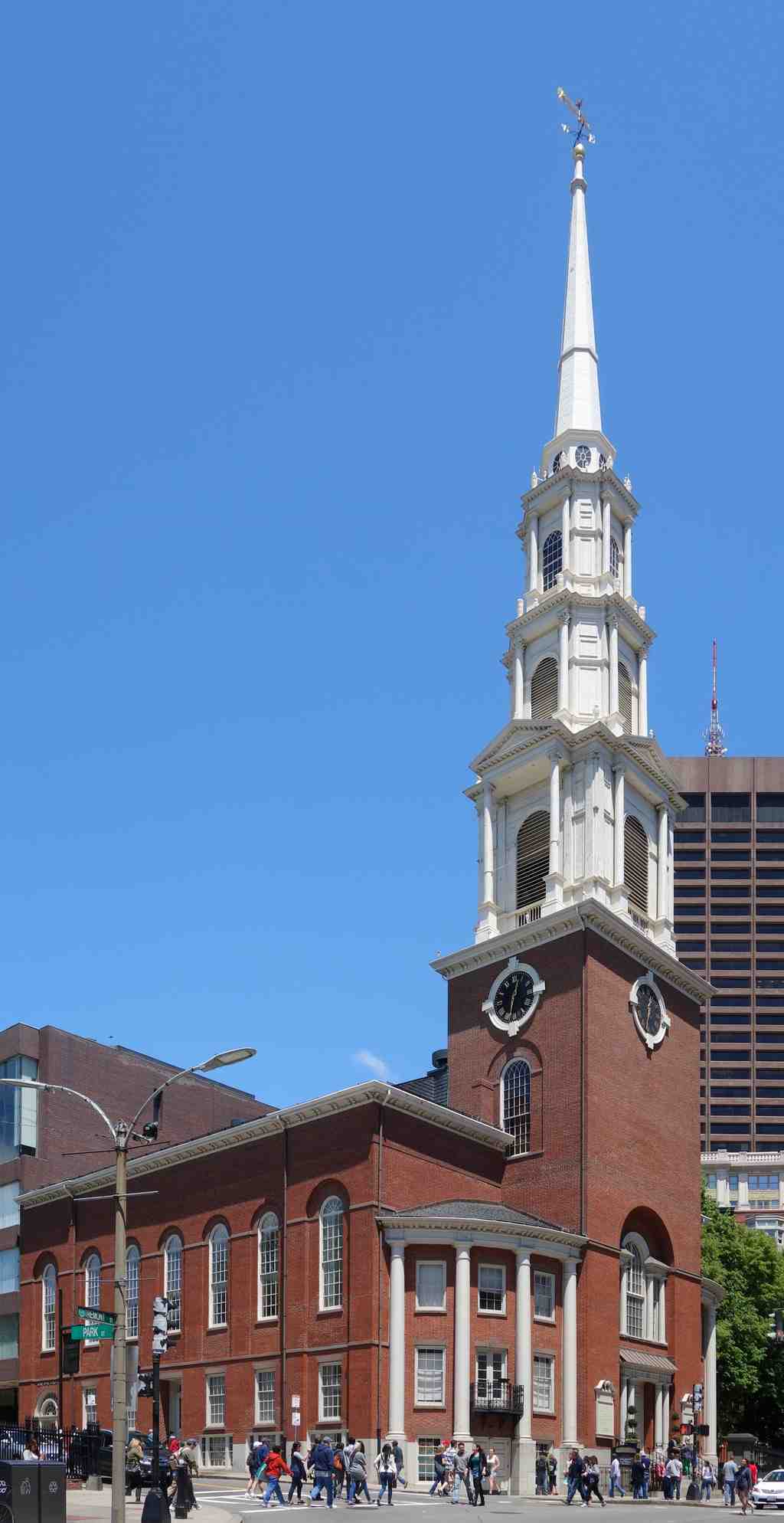
On your right, look for a red-brick church with a tall white steeple, a square tower, and a sharp spire that shoots high above the corner.
Here it is: Park Street Church, one of those buildings that seems to stand with its back straight. It has that effect on people. The church took shape in eighteen oh nine, when twenty-six Bostonians, many of them from Old South Meeting House, decided they wanted a congregation rooted in orthodox Trinitarian belief... meaning the traditional Christian idea of one God in three persons, Father, Son, and Holy Spirit.
Peter Banner designed it, chief mason Benajah Young handled the stonework, and Solomon Willard carved the wood details. Banner borrowed ideas from architectural pattern books and from the work of Christopher Wren in London, so what you’re seeing is Boston speaking with a little English accent. And that steeple? It rises two hundred seventeen feet. From eighteen ten to eighteen twenty-eight, this was the tallest building in the United States. For years, travelers coming toward Boston spotted this spire first, like the city had planted an exclamation point on the skyline.
The first service happened on the tenth of January, eighteen ten. Not long after, the place picked up the nickname “Brimstone Corner.” Partly because the preaching had real fire-and-thunder energy, especially around missions, and partly because gunpowder got stored here during the War of eighteen twelve. That is a very Boston combination: theology and explosives sharing the same address.
Park Street never stayed quiet. In eighteen sixteen, it joined with Old South to create the City Mission Society, serving Boston’s urban poor. In eighteen twenty-nine, William Lloyd Garrison came here and delivered one of his first major public arguments against slavery. Two years later, this church hosted the debut of “My Country, ’Tis of Thee,” sung here for the first time on the fourth of July, eighteen thirty-one. Lowell Mason, one of the giants of American church music, served as choirmaster and organist around then too. So this corner has carried sermons, protest, charity, and song... all in one stream.
If you want a neat visual of how long this steeple has ruled the scene, glance at the old bird’s-eye image on your screen.
And the city around it really did transform. Streetcars came, subways carved underneath, towers rose, retail surged, and the church kept holding the corner. You can check the old image on your screen to see that shift in one glance.
Park Street is still an active congregation now, with members from more than sixty countries, and it still ties faith to practical work through English classes, ministries for people experiencing homelessness, and education projects like Boston Trinity Academy. In the nineteen seventies, the church even added a sharply modern ministries building beside the historic sanctuary... concrete, glass, and brick in conversation with the old red walls.
If you’d like to come back inside another day, the church is generally open on Sundays from eight AM to six PM.
Park Street Church feels like a lighthouse for conviction, pointed straight up through two centuries of Boston change.
Take a moment with that steeple, and when you’re ready, we can wander on to the next stop.