
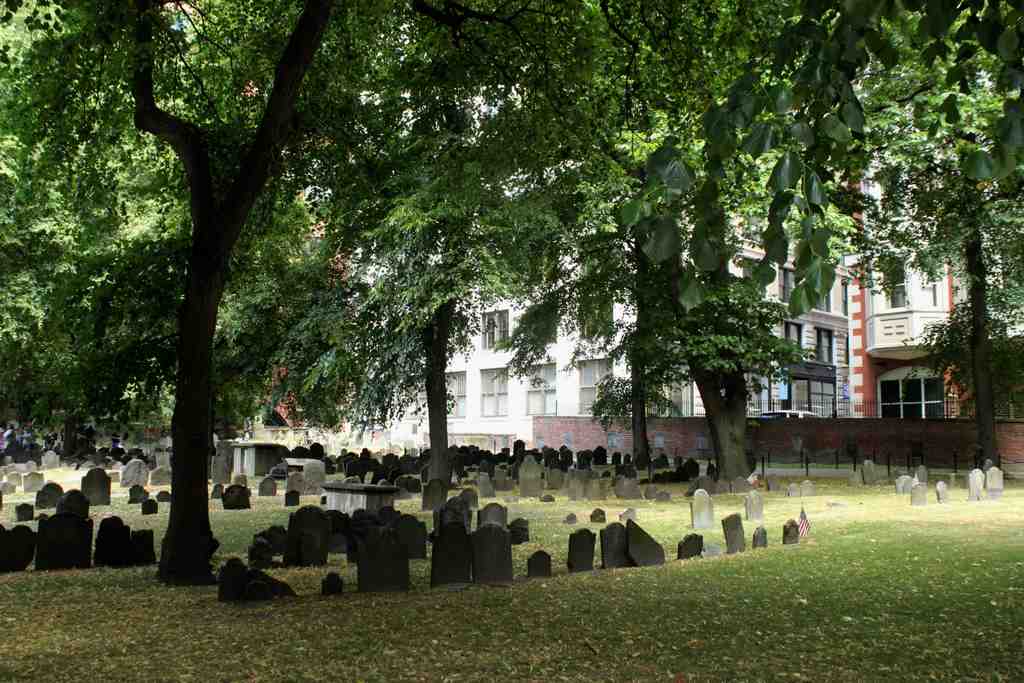
Look for the black iron fence and the stone Egyptian Revival gateway, with rows of slate and granite grave-markers packed behind it like a tilted little forest of stone.
This is Granary Burying Ground, Boston’s third-oldest cemetery, and it has that rare talent of making a loud city go quiet in your head. People started burying Bostonians here in sixteen sixty, when the older cemetery at King’s Chapel no longer had enough room for a growing town. Back then, this land actually belonged to Boston Common, before the city kept slicing the block into new uses. For years the place went by South Burying Ground, then in seventeen thirty-seven people started calling it Granary after the grain storage building that stood where Park Street Church rises now.
What gets me is the numbers. You can see about two thousand three hundred forty-five grave-markers... but historians think as many as five thousand people rest here. So this place is part cemetery, part puzzle, part crowded memory palace.
And the cast of characters? Absolutely stacked. Samuel Adams, John Hancock, and Robert Treat Paine, three signers of the Declaration of Independence, lie here. Paul Revere is here too, along with Peter Faneuil, whose money helped shape the market hall we visited earlier. Near the Tremont Street entrance lie the victims of the Boston Massacre, including Crispus Attucks, buried in a common grave. Benjamin Franklin is not here, though people often assume he is; instead, this ground holds his parents, Josiah Franklin and Abiah Folger, honored by a granite obelisk set up in eighteen twenty-seven.
If you look at your screen, image five shows one of the oldest stones here, carved with the Latin phrase tempus edax rerum, which means “time devours all things.” That line feels almost unfairly perfect for this place.
Early Boston’s Puritans kept churches plain and stripped of religious imagery, so families poured feeling into the gravestones instead. That is why you’ll find “soul effigies” here - winged skull carvings, basically a death’s head with wings - meant to show the soul flying upward. It’s grim, sure, but also strangely tender.
The entrance itself tells another chapter. In eighteen forty, architect Isaiah Rogers designed this iron fence and gate in Egyptian Revival style, meaning he borrowed the heavy, ancient look of Egyptian temples for a nineteenth-century cemetery. The project cost five thousand dollars, which would be roughly like spending around one hundred eighty thousand dollars today. Rogers even made a twin gate for Touro Cemetery in Newport. If you want, the comparison image in the app shows this gate going from opening onto a quieter Victorian graveyard to standing in a canyon of downtown Boston.
And here’s one more Boston-style twist: in two thousand and nine, a tourist on a self-guided visit stepped on an old slate slab and dropped into a hidden stairway leading to an intact crypt below. She was fine, no human remains were disturbed, and the crypt may belong to Jonathan Armitage, a Boston selectman from the seventeen thirties. Even the ground here keeps secrets.
If you want to go inside later, the burying ground generally opens daily from nine in the morning to four in the afternoon.
Granary Burying Ground feels like Boston compressed into stone: rebellion, family, vanity, grief, and the stubborn urge to be remembered.
Take a beat with it, and when you’re ready, we can wander on to King’s Chapel.




