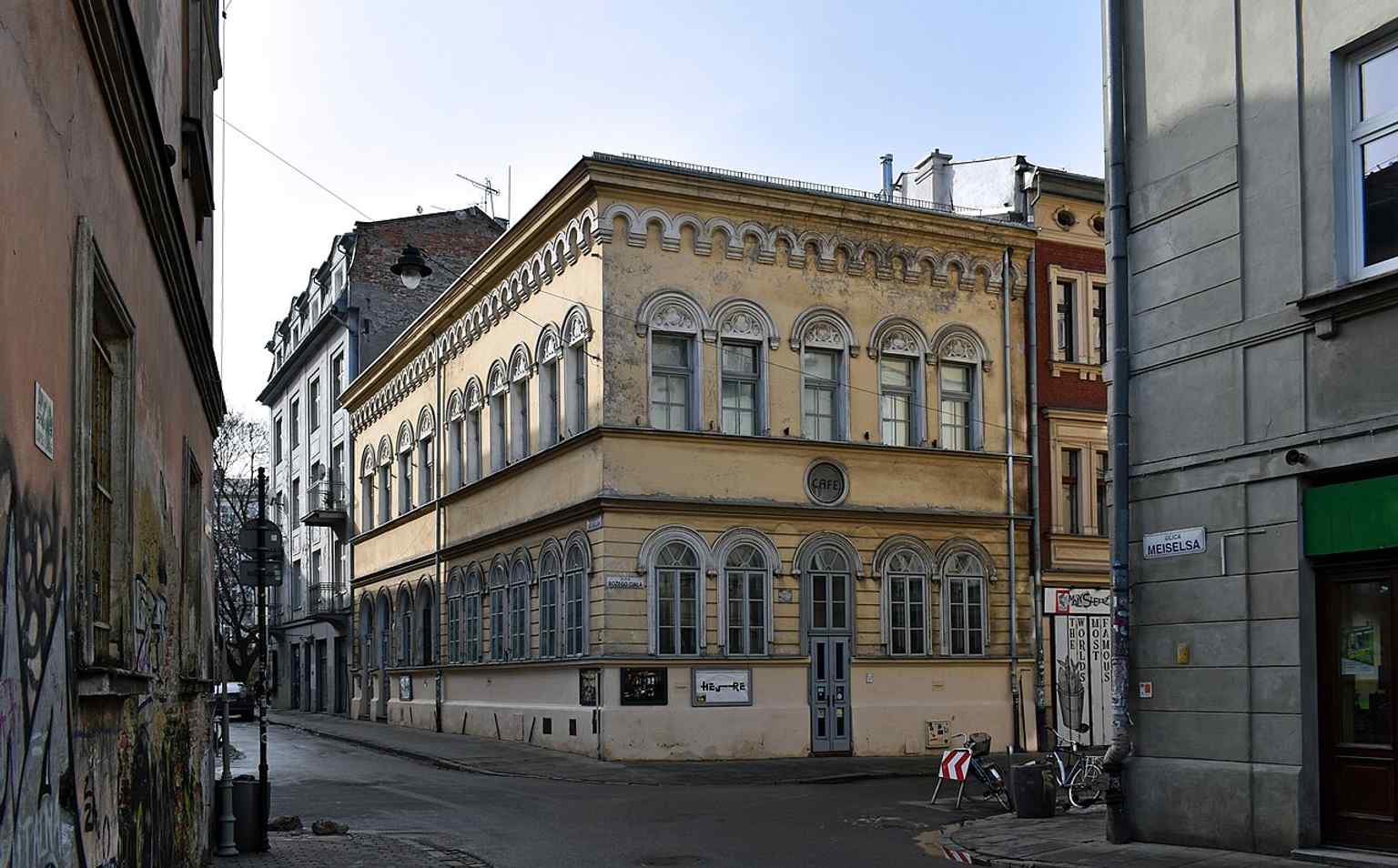
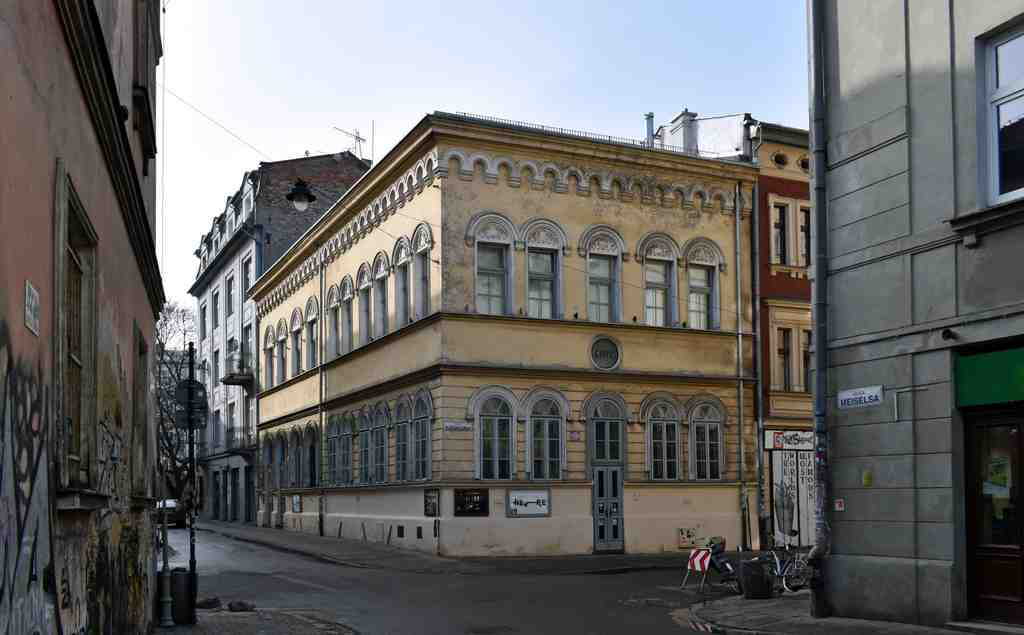
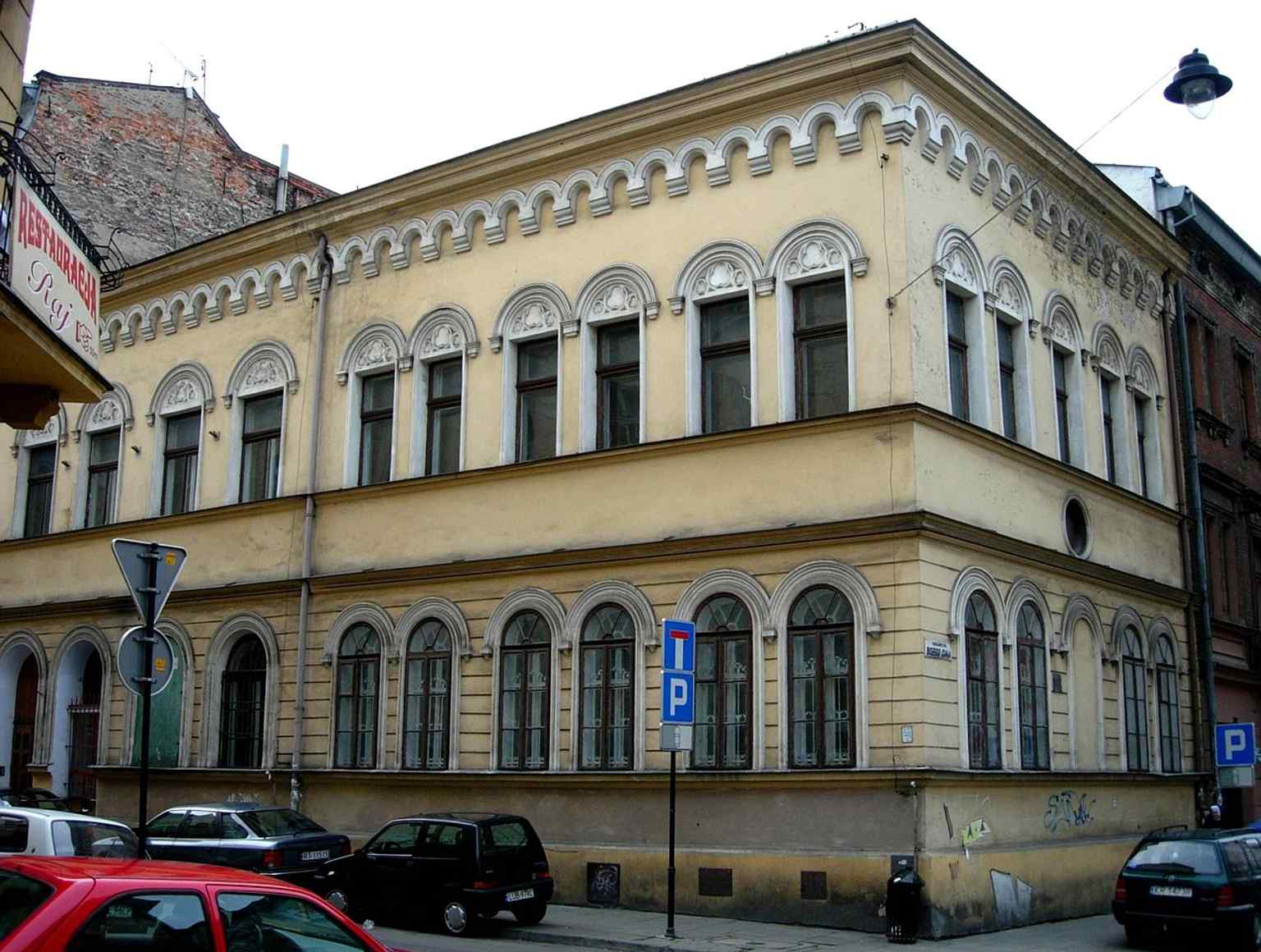
This is a modest two-storey brick-and-plaster corner building, rectangular in form, marked by round-arched windows and a distinctive row of small blind arches just beneath the roof.
At first glance, it can seem restrained, almost shy. But that is part of its story. This was never one of Kazimierz’s grandest synagogues. In eighteen ninety-six, the Psalm Brotherhood founded it as Chewra Thilim, literally the Psalm Society, and architect Nachman Kopald gave them a practical house of prayer with a touch of late nineteenth-century flourish. Those rounded windows and that arcaded frieze under the roofline borrow from older styles, giving a small communal building a certain dignity.
Behind this facade stood a whole little religious world: the men’s prayer hall on the ground floor, a women’s gallery upstairs, and a Talmudic school as well. Like some of the humbler prayer rooms we have met already, this place mattered because ordinary people kept it alive through repeated daily use, not because it dominated the skyline.
If you glance at the image on your screen, you can see the building from a little farther back and appreciate how firmly it sits in the street corner, still carrying the outline of its original purpose. In nineteen thirty-one, Salomon Jonkler remodelled the synagogue. Then the Germans came, and during the occupation they wrecked the interior. The shell survived, but survival here rarely meant peace. After the war, the building housed the Jewish Socialist Party. In nineteen fifty-one, the Krakowiacy folk song and dance ensemble moved in. That decision sounds odd until you remember the wider problem: many Jewish buildings in Kraków remained standing after the people who animated them had been murdered, scattered, or reduced to tiny communities.
That brings us to Tadeusz Jakubowicz, head of Kraków’s Jewish community after the building returned to communal ownership in two thousand and one under the restitution law. He faced a miserably practical question: how do you keep a former synagogue in Jewish hands when the community is small and the building needs constant care? His answer was a very local compromise. He allowed the ensemble to stay, but only on condition that it improve the building and prevent further decay.
Most tourists never notice that this synagogue’s fate turned not on a dramatic restoration campaign, but on that compromise between ownership and use. The ensemble said the condition was good enough and that the city funded occasional interior repairs. But they could not afford a major roof repair or new windows, and the city did not want to pay for a property it did not own. By two thousand and six, they left.
Then came a startling discovery. In two thousand and eight, conservators uncovered wall paintings inside: mostly blue and green, with biblical scenes, a lion, a tiger, part of an eagle, and a deer; views of Jerusalem and Rachel’s Tomb; and, near the wooden women’s gallery, Hebrew words meaning “the candle of the soul.” Fragments of the red curtain around the Aron ha-Kodesh, the holy ark niche where Torah scrolls were kept, also survived.
And yet discovery did not settle the building’s future. In two thousand and thirteen, a lease to the Mezcal nightclub provoked outrage. Scholar Jonathan Webber wrote publicly of his horror. Critics pointed to a bar installed in the former prayer hall, directly before exposed paintings that still lacked proper protection. Even after the building entered the heritage register, later alterations cut a new passage near the old ark niche. Activists answered with the RememberChewra actions, insisting that preservation means more than leaving the walls standing.
So here you are before a building that still exists because people kept finding uses for it, and yet each use asked a painful question. When the original world cannot simply be restored, what does respectful care actually look like?
When you are ready, continue to Corpus Christi Street. It is about a two-minute walk from here.