
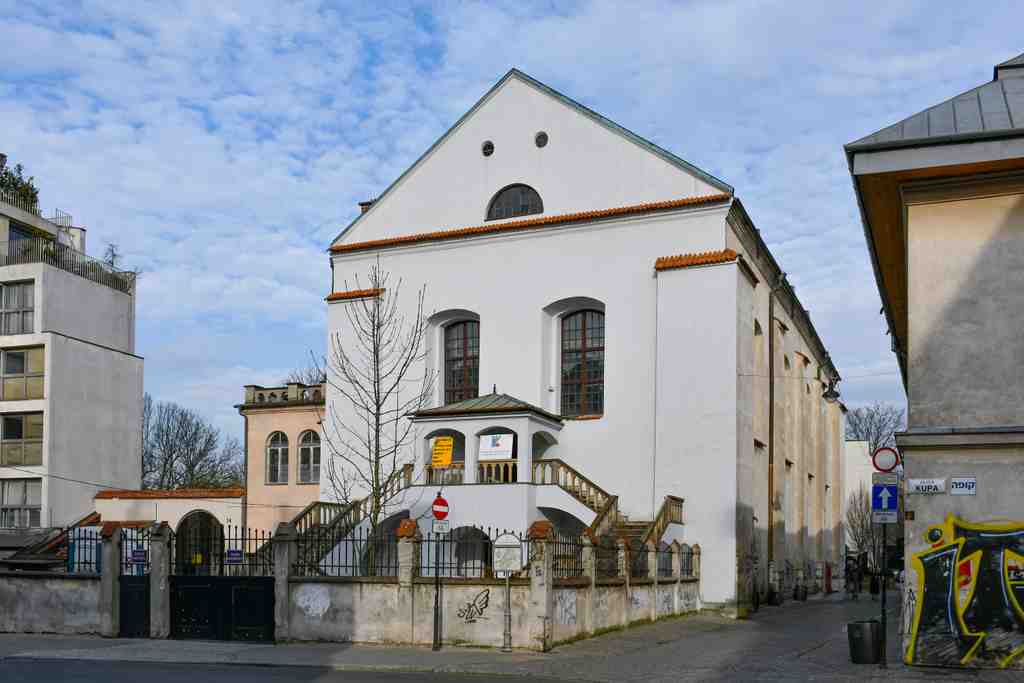
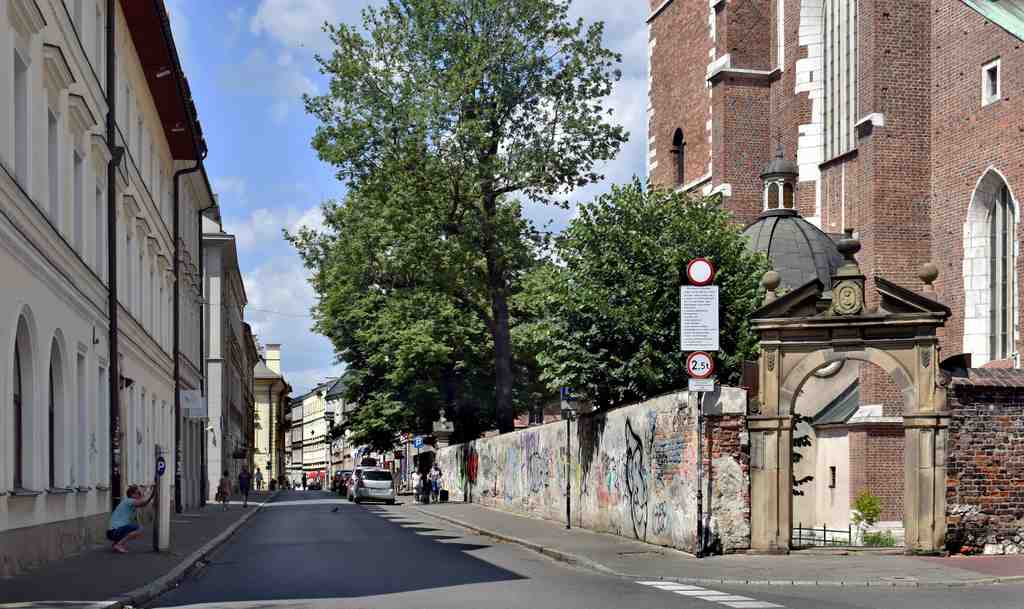
Look for a straight street framed by tall plastered townhouses, with a long, stone-edged perspective and the great church tower of Bożego Ciała rising as its unmistakable marker.
This street tells Kazimierz how to behave, or rather, how it learned not to behave neatly at all. Bożego Ciała Street, literally Corpus Christi Street, began in thirteen thirty-five as part of the original plan of Kazimierz. At first it was barely built up. The parish school stood here, and beyond that, open space. What you see now came much later, when the district pressed outward and filled itself in.
And that is the important shift. This is not simply a road between one sight and another. It is a shared urban axis, a seam where Jewish and Christian histories met in stone, trade, prayer, argument, and daily routine. Along one stretch you could find a church and monastic buildings, a former inn, prayer houses, and later the solid ranks of late nineteenth-century rental tenements. Kazimierz never lived in separate boxes for very long.
The street’s name also carries ritual memory. Kraków’s Corpus Christi procession passed into legend here, and so did the Lajkonik story, linked to an old tale of a Tatar raid during the feast. In other words, the street belonged not only to maps, but to processions, performance, and civic memory. People walked belief through this space. They made the street by using it.
Then history turned abruptly. In sixteen fifty-five, during the Swedish invasion known in Poland as the Deluge, King Charles Gustav took over the Corpus Christi church at the end of this street and used it as his quarters while directing the siege of Kraków. That is quite a reversal, is it not? A church made for worship became a military command post. The interior suffered heavy damage, and when people repaired it later, the balance tipped toward Baroque furnishings rather than the earlier Gothic character. Conquest left its fingerprints not only in chronicles, but in style.
The street changed again when Kazimierz lost its medieval walls in eighteen forty-two. Once those walls came down, Bożego Ciała no longer stopped at the old edge of town. The city pushed it outward to Miodowa, and later, in eighteen ninety-two, onward to Józefa Dietla Street. Most of the townhouses you see belong to that period of expansion, when old Kazimierz was being stretched beyond its original limits.
Even the individual addresses carry this layered life. At number thirteen, the Chewra Tehilim prayer house served a real neighborhood community; in nineteen thirty-seven, Eizyk Kryngel led a congregation of two hundred forty worshippers there. At numbers eighteen to twenty, an inn from eighteen oh two later housed the Etz Chaim prayer house before the war. One building held lodging, commerce, and devotion under the same roof. That, too, is Kazimierz.
So stand still for a moment and let the street speak. It records procession and occupation, demolition and expansion, worship and reuse. It is not just a route through Kazimierz. It is the hinge on which the district swung open. From here, we continue to the Tempel Synagogue, where another kind of reinvention awaits.




