
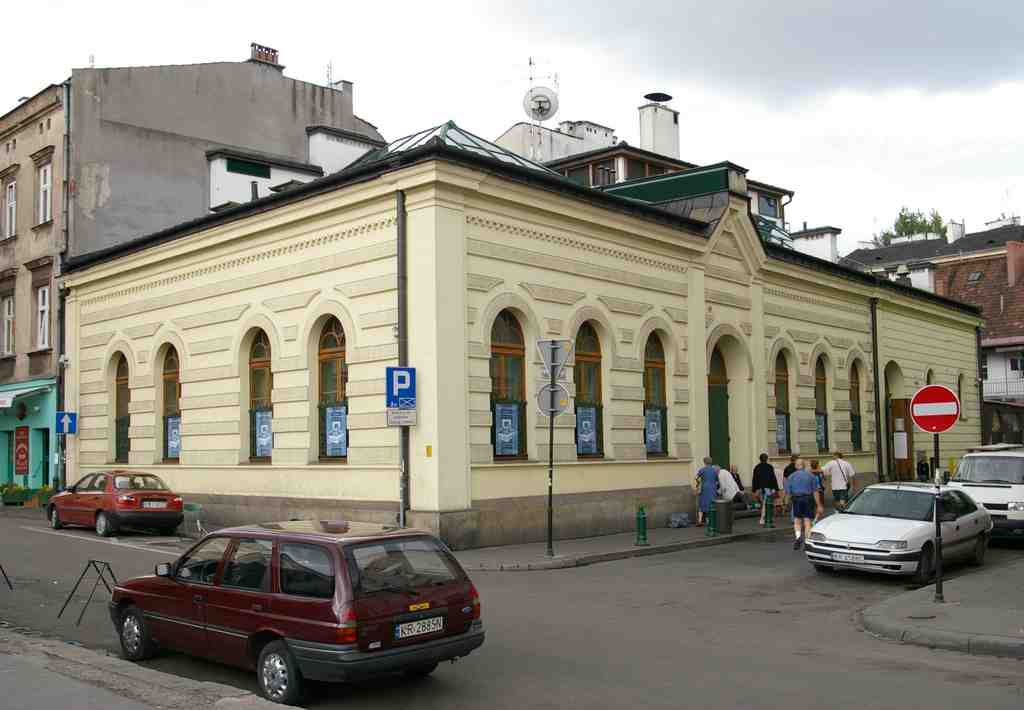
On your left, look for a modest stucco-faced building with a broad rectangular front, tall evenly spaced windows, and the entrance set into number seventeen on Meiselsa Street.
This address marks a quiet turning point in Kazimierz. Earlier on our walk, we met buildings that carried Jewish life in their original purpose. Here, the story shifts. This was once a Beit Tefillah, a house of prayer, built in the eighteen eighties and used for worship right up to the outbreak of the Second World War. Then, after ruin, neglect, and silence, people chose not merely to admire what had been lost, but to act.
That sort of rescue takes more than sentiment. In the nineteen eighties, the idea for the Judaica Foundation began to gather force, encouraged by the president of Kraków’s Jewish community. The foundation itself took shape in nineteen ninety-one, dedicated to preserving Jewish culture here in Kazimierz and, crucially, to opening it outward. Not a sealed memorial. Not a frozen ruin. A living place.
Architect Dariusz Gruszka supervised the building’s renovation from nineteen eighty-eight to nineteen ninety-three. The work was serious and painstaking, funded largely by the Congress of the United States, with further support from the city of Kraków, the provincial governor’s office, and monument conservators. Inside, restorers even rebuilt the men’s hall ceiling ornament and a plaster rosette, a circular ceiling decoration, using traces left from the turn of the twentieth century. Memory, in other words, was not guessed at. It was read in the walls.
If you look at the image on your screen, you can see the building after that revival, still modest, still reserved, but no longer abandoned to forgetting.
The Centre for Jewish Culture opened here on the twenty-fourth of November, nineteen ninety-three. From the outset, it welcomed Jews and non-Jews, visitors from Poland and abroad, and anyone willing to learn about Jewish history and Polish-Jewish coexistence. That openness mattered. Preservation here meant lectures, workshops, exhibitions, and difficult conversations. In nineteen ninety-six, the foundation launched Bayit Hadash, the Month of Encounters with Jewish Culture, often built around a single figure or theme, from Franz Kafka to Mordechaj Gebirtig to the history of Jewish Galicia.
This hall also gave space to voices that stretched far beyond Kraków. Czesław Miłosz opened the Aleksander and Alicja Hertz memorial lecture in nineteen ninety-nine. Israel Gutman later spoke here. So did Ryszard Kapuściński. In two thousand and nineteen, the center hosted a memorial evening for Henryk Halkowski and, in the same month, a debate on collaboration in occupied Kraków alongside survivor testimony on film.
So here is the question to carry with you: when a former house of prayer becomes a shared cultural space, has it lost its first calling, or has it found another way to gather souls?
That is the deeper rescue, I think: not only saving a building, but reopening conversation inside it. When you are ready, we shall continue to Chewra Thilim Synagogue, about one minute away.




