Visite Audio de Florence : Un Voyage à Travers l'Art et l'Architecture
Un complot Médicis fut jadis chuchoté derrière les épais murs de Florence tandis que des artistes façonnaient le marbre en légendes et que des révolutionnaires rôdaient dans les cryptes silencieuses sous les sols des églises. Cette ville recèle plus de secrets qu'il n'y paraît. Découvrez Florence grâce à une visite audio autoguidée qui révèle des histoires cachées et des drames oubliés, tapis juste au-delà de la foule. Parcourez les palais, les anciennes basiliques et les rues sinueuses avec des récits que vous ne trouverez dans aucun guide. Les premières pierres de Santa Reparata ont-elles vraiment abrité des hors-la-loi en fuite lors d'un soulèvement oublié ? Pourquoi le David de Michel-Ange a-t-il failli être détruit par des citoyens furieux quelques jours seulement après son dévoilement ? Quel coin inattendu à l'intérieur du Palazzo Medici Riccardi résonne encore des ombres de réunions secrètes et de scandales ? Parcourez Florence lors d'un voyage d'intrigue, de beauté et de découvertes audacieuses. Voyez l'âme de la ville derrière chaque chef-d'œuvre et sous chaque pierre. Commencez votre aventure et laissez les secrets enfouis de Florence se dévoiler à vos pieds.
Aperçu du tour
À propos de ce tour
- scheduleDurée 30–50 minsAllez à votre propre rythme
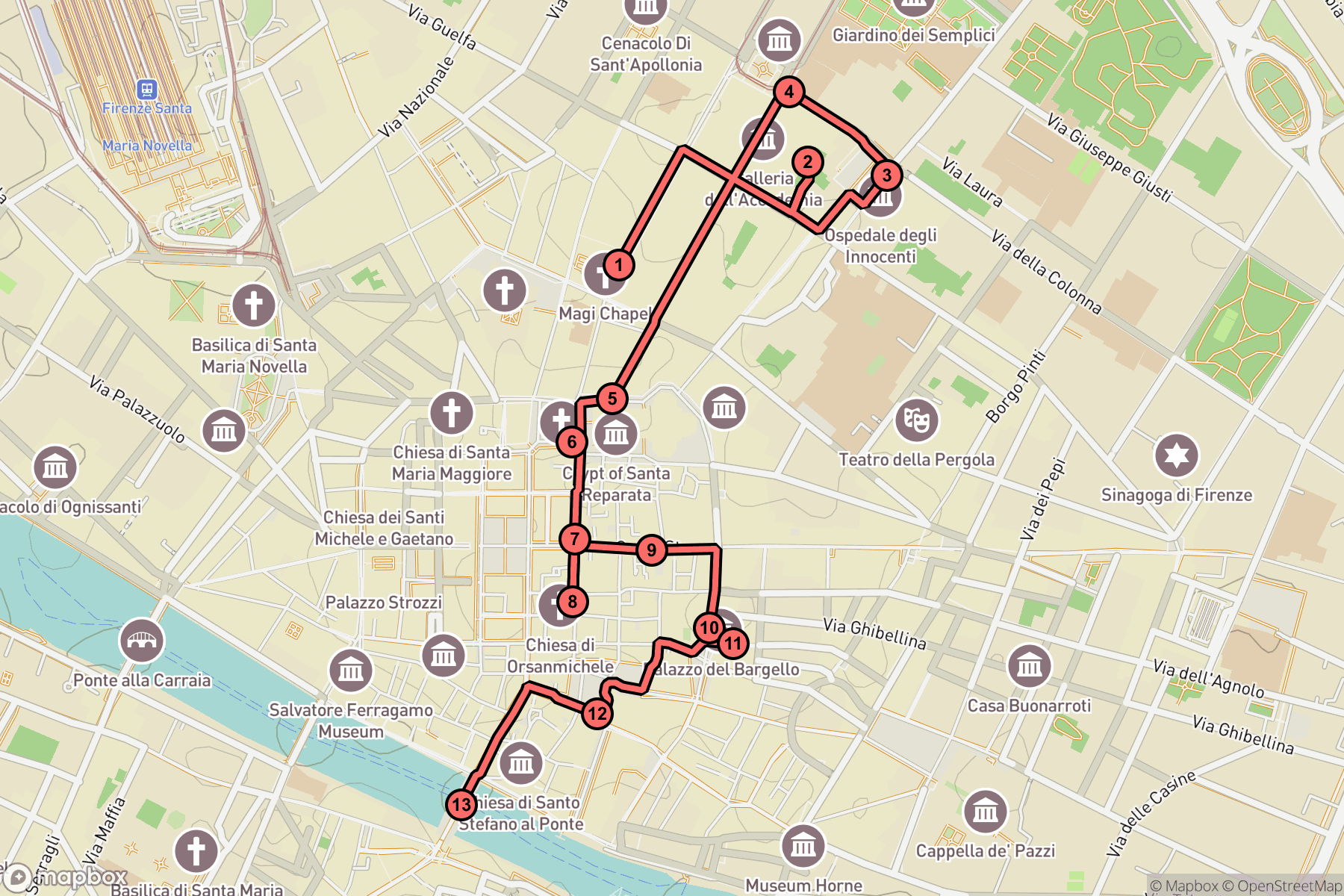
- straightenParcours à pied de 3.3 kmSuivez le sentier guidé
- location_on
- wifi_offFonctionne hors ligneTéléchargez une fois, utilisez n'importe où
- all_inclusiveAccès à vieRéécoutez n'importe quand, pour toujours
- location_onCommence à Palazzo Medici Riccardi
Arrêts de ce tour
To spot Palazzo Medici Riccardi, look to your right for a large, fortress-like stone palace with heavy rusticated blocks on the ground level and elegant rows of arched windows…Lire plusAfficher moins
To spot Palazzo Medici Riccardi, look to your right for a large, fortress-like stone palace with heavy rusticated blocks on the ground level and elegant rows of arched windows growing lighter and finer as you look up-this grand palazzo stretches along the street like a noble lion lounging in the sun, impossible to ignore once you see those bold horizontal stone bands and massive cornice. Ah, eccoci! Welcome, my friend, to the very heartbeat of Renaissance intrigue-the Palazzo Medici Riccardi! Listen to the footsteps echo on the stones, for this was once the home of Florence’s most powerful family. Picture Cosimo de’ Medici, pater patriae, the Godfather before there were Godfathers-plotting, smiling modestly, pretending, “Oh, this old stone house? Just something simple for the family!” But inside, beneath that thick, almost grumpy exterior, was a treasure chest of gold, marble, art, and secrets. It was built back in the days when Florence wasn’t just a city-it was a stew bubbling with rivalry and beauty. Cosimo needed a home that, from the outside, said, “See? I don’t show off” so he could slip under the radar of those pesky sumptuary laws. But between you and me, this was no ordinary house. Michelozzo di Bartolomeo, the genius architect-think of him as the Renaissance’s answer to your favorite handyman, but with a doctorate in style-dreamed up this palace for Cosimo between 1444 and 1484. They say Cosimo tossed aside Brunelleschi’s design because it screamed “Look at all my money!” Instead, Cosimo’s house gently whispered it. Look closely at the ground floor, those rough, gnarly stones-rusticated masonry, it’s called. It was all the rage, and soon, everybody wanted rough stones to show they had smooth coins. The building rises in perfect order: heavy at the ground, less so at your belly, light like a feather up top, with each storey divided by sharp horizontal lines. By the time your eye reaches that mighty overhanging cornice, you might feel-am I shrinking or is this palace growing? Just imagine the scene inside in 1459 when the fifteen-year-old Galeazzo Maria Sforza visited. Wide-eyed, he wrote home about ceilings painted with stars, marble shining everywhere, gardens that looked painted they were so magical, benches and floors so beautifully carved you’d think twice before sitting down. Even the gardens were so elegant he wondered if they were natural or some magician’s trick. Cosimo didn’t just invite powerful guests, he welcomed them inside a dream. Picture the air thick with the scent of polished wood and fresh-cut flowers, silk tapestries shimmering in the candlelight, and the quiet determination of the Medici-masters of appearing humble while living like kings. When old Cosimo passed away, his home stayed in the Medici family, witnessing all the wildness of Florentine politics-banishments, exiles, flashy returns-until Cosimo I decided the palace, stylish as it was, simply wasn’t flashy enough and moved house to the Palazzo Vecchio. Then, as the centuries ticked on, the Riccardi family swept in, adding their own splash of Baroque razzle-dazzle and frescoes by the mighty Luca Giordano. Step a little closer to the heart of the palace, and you’d find the hidden Magi Chapel, frescoed by Benozzo Gozzoli-a parade of kings, emperors, and Medici bigwigs masquerading as the Three Wise Men. It’s like a Renaissance selfie, but with more gold and more egos. You might even recognize a few famous faces if you stepped inside today. But oh, the stories these walls could tell! Here was the site of a royal wedding bash in 1689, where the future Grand Prince of Tuscany feasted with Violante Beatrice of Bavaria and half of Europe peering in. Centuries later, Cosimo’s modest dream would host less noble guests-a certain Mr. Mussolini and Herr Hitler, plotting over dinner during darker times. Even now, as officials bustle in and out and tourists snap photos, the spirit of the old palace lingers. The outside is still a bit gruff, but don’t be fooled-inside was, and remains, a dazzling labyrinth of power, art, and history, all hidden beneath a Florentine poker face. So take a breath, soak in the whispers of centuries, and imagine: if only the stones could talk, which Medici secrets would they spill? Ready to delve deeper into the architecture, reception or the art? Join me in the chat section for an enriching discussion.
Ouvrir la page dédiée →To spot the famous David, just look for the towering, gleaming white marble statue of a young man, larger than life, standing boldly and striking a dramatic pose in the gallery in…Lire plusAfficher moins
To spot the famous David, just look for the towering, gleaming white marble statue of a young man, larger than life, standing boldly and striking a dramatic pose in the gallery in front of you. Ah, eccolo! Here stands Michelangelo’s David, and let me tell you, he’s every bit as impressive as his reputation suggests-five meters of pure marble muscle and nerve! Just imagine the year is 1501. Florence is buzzing with uncertainty, the Medici have been sent packing, and the city’s future feels as wobbly as a waiter carrying too many bowls of pappa al pomodoro. The leaders want a symbol of strength, of independence-a “don’t mess with Florence” kind of message. And what better way than the biblical hero David, the underdog ready to face giants? But, ah! The tale of our David starts not with a flash of genius, but with a gigantic hunk of marble lying around like forgotten laundry for 25 years! First, one sculptor started on it, but gave up. Another one gave it a half-hearted try and then quit. By the time Michelangelo got his hands on it, this block was called il gigante-the giant-and had the reputation of being cursed. Yet, at just 26 years old, Michelangelo convinced the wool merchants and cathedral bosses to give him a shot. With a sparkle in his eye and a chisel in hand, he started carving at dawn on September 13, 1501. Imagine the intensity: Michelangelo saw the figure already inside the stone. He thought it was just his job to “liberate” David from that giant mass, bit by bit, revealing not just a boy but the symbol of Florence itself-defiant, ready, a touch nervous perhaps, with that brow furrowed as if he’s thinking, “Are you sure about this, Goliath?” And with hands and head a little bigger, just in case, so we could admire them from way down below if he’d ended up on the cathedral roof like originally planned. But, as the statue neared completion, it became clear that lifting this 8.5-ton giant up onto the dome was as likely as getting Florentine traffic to move on a Monday morning. Instead, there was a grand debate-Botticelli, Leonardo da Vinci, and a parade of artists argued about the best spot for him. Eventually, they chose the most important stage in the city: the entrance to the Palazzo della Signoria! So, in June of 1504, more than 40 men rolled him -very carefully!-through the streets, as everyone watched and held their breath. Four days of suspense, and then, David was in place, as if saying to the world, “Come at me, if you dare!” Of course, not everyone was a fan. He had stones thrown at him, and after a riot decades later, his poor left arm was shattered! Kids saved the pieces like precious treasures, fortunately. Over the centuries, he suffered all sorts of adventures-one block meant as his marble twin fell dramatically into the river, as if it couldn’t bear its fate, and in the 19th century, Florence decided David was simply too precious to stand out in the elements. He was moved to this gallery in 1873, rumbling slowly across town in a wooden crate, while a replica took his place outside. And, my friend, David’s story is not just about art, but politics too! Florence saw itself in that young shepherd-small, threatened by big bullies but full of cleverness and heart. The statue became their rallying cry for freedom, a reminder that the city could stand tall (and naked!) before its enemies. They even adorned him with gilded leaves and vines to preserve a little bit of modesty-and perhaps to distract the ladies, who, Machiavelli joked, should be forced to look at David up close as punishment! So while you stand here, look at the veins in that hand, the twist in his hips, the suspense in his eyes. This isn’t just marble. This is the spirit of Florence, captured forever-buff, beautiful, and just a little bit defiant. And hey, if you hear the echoes of chisels and city crowds behind you, well, maybe you’re just feeling the heartbeat of Renaissance Florence! If you're curious about the interpretation, political implications or the pedestal, the chat section below is the perfect place to seek clarification.
Ouvrir la page dédiée →In front of you stands a long, yellowish building with a row of dark stone arches at the base-just look for the repetitive arcade stretching along the street and the line of…Lire plusAfficher moins
In front of you stands a long, yellowish building with a row of dark stone arches at the base-just look for the repetitive arcade stretching along the street and the line of bicycles parked under its shade. Ah, you’ve made it! Take a deep breath and savor that delicious scent in the air: a mix of academic brilliance, a hint of old stone, and, let’s be honest, maybe a dash of espresso from somewhere close by-because this is Florence, my friend. Before you stands the legendary Accademia di Belle Arti di Firenze, a cornerstone of creativity in this city of marvels. Picture it: the year is 1563. Florence is buzzing with ideas, patrons, and a bit of family drama (what else with the Medici at the helm, eh?). Cosimo I de’ Medici, the city’s big boss with an eye for art and a flair for power, decides to cook up something special. He teams up with Giorgio Vasari, a Renaissance Mark Zuckerberg, but with a better beard, and together they hatch a plan: why not make a club-a very exclusive club-for the best artists around? Voilà! The academy and company of arts and drawing is born, like a creative Avengers headquarters. Now, this place wasn’t just for anyone with a paintbrush. You had to be the real deal-think Michelangelo, yes, *the* Michelangelo-plus legends like Benvenuto Cellini, Agnolo Bronzino, and a laundry list of artists with more talent than you could fit on a fresco. For years, the academy guided Florentine art, deciding what style was in and what was, let’s say, “needing improvement.” And about the ladies? Oh, it took some time, but Florence couldn’t keep them out forever. Artemisia Gentileschi finally broke through as the first woman member, swinging her paintbrush like a sword. Later, Angelika Kauffmann and others joined the club, and with each new artist the halls buzzed louder with creativity and a little tasty gossip. As centuries rolled by, the Accademia evolved. In 1784, Pietro Leopoldo swooped in and said, “Let’s mix it up!” He rolled all the art schools into one, plopping them right here inside this old convent. Today, the academy still shapes Italy’s artists-only now, paint and marble stand side by side with digital screens. And as you stand here, listen: the echoes of whispered critiques, laughter, and creative outbursts float all around you. Michelangelo might not be lurking in the shadows anymore, but who knows? Maybe you’ll spot the next big star on their way to class, sketchbook in hand. This isn’t only a building; it’s a living, breathing story of art’s wild adventure through Florentine history.
Ouvrir la page dédiée →
Afficher 7 arrêts de plusAfficher moins d'arrêtsexpand_moreexpand_less
Look for a long, elegant building ahead of you with a grand row of nine beautiful stone arches, each nestled with a round blue-and-white medallion featuring swaddled babies - you…Lire plusAfficher moins
Look for a long, elegant building ahead of you with a grand row of nine beautiful stone arches, each nestled with a round blue-and-white medallion featuring swaddled babies - you can’t miss its regal loggia rising above the steps at the edge of Piazza Santissima Annunziata. Ah, now you’re standing before the Ospedale degli Innocenti, one of Florence’s most heartfelt and revolutionary treasures! If this building could talk, oh, the stories it would tell - stories of hope, heartbreak, and a dash of Tuscan inventiveness. Picture Florence in the early 1400s - a city bursting with art, bustling markets, and the loud debates of wool and silk merchants. It was here, commissioned by the mighty Arte della Seta, the rich Silk Guild, that maestro Filippo Brunelleschi - the father of Renaissance architecture himself! - drew up a vision that was as bold as it was compassionate. Step a little closer and focus on those nine perfect arches - they mark the front loggia, an architectural marvel at the time. Feel how the air shifts, almost echoing with the footsteps of mothers and fathers who, through both heartbreak and hope, pressed tiny bundles into a stone basin or slipped them through a secret rotating wheel just here at the entrance. Can you imagine it? Anonymity and mercy intertwined, with the voices of the city swirling all around. Now, look above the arches - see those blue terracotta roundels? They’re not just decor; they tell the building’s story in relief. Each one, designed by Andrea della Robbia, cradles the image of a little baby, swaddled in white, eternally watched over. It’s not just a cutesy touch - even the American Academy of Pediatrics pinched a design for their insignia! And for the writers among us, E. M. Forster’s Lucy in “A Room with a View” much preferred these “Della Robbia babies” to Giotto. That’s high praise, no? But those arches, those columns - oh, they were a revolution! Before Brunelleschi, buildings were pointy and gothic, all grandeur but little regularity. Here, every column’s height matches the width between columns and even the width of one arch, creating an elegant, harmonious cube. In other words, it’s so satisfyingly symmetrical it’ll make your heart - and a mathematician’s - skip a beat. This was Florence’s first “pure” Renaissance building - clear lines, classical references, and oh, a sense of order that said, “We’re done with chaos, let’s start something new!” But don’t think it was just about pretty facades. Inside, this was a lifeline for abandoned children. The hospital cared for those little innocenti, providing them not just with a warm place to sleep, but with nurses, food, and the hope of a future - training for trades, reading, writing, even dowries for girls so they could marry or join convents. Florence wasn’t always so sunny, though. Imagine 1557: famine stalks the city, wheat prices soar, and even this bastion of charity teeters on the edge. The hospital was sometimes so stretched it had to send boys away at 18, and try to place the girls in noble homes with whatever dowries they could still muster. In the wild twists of Florentine economy, the hospital even became a sort of savings bank - can you picture Cosimo de’ Medici with his purse strings a little too loose, juggling debts and charity at the same time? But let’s not gloss over a little scandal. Some clever ladies would abandon their own babies here, get hired as wet nurses, and end up getting paid to feed their own child! Only in Florence - the city of saints, artists, and a good side of mischief. Today, this elegant structure houses UNICEF’s Innocenti Research Centre and a delightful little museum graced by Botticelli, Luca della Robbia, and even an Adoration of the Magi by Ghirlandaio. And as you gaze at its graceful face, remember that this is also a place where proportion meets compassion, where the cold stone has guarded centuries of laughter, tears, and the very best - and quirkiest - of what it means to be Florentine. To delve deeper into the façade, design or the the tondi, simply drop your query in the chat section and I'll provide more information.
Ouvrir la page dédiée →To spot Giotto’s Campanile, look for a tall, slender tower covered in dazzling patterns of white, green, and pink marble rising high above the neighboring rooftops, right beside…Lire plusAfficher moins
To spot Giotto’s Campanile, look for a tall, slender tower covered in dazzling patterns of white, green, and pink marble rising high above the neighboring rooftops, right beside Florence’s grand cathedral in Piazza del Duomo. Ah, now you see it-Giotto’s Campanile, the elegant bell tower that’s as much a Florentine fashion icon as a masterpiece of architecture, strutting its stuff in perfect harmony with the nearby cathedral like two models on a Renaissance catwalk! Take a good look at this beauty: square in shape, with every side measuring just over 14 meters and reaching an impressive 85 meters high. But don’t let its slimming geometric lines fool you-this tower is packed with more drama and history than a Tuscan telenovela. Now, imagine Florence in the year 1334. The city is alive with ambition and the air is full of energy, but since the death of master Arnolfo di Cambio, not much has happened on the Cathedral works. Enter Giotto di Bondone, a painter famous across Italy-and already sixty-seven years old! Instead of just daubing paint, now he’s got a grand plan for a tower that’d make nearby Pisa jealous. Picture Florence’s artisans gathering in the square as the first stone is laid, a moment full of hope. Giotto was determined his tower would be a rainbow of marble, echoing the magic of the Cathedral next door: white from Carrara, green from Prato, and red from Siena. He designed it not as a skeleton of spindly Gothic lines, but as a sculpted painting in stone. The result? From afar, the campanile glows in the sun like a candied fruit on a festive pastry. But be honest, you didn’t come here just for colors-you want a story! Giotto managed to finish only the lower level, studding it with dazzling bas-reliefs in hexagonal panels, creating a sort of comic strip in marble. The panels are a parade of scenes, each one with a tale: here’s Adam and Eve (with less leaf coverage than you’d expect), Jabal the shepherd, Jubal with his harp, Tubalcain the blacksmith, and the ever-industrious Noah with his new vineyard. The panels don’t just delight the eyes, they hint at the perfectibility of man-seven per side, a sacred number with a wink to heavenly mathematics. After Giotto waved arrivederci in 1337, Andrea Pisano took the wheel, adding levels decorated with lozenges (the Renaissance answer to trading cards) and launching the tower toward the clouds. His reliefs show everything from the liberal arts to the planets themselves: Saturn, Jupiter, even Mercury-no Roman god left behind! On went the building work, but in 1348, Florence faced the terrifying silence of the Black Death. Years passed with the project on pause. Finally, Francesco Talenti, a real headliner in the world of Florentine construction, finished those upper three levels. Talenti was so clever, he made each level a bit wider, exactly countering the tricks of perspective-so from where you stand, the top seems as grand as the base. No finishing spire, just a panoramic terrace fit for any would-be Dante or daydreaming poet. If you’re wondering-yes, you can climb all 414 steps to that glorious view, though after you reach the top, you may feel Florence owes you a big gelato. Now, the bells! Oh, those bells have rung out over Florence for centuries, marking every moment of joy, warning of danger, timing the market, even signalling the start of a good argument between neighbors. There are seven in all-enough to make this campanile Florence’s own seven-note symphony. The statues in the niches are a who’s who of prophets, sibyls, patriarchs, and thinkers-some by Donatello, others by Pisano, each one with a story. There’s Moses, all beard and fury, prophets who may look suspiciously like local rivals, and wise Solomon who probably would’ve asked for ear plugs during a busy bell day. Today, Giotto’s Campanile stands as a masterpiece of Florentine ambition: a tower that’s both a painting and a poem, a monument to endurance, skill, and a bit of wily rivalry. When you gaze up at it, think of centuries of hands carving, chiseling, and dreaming-each one eager to leave their mark on Florence’s skyline, and all hoping their tower might just be the one that finally gets noticed. And with that, take a deep breath. You’re standing in the shadow of genius-just mind your neck!
Ouvrir la page dédiée →Look ahead for a tall, pale stone façade set right on the narrow street, with three grand arches held up by elegant columns and a striking, large arched window above-the Church of…Lire plusAfficher moins
Look ahead for a tall, pale stone façade set right on the narrow street, with three grand arches held up by elegant columns and a striking, large arched window above-the Church of Santa Margherita in Santa Maria de’ Ricci greets you with its proud yet understated presence. Ah! My friend, you’ve found one of Florence’s most dramatic tales wrapped in stone. If these arches could whisper, you’d hear stories of scandal, repentance, and, naturally, a bit of Florentine mischief. This church, despite its peaceful look, was born out of a full-blown 16th-century fiasco-so let’s dive right in. Picture Florence in July, 1501. The night was thick with heat, the city restless, and a man named Antonio Giuseppe Rinaldeschi, let’s say... not at his best. Our dear Antonio had been drowning his sorrows at the Osteria del Fico-probably after losing his fortune on dice, drunk, half undressed, and fuming. As he staggered through the narrow alleys around the Duomo, cursing his bad luck, he made a split-second decision that would leave the city talking for centuries. He spotted an image of the Virgin Mary-so gentle, so serenely painted on a corner near Santa Maria degli Alberighi-and in a moment of madness, scooped up some horse dung from the street and hurled it right at the holy face. Mama mia! Even the pigeons must have stopped in shock. Now, if you think the people of Florence would just let this pass-ha! You don’t know Florentines yet. The onlookers (imagine their faces) ran straight to the authorities, and Antonio, still probably reeking of cheap wine, found himself hauled off and thrown, quite literally, into the lion’s den: the Bargello prison. His pleas and apologies didn’t melt any hearts that day; the judges declared him a living warning, giving him the ultimate punishment. He met his end, dangling from the windows of the Bargello, visible for all-a stark reminder that in Florence, respect for the Madonna was no laughing matter. But let’s not leave you with only shadows! The city, wanting redemption for this insult, sought to turn bad luck into good. In 1508, on the very site of the offense and under the care of the noble Ricci family, this church rose as a heartfelt act of atonement. They built not only to protect the once-desecrated fresco, but also to cradle it in beauty-and, honestly, keep any other hotheads away. Even today, inside the main altar, you can find a shimmering baroque frame holding a copy of that infamous Annunciation. The actual story-Antonio’s wild night, the villagers’ fury-is painted like a comic strip on a tempera panel, now kept in the Stibbert Museum. Nine scenes of scandal, justice, and the city’s longing for forgiveness. The church itself, later revamped by Gherardo Silvani in the 1600s, got that handsome portico you’re standing by-three great arches, columns with leafy capitals, and above, a grand arched window flanked by Corinthian pilasters. It’s all crowned with an undecorated pediment, as if the church prefers to keep a little modesty after so much drama. Step inside, past the iron gates and cool shadows, and you’ll find a single, graceful nave with side chapels bursting with art-Saint Margherita of Antioch watches over you, while, in another, Saint Augustine gives away the riches of the Church in a glorious flurry of color. And don’t miss the stories of the Madonna’s life painted by Giovanni Camillo Sagrestani-pure baroque theater. Above, the dome glows with frescoes of the Assumption, painted by Lorenzo del Moro. And if you hear music echoing? That’s the grand pipe organ, updated in 1989 but truly a modern marvel, able to fill the nave with angelic sound-powered by both old-fashioned mechanics and modern electricity. Florence always wants the best of both worlds, no? So, my friend, from wild scandal to beautiful atonement, this church holds the heartbeat of Florence-a city that can turn even a pile of horse dung into a triumph of beauty, forgiveness, and a story you’ll never forget!
Ouvrir la page dédiée →To spot Badia Fiorentina, look straight ahead for a large, honey-colored stone church with a tall, octagonal bell tower peeking out behind and an ornate arched doorway topped by a…Lire plusAfficher moins
To spot Badia Fiorentina, look straight ahead for a large, honey-colored stone church with a tall, octagonal bell tower peeking out behind and an ornate arched doorway topped by a colorful glazed terracotta lunette, right where the busy Via del Proconsolo crosses with Via Ghibellina. Ah! You’ve arrived at the Badia Fiorentina, the abbey that’s been keeping the Florentines-and their secrets-since 978! Just look up at that delicate, pointed bell tower-at nearly 70 meters tall, it’s been ringing out the hours for centuries. Imagine the clang of bells echoing through these narrow streets, starting the city’s buzzing day and calling the tired artisans home by sunset. Here we are, right in the heart of Florence-literally. Of the five great Benedictine abbeys surrounding the city like the points on a compass, this one is the beating heart, straddling both history and myth. Now, let’s take a little stroll back in time. Long before this grand stone façade, there was just a dusty old parish church, Santo Stefano, sitting right here-already known as “del popolo” way back in 960 AD! But soon, the ambitious Willa of Tuscany, one determined lady, snapped it up for her noble son Ugo-he became “the Gran Barone,” the city’s most beloved benefactor. To this day, every December 21, a solemn mass is celebrated for him. Fancy that, over a thousand years and the man still gets fresh flowers-white and red, precisely matching his coat of arms! Bet he’d be more than a little smug, eh? Picture the scene through the ages-Medieval monks tending their vines on Via della Vigna Vecchia (yes, they made plenty of wine, and from what I hear, there was certainly no shortage of sampling on those long Florentine nights!). At the time, this abbey was dripping in wealth: kings and popes showered it with gifts, and scribes, bookbinders, and illuminators filled the adjoining streets, their quills scratching out masterpieces destined for palaces and scholars across Europe. But, ah, the drama! In 1285, the church was overhauled in the Gothic style by Arnolfo di Cambio, one of Florence’s most legendary architects. He turned the church around-literally!-so the sunlight could spill in every morning. The church soon dazzled with color, dazzling ceramic floors and sparkling frescos (some by the likes of Giotto himself!), until fashion changed and, alas, the walls were buried under centuries of whitewash-a bit like hiding a Botticelli behind your grandma’s sofa. Now, about that bell tower-once the pride of the city-did you know it was chopped in half by angry officials? The monks refused to pay a tax, slammed the doors, and rang their bells in protest. So in 1307, the city lopped off their tower to teach them a lesson-Florentine justice, quick and severe. A new, six-sided marvel was raised in its place, with a famous weather vane at the top-a spinning angel! Locals used to say, “He’s as fickle as the Badia’s angel,” whenever someone changed their mind too often. Florence and its artists-always a little competitive! Badia Fiorentina became a playground for geniuses: Rossellino, Mino da Fiesole, and even Masaccio, who painted a Saint Ivo on one of its pillars (sadly, now lost). Cosimo the Elder himself offered to fund a renovation, but the monks-cheeky as ever-refused to hang his coat of arms inside. (He took his money to San Marco instead. Florence: where even the sponsorship deals have drama.) Look closer and you’ll find little surprises everywhere: an enormous red-and-gold silk altar cloth that once transformed the church for special occasions and, inside, paintings by Filippino Lippi and Vasari, and the legendary tomb of “the Gran Barone” in resplendent marble and porphyry. And just off to the side, through ancient cloisters smelling gently of citrus, is the Chiostro degli Aranci, where oranges still dangle in the spring air and frescos hint at the secret lives of Florentine saints. But don’t let the abbey’s noble air fool you. For all its grandeur, it’s seen monks running secret societies, wild Carnival parades disrupting the Mass, and more than a few grand funerals. Even Dante and Boccaccio chose this place for their most dramatic moments-Dante seeing Beatrice for the first time here, and Boccaccio giving the very first public reading of the Divine Comedy right in the nave. So go ahead-stand still for a moment and imagine Florence’s greatest poets, the illicit wine, the irate city officials, and all the whispered prayers and outrageous ambitions this golden stone has seen.
Ouvrir la page dédiée →To spot Orsanmichele, just look for the big, cube-shaped stone building with tall, arched windows lined by white marble on the upper floors and rows of grand statues nestled into…Lire plusAfficher moins
To spot Orsanmichele, just look for the big, cube-shaped stone building with tall, arched windows lined by white marble on the upper floors and rows of grand statues nestled into deep niches at street level-it stands right at the corner, rising like a fortress in the heart of busy Florence. Now, take a good long look-maybe even a dramatic gasp for effect-because you’re standing before one of Florence’s quirkiest landmarks. Orsanmichele didn’t start off as a church; oh no, she got her big break as a humble loggia, a covered marketplace for grain. Just imagine the noisy clatter of merchants haggling over sacks of wheat and locals gossiping over the latest city scandal right where you’re standing now. But this is Florence, my friend-where even grain gets an upgrade! In the 14th century, the city’s powerful guilds, those famous “Arti,” decided to move in, and suddenly, Orsanmichele’s walls echoed not with the rustling of wheat, but the whispers of rival silk merchants and wool weavers trying to outdo each other with saintly devotion and competitive statue commissioning. Legend tells us that even before the marketplace days, this site hosted a garden-laden convent-hence the strange name, “Orto di San Michele,” or “The Garden of St. Michael.” As the centuries rolled on, fires, political coups, and the odd miraculous painting (rumor had it, a Madonna here could grant wishes-take that, modern influencers!) added to the ever-thickening stew of Florentine history. Picture this: 1304, fiery disaster erupts, the revered image is lost in the flames, and all of Florence weeps. The people, never ones to wallow, ordered the finest artists of their era to conjure up beauty anew. The new loggia blossomed, complete with an altar to Sant’Anna, erected in a fit of post-coup gratitude after the people chased out a most unpleasant Duke-così va Firenze! But the real fun began when the city’s guilds-think of them as the seven dwarves, but with money and a grudge-each demanded their own tabernacle along the building’s sides to display statues of their patron saints. The city decreed: thirteen spots, first come, first carved, but take too long and you’ll lose your slot! Artists like Donatello, Ghiberti, and Brunelleschi were dragged in, arm-wrestling chisel to chisel for a place in Florence’s memory. Some of these sculptures are marble, others, cast in rich bronze-because if you were Calimala or the bankers, you had to show off a bit, eh? The statues you see outside now? Most are copies, swapped out for the precious originals after a few centuries of Florentine air had left them looking less Renaissance, more “weathered retiree.” At one point, someone decided that marble next to bronze didn't look snazzy enough, so they slapped a dark oily patina on the marble to match-result: half the statues looked sunburned for eternity. Only in Florence! Now gaze up at the windows-those elegant stone arches called “bifore” are decorated with symbols of the Republic and the guilds, and way above, stone corbels support a fringe of pointed arches. Each tabernacle is crowned with a rounded medallion, often bright glazed terracotta, showing the coat of arms of whichever guild paid for their slice of immortality. Above the doorways, the portico details by Niccolò di Pietro Lamberti whisper stories from 1410, and below, look for carved clusters of wheat, flowers, and grapes, an agricultural nod to Florence’s ancient roots-if you find grapes, that’s autumn; dried twigs, that’s winter! Inside, the wonder continues; the air is cool, dim, with sunlight slanting through stained glass portraying tales of the miraculous Madonna and assorted saints. There’s an organ humming quietly to the side, its pipes echoing the gentle footsteps of centuries past, while monumental marble altars tell stories of rebellion, gratitude, and never-ending faith. Whether it’s the riotous population running off corrupt dukes or the pious artists racing for guild favor, Orsanmichele really has seen it all. Sometimes she’s a church, sometimes a concert hall, sometimes, I swear, just a place for Florence’s best soap opera. Isn’t it lovely? You never know, take a closer look-Florence always saves a story just for you. Shall we drift onward, or would you like to peep closer at the statues and let your imagination play among the legends?
Ouvrir la page dédiée →To spot the Loggia dei Lanzi, look ahead for three massive, open stone arches stretching high above the square, held aloft by grand columns-like the welcoming arms of Florence…Lire plusAfficher moins
To spot the Loggia dei Lanzi, look ahead for three massive, open stone arches stretching high above the square, held aloft by grand columns-like the welcoming arms of Florence itself opening towards you right at the corner of Piazza della Signoria. Now, bellissimo, you’ve arrived at one of Florence’s most dramatic outdoor stages-not for opera, but for power, intrigue, and a few wild parties over the centuries. Take a moment to gaze up at these colossal arches, nearly floating above you, as sunlight spills through. Close your eyes-can you hear the old city breathing? Built between 1376 and 1382, the Loggia dei Lanzi was born as Florence’s open-air parliament. Here, fiery debates filled the air as citizens gathered to witness public ceremonies and the swearing-in of the city’s top officials. Florence wasn’t always about slow gelato strolls-back then, every political move was a theatre, and this was its front row! The thick, ornate cluster columns you see with their Corinthian capitals held up more than a roof-they propped up the dreams and schemes of a whole republic. Michelangelo himself adored these arches so much he suggested wrapping the whole square in their soaring style! Imagine if he’d had his way-Florence would have looked like it was built by giants with a taste for drama. The Loggia gets its name from Cosimo I, one of the Medici big bosses. He camped his “Lanzichenecchi”-tough-as-old-boots German mercenary pikemen-right here. Locals twisted the name to “Lanzi,” and it stuck. When the Medici built the Uffizi behind us, the Loggia’s roof was remixed into a terrace for the princes. Picture it-powerful Medici watching festivals below from above, maybe with a glass of Chianti (or two). Privilege, Italian style, eh? Look up at the façade and spot the four figures tucked under trefoil arches-those are the virtues: Fortitude, Temperance, Justice, and Prudence, painted in bold blue and glittering with golden stars. Just in case anyone forgot how to behave in the square! The dome-like vaults above you, crafted beautifully by Antonio di Puccio Pucci, create acoustics so sharp you could probably hear a Medici’s secrets bouncing off the walls. On the steps, meet two lions-one Roman original and one proud Renaissance copy. Moved here from Rome, now watching Florence’s comings and goings with stony indifference. Let’s talk statues-a veritable who’s who with more drama than an Italian soap. Under the far left arch, there’s Perseus, standing triumphant, brandishing Medusa’s severed head. Poor Cellini nearly lost his mind casting this masterpiece-at one point, the bronze refused to flow, so he threw his furniture and every kitchen pan he owned into the furnace. Imagine the clatter -Florence’s most creative recycling job! Even so, Perseus came out nearly perfect, except for three toes, which he had to fix later. Nobody’s perfect, not even heroes. On the right, you’ll find Giambologna’s Rape of the Sabine Women, swirling upwards in a snakelike spiral. Try circling it-there’s no front or back, just raw energy spinning skyward. He made it from a single block of marble, the largest ever shipped to Florence. It took muscle, vision, and nerves of steel-Florence never does things by halves. Next, there’s Hercules wrestling a centaur in marble, the Rape of Polyxena, and the crumbling, ancient Roman Menelaus supporting Patroclus-each statue carries its own tangled tale of myth and power. Don’t miss the five marble ladies standing at the back-Matidia, Marciana, and Agrippina, three proud Roman women, and then some Sabines and a Barbarian queen. They all took a wild ride from Rome to the Medici villas and finally here, beautifully restored after generations underground. If you spot a Latin inscription, that’s a clue to Florence’s quirky past-until 1749, the city’s year started on March 25, not January 1. Not to be outdone, another plaque honors Florentine heroes who helped stitch together Italy’s modern identity. And here’s a secret for your next pub quiz-the grand Feldherrnhalle in Munich copied its own arches from this very loggia. Florence, always a trendsetter! Soak up the stories in the air, let your eyes dance over stone, and imagine the crowds and chaos of centuries past. In the Loggia dei Lanzi, history isn’t silent-it’s a spectacular show that never ends.
Ouvrir la page dédiée →Look straight ahead and you’ll spot the Ponte Vecchio spanning the river: it’s an extraordinary old stone bridge, bursting with little boxy shops in yellow and orange stacked…Lire plusAfficher moins
Look straight ahead and you’ll spot the Ponte Vecchio spanning the river: it’s an extraordinary old stone bridge, bursting with little boxy shops in yellow and orange stacked along its sides and crowned by three spacious arches over the sparkling Arno. Ah, the Ponte Vecchio! Quite literally the “Old Bridge,” but don’t let the name fool you-it’s as lively and vibrant as a Saturday market in springtime, and the stories it holds are juicier than a Florentine steak. You’re standing before the oldest bridge in Florence, a true survivor that’s seen everything from Roman sandals to Renaissance slippers to, nowadays, the shuffling feet of tourists and locals alike. Picture it buzzing with voices, the clattering of merchant wares, and the melodious splash of the river Arno just beneath your feet. But let’s rewind a little: this very spot has been a river crossing since the days of the Romans, when the Via Cassia-Florence’s noble artery to Rome-needed a sturdy bridge. In those early years, bridge-building meant a stone base under a wooden road, and as you can imagine, wood and the Arno’s moody river floods weren’t a match made in heaven. The bridge first pops up in the history books in 996 and met its watery fate in a terrible flood of 1117. It sprung back as stone a few years later, only to be demolished again in 1333-Florence was really giving Noah a run for his money with all these floods! Only two central piers survived that deluge, clinging on like stubborn Florentines refusing to leave a wine bar before midnight. The Ponte Vecchio you see today? Born again in 1345, and it’s stood strong ever since. Some say the genius behind its design was Taddeo Gaddi, others whisper it was Neri di Fioravanti-either way, hats off to whoever chose those beautiful shallow arches that let loaded animal carts-and perhaps the odd donkey with attitude-march across with ease. In fact, the wide central piazza on the bridge was so handsome, Leon Battista Alberti called it one of Florence’s great ornaments. Even Dante got in on the act, with a stone at the bridge’s entrance reminder of a legendary murder in 1215-the poor Buondelmonte, felled by the rival Amidei family, setting off centuries of clashes between the Guelphs and Ghibellines. Now that was a family drama that made Shakespeare’s “Romeo and Juliet” look tame. Look up for a moment-see that corridor running above the shop roofs? That’s the Vasari Corridor, built by order of the Medici Grand Duke Cosimo I in 1565. The Medici weren’t about to rub elbows with butchers and tanners, oh no. They wanted a clean, private corridor straight from their palace to the government offices. And speaking of cleaning up-if you were sniffing for some tripe or fresh hide, forget it. In the same year, Cosimo had all the butchers booted out in favor of goldsmiths and jewelers. Since then, only the sparkle of precious metals is allowed to dazzle the eye here; Florence’s butchers may grumble to this day. Oh, and keep an eye out for the little loggia at the center, where you’ll find a weathered dedication stone. Shields once hung from its walls, and from the 1900s onward, a bronze bust of Benvenuto Cellini-Florence’s most famous goldsmith-presides over the scene. That’s where sweethearts come to snap selfies and, until recently, lock “love padlocks” onto the railings. The city-romantic, but practical as always-had to cut away thousands when they realized the poor bridge was groaning under the metal weight. There’s even a fine now if you try to leave your padlock of amore! Imagine the thick bustle centuries ago: shouts of market traders, the clash of wares laid out for your perusal, pungent smells wafting from fishmongers and butchers-now elegantly swapped for rows upon rows of glittering jewels and fine art. Now, here’s a twist of fate: during World War II, Florence’s retreating German occupiers destroyed every bridge in the city except this one. Some say it was a direct order from Hitler, who couldn’t bring himself to harm such beauty-make of that what you will, but if you hear the Arno whisper at night, it’s probably still telling the tale. Floodwaters in 1966 battered the bridge, washing debris through the tiny shops, yet it stood firm. These days, with recent restorations, Ponte Vecchio is a promenade for lovers, dreamers, and the eternally curious-linking the grandeur of Florence’s Duomo and Signoria square to the calm of Palazzo Pitti and the Oltrarno’s bohemian spirit. Stand here and listen-not just to the hubbub of the crowds, but to centuries of history echoing across the stones beneath your feet. My friend, you’re walking the same path as emperors, artists, and yes, a rogue or two. Only in Florence! Interested in knowing more about the later additions and changes, 20th century or the panorama
Ouvrir la page dédiée →
Foire aux questions
Comment commencer le tour ?
Après l'achat, téléchargez l'application AudaTours et entrez votre code de réduction. Le tour sera prêt à commencer immédiatement - il suffit d'appuyer sur lecture et de suivre l'itinéraire guidé par GPS.
Ai-je besoin d'Internet pendant le tour ?
Non ! Téléchargez le tour avant de commencer et profitez-en pleinement hors ligne. Seule la fonction de chat nécessite Internet. Nous recommandons de télécharger en WiFi pour économiser vos données mobiles.
S'agit-il d'une visite de groupe guidée ?
Non - il s'agit d'un audioguide en autonomie. Vous explorez indépendamment à votre propre rythme, avec une narration audio diffusée par votre téléphone. Pas de guide, pas de groupe, pas d'horaire.
Combien de temps dure le tour ?
La plupart des tours durent entre 60 et 90 minutes, mais vous contrôlez totalement le rythme. Faites des pauses, sautez des arrêts ou arrêtez-vous quand vous le voulez.
Et si je ne peux pas finir le tour aujourd'hui ?
Pas de problème ! Les tours disposent d'un accès à vie. Faites une pause et reprenez quand vous le souhaitez - demain, la semaine prochaine ou l'année prochaine. Votre progression est sauvegardée.
Quelles sont les langues disponibles ?
Tous les tours sont disponibles dans plus de 50 langues. Sélectionnez votre langue préférée lors de l'utilisation de votre code. Note : la langue ne peut pas être changée après la génération du tour.
Où accéder au tour après l'achat ?
Téléchargez l'application gratuite AudaTours sur l'App Store ou Google Play. Entrez votre code de réduction (envoyé par e-mail) et le tour apparaîtra dans votre bibliothèque, prêt à être téléchargé et commencé.
Si vous n'appréciez pas le tour, nous vous rembourserons votre achat. Contactez-nous à [email protected]
Paiement sécurisé avec 



