
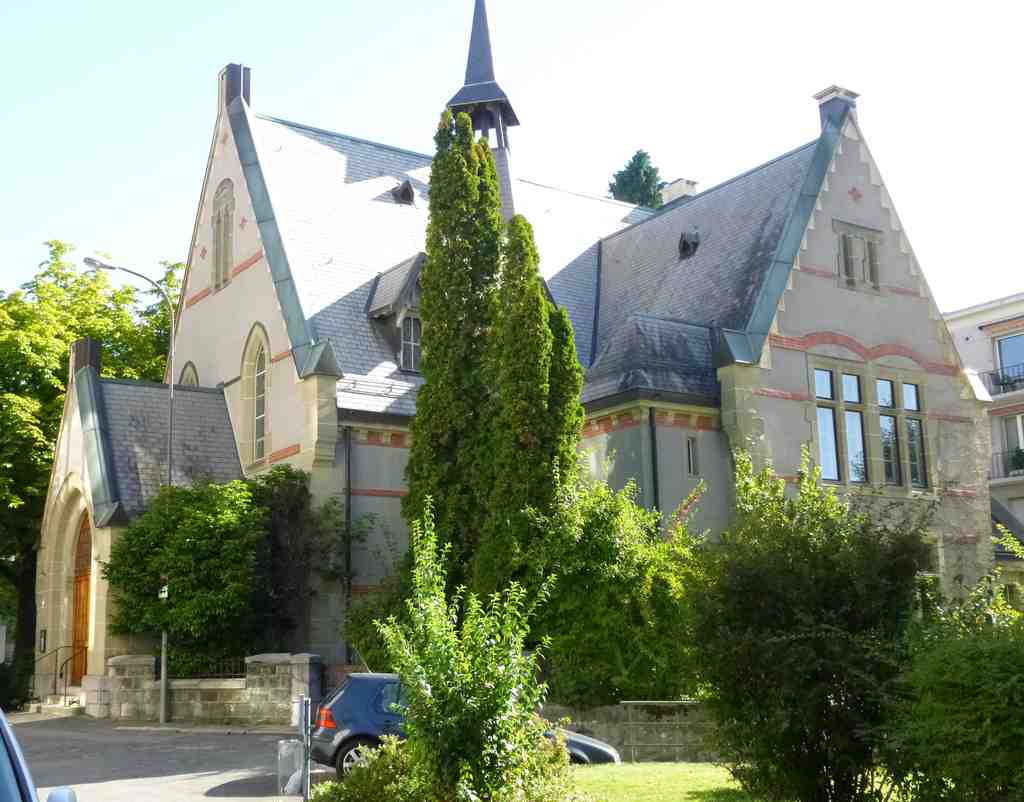
Jules Verrey, un arquitecto local, llevó a cabo la construcción. Dedicaron la iglesia en abril de mil ochocientos setenta y siete, incluso antes de que todo estuviera terminado, y añadieron la sacristía dos años después. A diferencia de la catedral que vimos antes, estratificada a lo largo de los siglos, este edificio llegó rápidamente y con un propósito: una identidad protestante escocesa, cuidadosamente traducida a la piedra de Lausana. Su forma asimétrica y su techo de madera se inspiraron en las iglesias rurales inglesas y escocesas y, en el interior, Viollet-le-Duc también diseñó el mobiliario original, incluido el púlpito central elevado al que se accede por dos escaleras que convergen como una pequeña pieza de escenografía teológica. La kirk más tarde tomó el nombre de Saint Andrew’s. Sobrevivió a restauraciones, obtuvo protección patrimonial y siguió adaptándose. Hoy pertenece al Presbiterio Internacional de la Iglesia de Escocia, celebra servicios en inglés y reúne a personas de veintitrés nacionalidades. El salón alberga almuerzos compartidos, clases de conversación, bailes tradicionales escoceses y, tras la invasión rusa de Ucrania en dos mil veintidós, la iglesia ayudó a lanzar un Centro de Ucrania local con las congregaciones vecinas. Así que esto no es solo un refugio para expatriados. Es uno de esos edificios de Lausana que sigue encontrando nuevos usos sin perder su memoria. Y eso es, verdaderamente, muy propio de Lausana. En unos minutos, verá el mismo talento para las segundas vidas con un disfraz completamente moderno, donde la reinvención se traslada del santuario al laboratorio... en Debiopharm.
Jules Verrey, a local architect, then carried out the construction. They dedicated the church in April of eighteen seventy-seven, even before everything was finished, and added the vestry two years later. Unlike the cathedral we saw earlier, layered over centuries, this building arrived quickly and on purpose: a Scottish Protestant identity, carefully translated into Lausanne stone. Its asymmetrical shape and timbered roof drew on rural English and Scottish churches, and inside, Viollet-le-Duc designed the original furnishings too, including the raised central pulpit reached by two staircases converging like a small piece of theological stagecraft.
The kirk later took the name Saint Andrew’s. It survived restorations, gained heritage protection, and kept adapting. Today it belongs to the Church of Scotland’s International Presbytery, holds services in English, and gathers people from twenty-three nationalities. The hall hosts potluck lunches, conversation classes, Scottish country dancing, and, after Russia’s invasion of Ukraine in twenty twenty-two, the church helped launch a local Ukraine Centre with neighboring congregations. So this is not just a refuge for expatriates. It is one of those Lausanne buildings that keeps finding new uses without losing its memory.
And that, is very Lausanne indeed. In a few minutes, you’ll see the same talent for second lives in a thoroughly modern costume, where reinvention moves from the sanctuary to the laboratory... at Debiopharm.




