
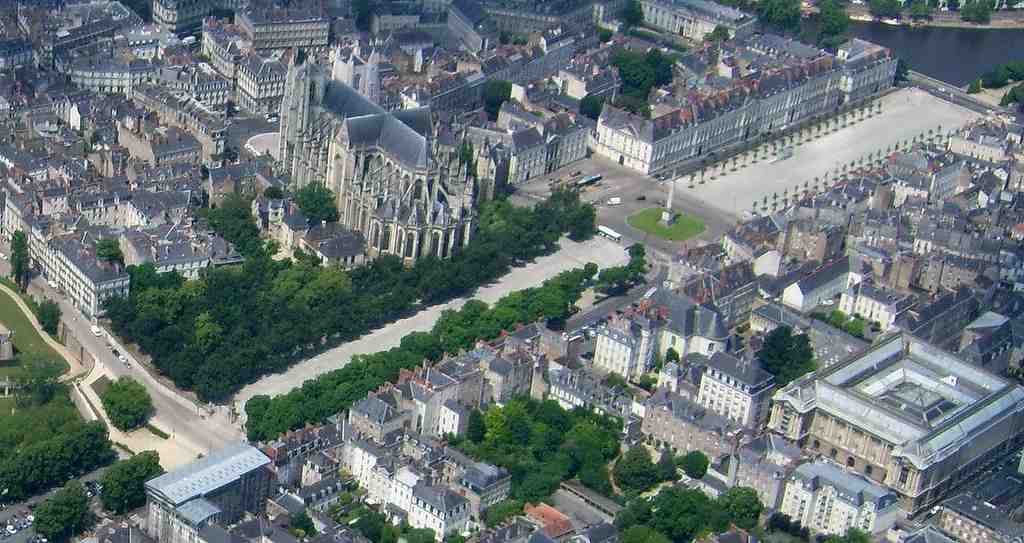
On your left, look for a long formal promenade of pale gravel and stone terraces, framed by straight rows of trees and marked by statues and broad stairways at its ends.
This is the pair of promenades called the cours Saint-Pierre and cours Saint-André. In French, a cours is a broad public walk, designed not just for getting somewhere, but for being seen, meeting others, and letting the city present itself with a little grace. These were the first spaces like that in Nantes. Before that, this ground lay outside the old walls... rough, open, and defensive, kept bare so enemies could be spotted.
That is part of what makes this place so moving. A neat promenade came to life on land shaped first by fear. In Roman times, a road crossed here toward Angers, and funerary stones stood nearby. Later, Merovingian burials filled parts of this area. In the Middle Ages, the two raised mounds here, Saint-Pierre to the south and Saint-André to the north, helped protect the eastern edge of the city, where there was no river to shield Nantes. A belouard stood between them, a fortified bulge in the wall defending the gate; that old word, belouard, is one of the roots of our word boulevard.
Then, in the late eighteenth and early nineteenth centuries, city leaders helped Nantes imagine something gentler. He pushed to level the southern mound, cover it with sand, plant hundreds of elm trees, and open it as a promenade. Later, the city architect Jean-Baptiste Ceineray straightened the whole composition, linked the two cours with the square ahead, and turned military ground into civic theater.
And theater it became. On the fourteenth of June, seventeen eighty-four, around eighty thousand people packed these walks to watch the balloon called the Suffren rise into the sky. Father Mouchet and Coustard de Massy guided it upward after local residents funded the project by public subscription. Imagine the gasp that must have rippled through the crowd as a gas balloon lifted above the roofs of Nantes. For a moment, this promenade stopped being a city path and became a stage for wonder.
If you ever want a local’s way of seeing the place, notice the monuments as carefully as the trees. Down on the Saint-Pierre side, the memorial to the dead of the war of eighteen seventy stands between Anne of Brittany and Arthur the Third. Those statues have had their own wandering lives. Dominique Molknecht carved them in the eighteen twenties, then time wore them down so badly that sculptors removed and recut them in harder stone before returning them here in nineteen hundred. They make this promenade feel like a quiet museum of memory that has been lifted, altered, and set back in place.
The mood deepens at the far north end of Saint-André, where a First World War memorial lists the names of Nantes dead. Even that solemn wall became the center of fierce argument in the nineteen twenties, when the city placed Émile Guillaume’s bronze figure La Délivrance before it, and opponents attacked the statue with axes. Here, public space never stayed simple for long.
So as you stand here, hold both truths together: a place for strolling, and a place laid over old lines of defense, burial, ceremony, and collective emotion. In a moment, we’ll step into Maréchal-Foch Square, where that formal civic staging comes fully into view. And if you return later, these promenades are always open.




