
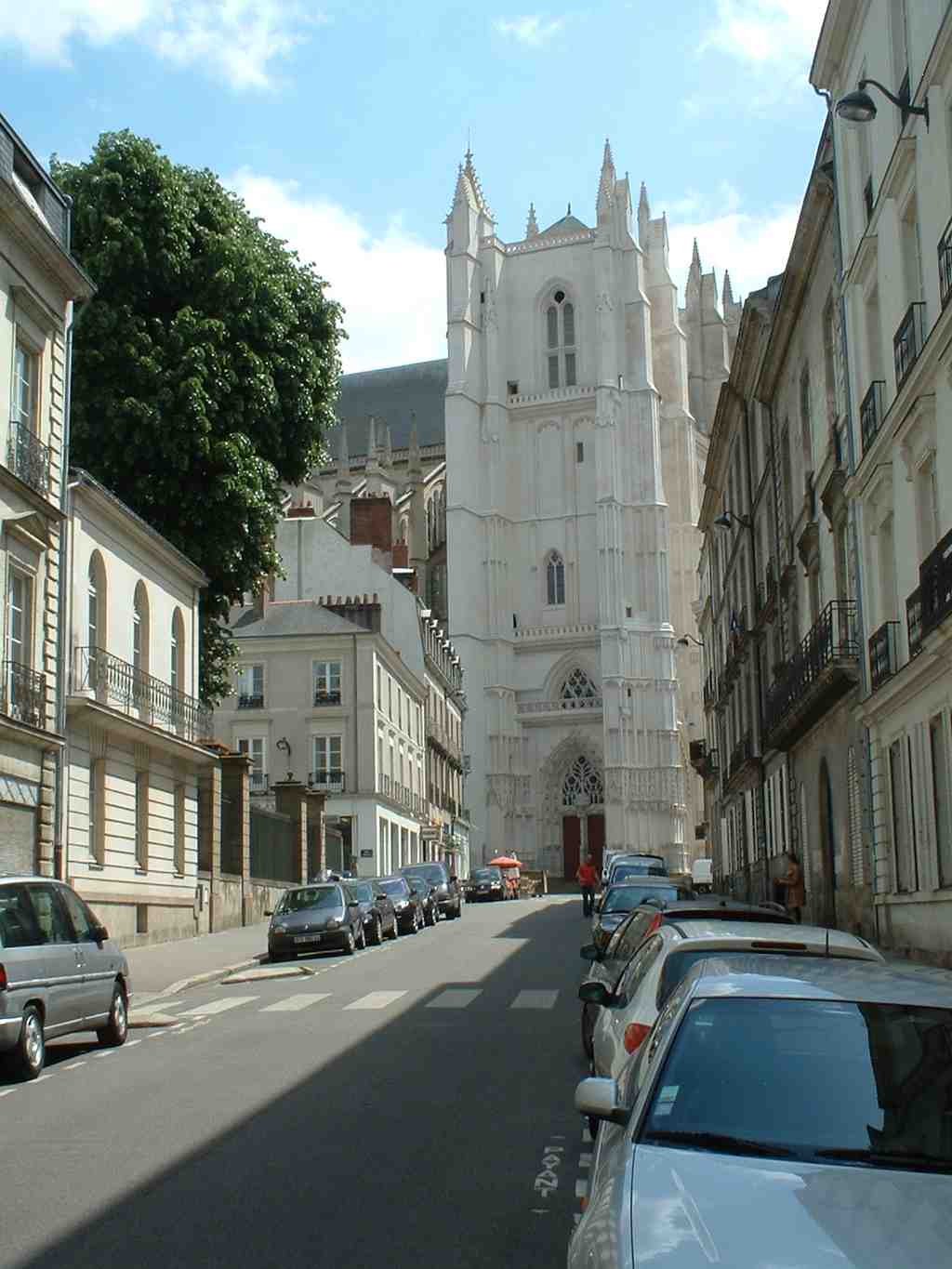
Look for a broad, straight street paved in dark asphalt, lined with pale tuffeau-and-granite townhouses in orderly rows, with the massive stone body of the cathedral marking one end.
This is Rue du Roi-Albert, and at first glance it feels almost ceremonial... a clean line drawn between the cathedral and the prefecture, church at one end, state at the other. In the late eighteenth century, the architect Jean-Baptiste Ceineray helped give Nantes this rational face. He traced this street through ground left open after the old medieval walls began to come down, and he made it unusually wide for its time, about twelve meters across, as if the city wanted to present itself with confidence.
But Nantes is what some people call a palimpsest city... a city rewritten over itself like old parchment used again and again. This street is a first lesson in that. Workers carving out this neat passage uncovered older layers: the crumbling medieval rampart leaned on part of an even older Gallo-Roman wall. So before this became a formal urban axis, it was already a place of buried boundaries, erased defenses, and stubborn remains.
Pause a moment and look along the slope of the street. Notice how much authority is created by straightness alone... by the way one important building answers another, and by the calm discipline of the façades.
Even the name teaches the same lesson. Ceineray’s street first carried the royal title Rue Royale. The Revolution stripped that away and called it Rue du Peuple-Français, the Street of the French People. Later it became Rue du Département, then turned back to Rue Royale, and in nineteen sixteen Nantes renamed it again for King Albert the First of Belgium. That choice was not decorative. The city wanted to honor the Belgian ruler admired across Europe for resisting the German invasion in the First World War. A street name, here, acts like a public monument. Power changes, grief arrives, loyalties shift... and the map itself gets rewritten.
The most painful rewriting came in the Second World War. On the twentieth of October, nineteen forty-one, at about seven-thirty in the morning, Gilbert Brustlein and two other Resistance fighters waited near number one. Brustlein shot Karl Hotz, the German military commander in Nantes, in the back. Hotz died at once. What makes the story harder is that he had already spent time in Nantes before the occupation, working as an engineer on civil projects. After his death, the German authorities took hostages. Forty-eight men were executed in Nantes, Châteaubriant, and near Paris in retaliation.
So this elegant street, with its composed stone fronts and careful proportions, carries more than good manners. It carries planning, protest, renaming, occupation, and mourning. Later, even Jacques Demy chose it for Une chambre en ville because this tidy, bourgeois setting could hold a charged confrontation so well.
Ahead, the city opens into formal walks and squares where power liked to display itself in public. We’ll follow that thread next toward the Saint-Pierre and Saint-André courses, about a four-minute walk from here.




