
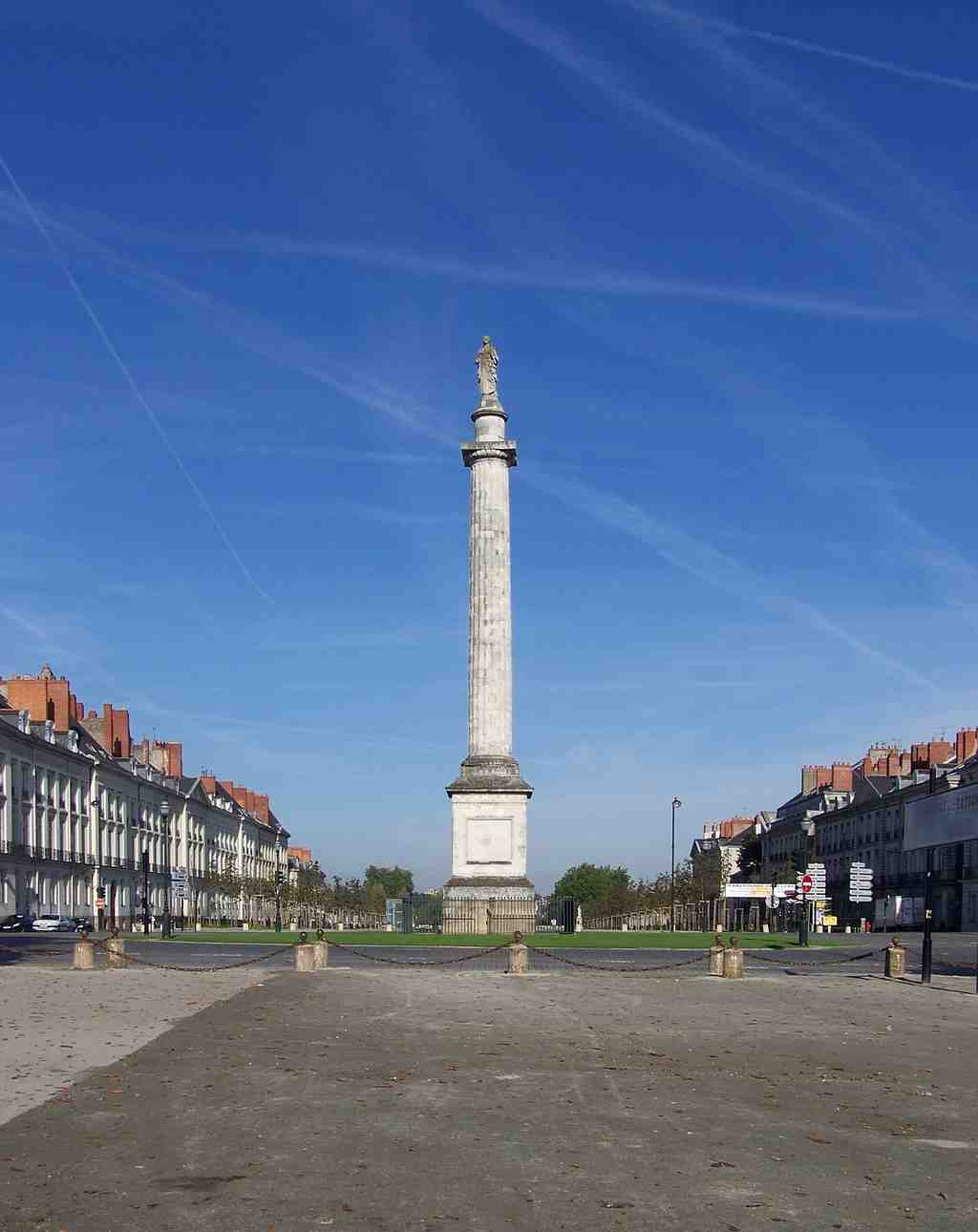
Sus nombres cuentan una historia aún más marcada. Durante años, la gente la llamó Place d’Armes (Plaza de Armas), literalmente el campo de desfiles, una plaza militar. Durante la Restauración, cuando la monarquía regresó después de Napoleón, se convirtió en la plaza de Luis XVI. Luego, en 1929, el ayuntamiento la rebautizó oficialmente en honor a Ferdinand Foch, el mariscal francés. Pero los nombres oficiales no siempre ganan al corazón. Muchos nantais, especialmente las familias mayores arraigadas aquí durante generaciones, todavía dicen "plaza de Luis XVI" sin siquiera pensarlo. Los mapas cambian más rápido que la memoria.
Esa tensión surge justo en el medio de la plaza, en la columna que tiene ante usted. Comenzó en 1790 como una Columna de la Libertad. Piense en eso por un momento: un monumento revolucionario, plantado a finales del siglo XVIII. Luego la política cambió y, en 1823, bajo el mandato del alcalde Louis-Hyacinthe Levesque, el escultor Dominique Molknecht colocó a Luis XVI en la cima. La misma piedra permaneció allí, pero su significado cambió por completo. Un historiador lo llamó una especie de palimpsesto: una página raspada y vuelta a escribir. En palabras más simples, el mensaje antiguo nunca desapareció; se impuso uno nuevo encima.
La gente siguió luchando por ese significado. Cada 21 de enero, los monárquicos se reunían aquí para conmemorar la ejecución del rey. En 1993, realistas y librepensadores acudieron uno tras otro a este mismo lugar, casi turnándose en una pequeña guerra de memoria.
Y la plaza también ha conocido sangre real además de batallas simbólicas. Durante la Revolución de Julio de 1830, diez personas de Nantes murieron aquí al pie de la columna el 30 de julio. Un médico de París, el señor Martin, sintió su pérdida lo suficiente como para enviar al alcalde una placa conmemorativa de bronce. Cometió un extraño error en la inscripción: en lugar de honrar a los trabajadores, honró a los labradores. Es un pequeño error, pero humano. Incluso el dolor, enviado desde la distancia, puede llegar ligeramente alterado.
Mire alrededor de los bordes y verá que la plaza sigue cambiando de máscara. El Hôtel d’Aux comenzó como una mansión privada para René-Louis d’Aux, luego albergó al Instituto Nacional, después dio la bienvenida a Napoleón y Josefina en 1808 y más tarde sirvió al ejército. Cerca de allí, el Hôtel de Charette cargó con una carga más oscura durante la Segunda Guerra Mundial, cuando los lugareños lo conocían como la sede de la Gestapo. Fachadas aristocráticas... recuerdos terribles.
Eso es lo que este lugar hace tan bien: suaviza la ruptura sin llegar nunca a borrarla del todo.
Cuando esté listo, camine hacia la Catedral de Nantes, justo delante. Allí, la grandeza de la piedra y la violencia humana se encuentran aún más abiertamente que aquí.
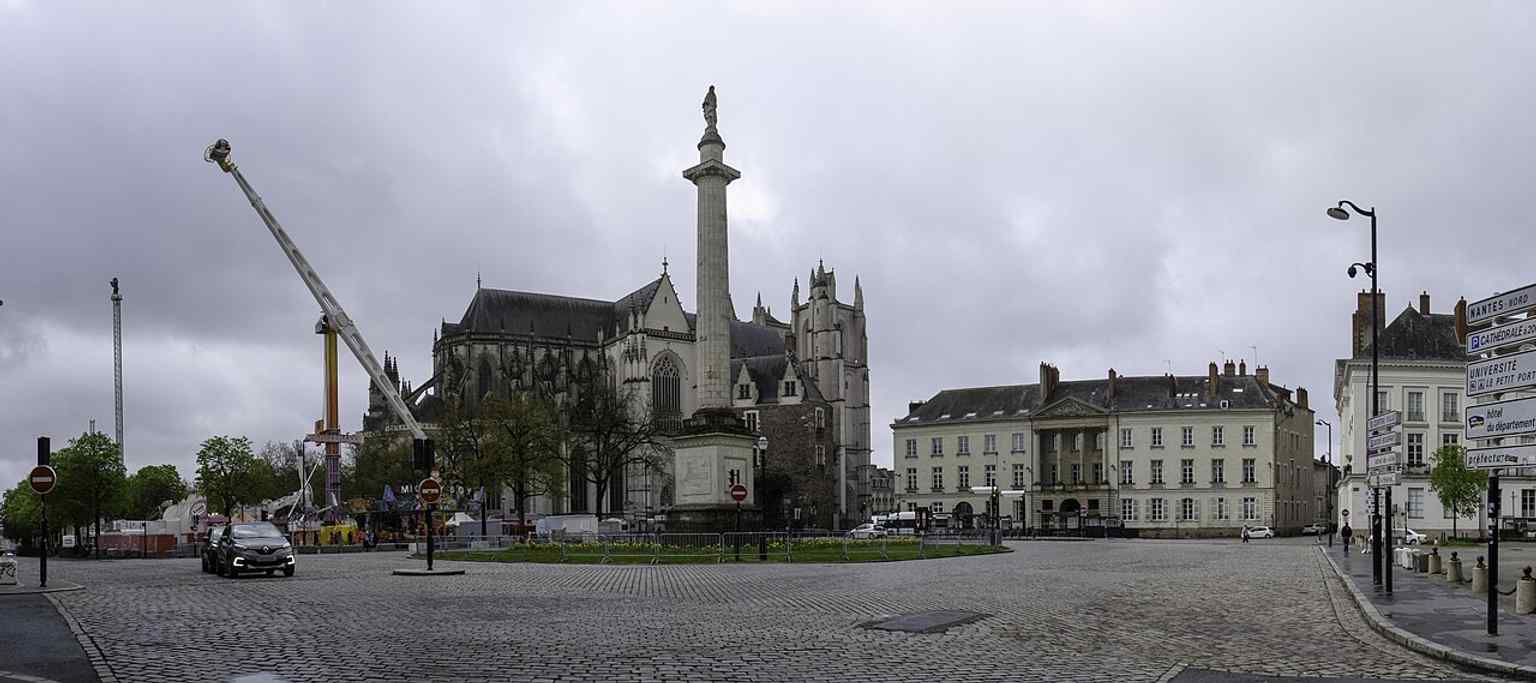
Its names tell an even sharper story. For years, people called it Place d’Armes - literally the parade ground, a military square. Under the Restoration, when the monarchy returned after Napoleon, it became Place Louis the Sixteenth. Then, in nineteen twenty-nine, the city council officially renamed it for Ferdinand Foch, the French marshal. But official names do not always win the heart. Many Nantais, especially older families rooted here for generations, still say Place Louis the Sixteenth without even thinking. Maps change faster than memory.
That tension rises right in the middle of the square, at the column before you. It began in seventeen ninety as a Column of Liberty. Think about that for a moment: a revolutionary monument, planted at the end of the eighteenth century. Then politics turned, and in eighteen twenty-three, under Mayor Louis-Hyacinthe Levesque, the sculptor Dominique Molknecht placed Louis the Sixteenth on top. The same stone stayed put, but its meaning changed completely. One historian called it a kind of palimpsest - a page scraped and written over again. In simpler words, the old message never vanished; a new one was forced on top of it.
People kept fighting over that meaning. Every twenty-first of January, monarchists gathered here to mark the king’s execution. In nineteen ninety-three, royalists and free-thinkers came one after the other to this same spot, almost taking turns in a small war of remembrance.
And the square has known real blood as well as symbolic battles. During the July Revolution of eighteen thirty, ten people from Nantes died here at the foot of the column on the thirtieth of July. A doctor in Paris, Monsieur Martin, felt their loss strongly enough to send the mayor a bronze memorial plaque. He made one strange error in the inscription: instead of honoring workers, it honored ploughmen. It is a tiny mistake, but a human one. Even grief, sent from a distance, can arrive slightly altered.
Look around the edges and the square keeps changing masks. The Hôtel d’Aux began as a private mansion for René-Louis d’Aux, then sheltered the National Institute, then welcomed Napoleon and Josephine in eighteen oh eight, and later served the army. Nearby, the Hôtel de Charette carried a darker burden during the Second World War, when locals knew it as the Gestapo headquarters. Aristocratic facades... terrible memories.
That is what this place does so well: it smooths over rupture without ever quite erasing it.
When you are ready, walk toward Nantes Cathedral, just ahead. There, stone grandeur and human violence meet even more openly than they do here.





