AudaTours logoAudaTours

Baltimore Audio-Tour: Ein Wandteppich aus Gedenkstätten, Märkten und Mythen

Audioguide15 Stopps

Eine Mitternachtsglocke läutete einst über der Skyline von Baltimore und markierte nicht nur die Zeit, sondern auch unerzählte Geheimnisse, die die Stadt darunter prägten. Erkunden Sie Downtown auf dieser selbstgeführten Audio-Tour und enthüllen Sie Schichten von Rebellion, Zuflucht und Skandal, die sich hinter berühmten Fassaden verbergen. Entdecken Sie fesselnde Geschichten, die die meisten Besucher übersehen, während Sie von heiligen Schreinen zu legendären Türmen wandern. Warum diente ein Symbol der Heilung auch als Kulisse für eine stadtweite Panik? Welche verborgene Botschaft ist in den verzierten Kuppeln der ersten Kathedrale Amerikas verborgen? Welcher kühne Künstler löste in der CFG Bank Arena einen öffentlichen Aufschrei aus, der alles veränderte? Schreiten Sie durch hallende Gänge und schattige Straßen. Jeder Schritt taucht tiefer ein in Baltimores elektrisierendste Geschichten – dramatische Auseinandersetzungen, mysteriöse Rituale und vergessene Momente, die in sein urbanes Herz eingewoben sind. Die Uhr tickt. Treten Sie unter die Skyline und drücken Sie auf Play – die Geheimnisse von Baltimore warten darauf, enthüllt zu werden.

Tourvorschau

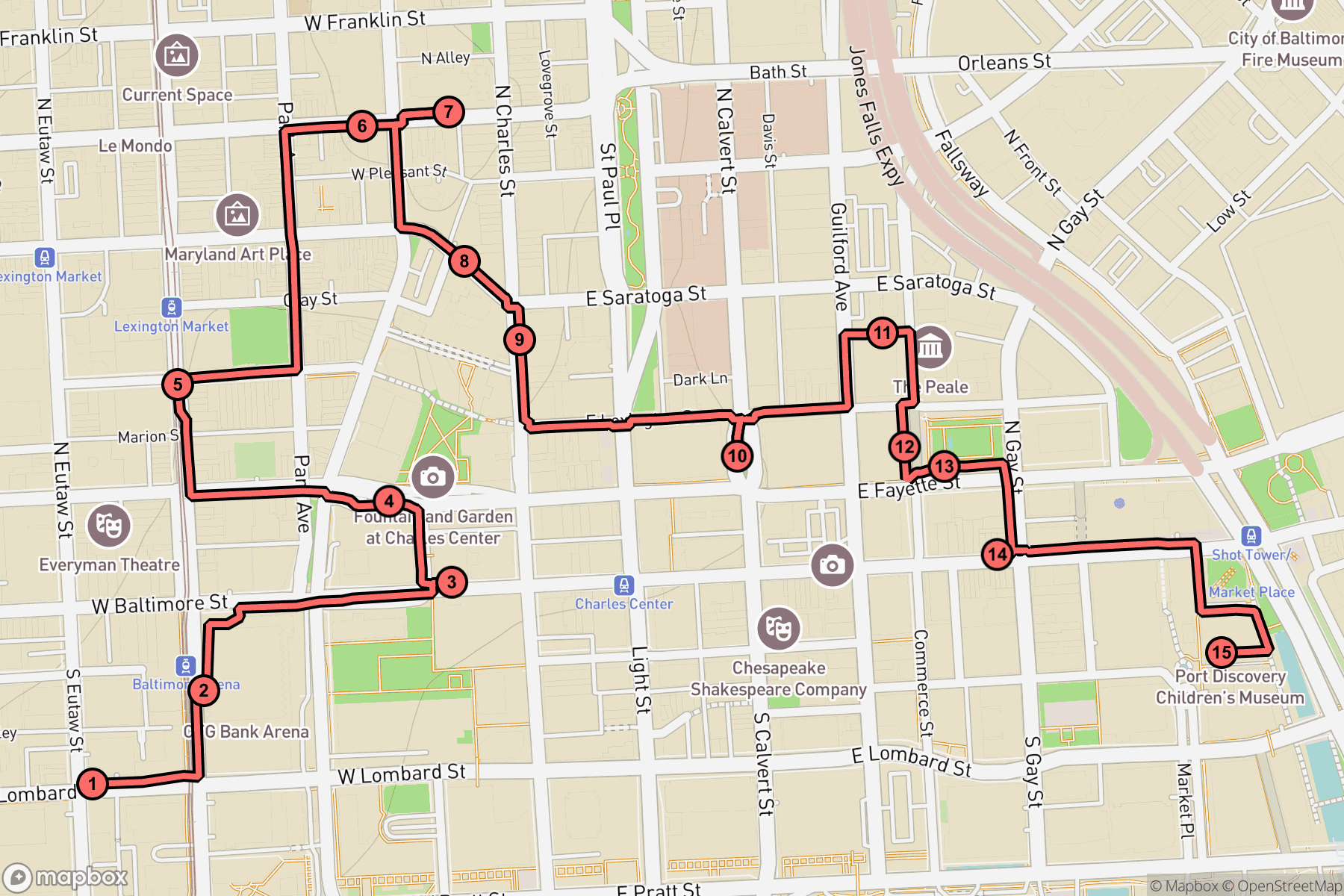
map

Über diese Tour

  • schedule
    Dauer 40–60 minsEigenes Tempo
  • straighten
    3.7 km FußwegDem geführten Pfad folgen
  • location_on
  • wifi_off
    Funktioniert offlineEinmal herunterladen, überall nutzen
  • all_inclusive
    Lebenslanger ZugriffJederzeit wiederholen, für immer
  • location_on
    Startet bei Emerson Bromo-Seltzer Turm

Stopps auf dieser Tour

  1. Alright, have a look up - Baltimore’s answer to Florence, at least if you squint. This is the Emerson Bromo-Seltzer Tower, or just the Bromo Tower if you’re in a hurry. Built…Mehr lesenWeniger anzeigen

    Alright, have a look up - Baltimore’s answer to Florence, at least if you squint. This is the Emerson Bromo-Seltzer Tower, or just the Bromo Tower if you’re in a hurry. Built between 1907 and 1911, it used to be the absolute giant in the Baltimore skyline, casting a long, literal shadow over the city for over a decade before being outdone by, of all things, a bank. This clock tower is no ordinary showpiece. It was dreamed up by Isaac Emerson. Now, Isaac wasn’t an architect or an artist - he was a pharmacist. He made his fortune with something called Bromo-Seltzer, a sparkling cure for headaches that became so popular he could put his name in 24-foot neon letters. He’d taken a trip to Italy and, like anyone returning from vacation, decided Baltimore could use a little Renaissance flair. So he had local architect Joseph Evans Sperry design him a tower in the style of Florence’s Palazzo Vecchio. The result? This 15-story, 289-foot marvel. Now, if the clocks catch your eye, you’re not alone. There are four of them up there - one facing each cardinal direction - put up by the Seth Thomas Clock Company for a cool four grand back then, which today would buy you… let’s call it a very fancy smartwatch, with some change left for a headache remedy. What’s quirky is, the Roman numerals aren’t the boldest thing you’ll see. Instead, “B-R-O-M-O S-E-L-T-Z-E-R” runs around each face. Subtle as a sledgehammer. Originally, the whole thing was topped with a 51-foot rotating blue Bromo-Seltzer bottle - that’s right, a spinning advertisement so big folks could see it 20 miles away on a clear night. It was lit up with over 300 bulbs. Sadly, in 1936, engineers decided the giant glowing bottle was about as smart for the tower as a headache is for a good night’s sleep, so off it came. Fast-forward to today, the tower has found new life hosting artists’ studios, and there’s even a small museum with jars, bottles, and all the blue glass souvenirs you could ever want to see. So yeah - once a monument to headache relief, now a creative spark plug for Baltimore. When you’re ready to keep moving, CFG Bank Arena is a quick 3-minute stroll east.

    Eigene Seite öffnen →
  2. Alright, you’re looking at the CFG Bank Arena, though Baltimore locals have called this place by about as many names as a witness in a mob trial. Since it opened in 1962, it’s…Mehr lesenWeniger anzeigen

    Alright, you’re looking at the CFG Bank Arena, though Baltimore locals have called this place by about as many names as a witness in a mob trial. Since it opened in 1962, it’s changed monikers more times than the Orioles have changed managers-starting out as the Baltimore Civic Center, becoming the Baltimore Arena, then 1st Mariner Arena, Royal Farms Arena, and finally-after a $250 million overhaul in 2023-CFG Bank Arena. Even here, the only constant is change. Picture this spot in 1776, long before the roar of crowds and smells of hot dogs-back then, this was the site of Old Congress Hall, where some very serious wigs debated the foundations of the United States. That’s right, the Continental Congress met right here, setting the stage for a kind of “arena” with slightly less pyrotechnics and a bit more parchment. Fast forward to the early ‘60s: the designers, AG Odell Jr. and Associates, roll out a modern, multipurpose arena for city folk hungry for world-class sports and entertainment. On opening day in October 1962, they even buried a time capsule in the foundation, sealed with messages from President John F. Kennedy and Maryland’s governor. That capsule sat quietly for forty-five years before finally seeing daylight in 2006-talk about a slow news cycle. The arena quickly became the city’s front-row seat to big-league action. The NBA’s Baltimore Bullets-now the Washington Wizards-called this place home from the early '60s to the early '70s, giving the city a ticket to basketball history. It also hosted the Baltimore Clippers and a parade of hockey teams, proving Baltimore’s love for fast, icy mayhem, even if the teams themselves sometimes disappeared faster than a half-smoke at a tailgate. If your idea of a classic arena is a heavy dose of ear-splitting music, this place doesn’t disappoint. The Beatles played two sold-out shows here in 1964 for a total of 28,000 fans-the city shaking almost as hard as Paul McCartney’s left leg. Elvis Presley belted out hits here too, his big final bow in May 1977 just months before his famous exit. The Jimi Hendrix Experience slipped in a now-legendary concert in June 1970; many say it was one of his finest, and it was one of his last. Led Zeppelin, Chicago, The Grateful Dead, even Luciano Pavarotti-name a giant, odds are they stood under these lights. Of course, the arena weathered rough patches. In the late 2000s, Baltimore considered trading it in for a shiny new model. The cost? In the ballpark of $60 million back then-nearly $95 million today, adjusting for inflation. But you know how local government works: by committee, with lots of meetings and spirited “discussions.” At one point, there were so many ideas for what to build here, you’d think Baltimore was going into the hotel, movie theater, AND concert business all at once. In the end, leaders stuck with the old but true, wisely opting in 2023 to fully renovate the existing building instead of starting from scratch. So today, CFG Bank Arena is a state-of-the-art venue, somehow managing to honor the ghosts of the past while serving up everything from basketball showdowns to bull riding, marching bands to megastar concerts. And, true to Baltimore fashion, it’s right at the heart of the action, easy to reach by light rail, subway, or the time-honored tradition of circling the block four times for parking. Alright, take a minute to soak in this piece of Baltimore’s living history, then when you're ready, head north for about five minutes to reach the B&O Railroad Headquarters Building.

    Eigene Seite öffnen →
  3. All right, look to your left - that grand stone building isn’t just flexing its muscles for today’s business crowd. That’s the B&O Railroad Headquarters Building, a real…Mehr lesenWeniger anzeigen

    All right, look to your left - that grand stone building isn’t just flexing its muscles for today’s business crowd. That’s the B&O Railroad Headquarters Building, a real heavyweight in Baltimore’s skyline since 1906. Imagine standing here just after the Great Baltimore Fire of 1904, when whole blocks downtown were still smoldering. The Baltimore & Ohio Railroad - America’s oldest and, at the time, the most powerful railroad - needed a comeback. But they didn’t just go for a basic office. No, sir. They hired Parker & Thomas, the same folks who did the fancy Belvedere Hotel uptown. Their orders to the architects? Go bigger, go better, and let everyone know Baltimore is open for business. Now, take a second and check out the entrance. Up there, Mercury - the Roman god of commerce - looks like he’s watching your every move. And right beside him is Progress of Industry, clutching a locomotive in one hand and a torch in the other, as if to say, “We’ll light the way. We’ll get you there... probably on time.” This place was no run-of-the-mill office block. When it opened, it had 13 stories - that’s 220 feet straight up - making it the second tallest building in Baltimore. It used 1,600 windows, seven types of marble (shipped in from four different continents), and the bottom three floors are clad in legit New Hampshire granite. Basically, if you were one of the 1,000 people working here in its heyday, you’d feel like you were clocking in at a palace rather than a workplace. Oh, and they could feed 500 people in the company dining room at once. Back then, given the cost of building it - millions in 1906 dollars, which translates to something like $70 million or more in today’s cash - they really spared no expense. Marbled lobbies, two grand white staircases, those stained-glass windows by Tiffany... it was a glittering symbol of Baltimore’s ambition. Of course, the city didn’t forget what happened to the first B&O HQ down the road - the fire took care of that one - so they made sure this building was steel-framed. Literally fireproof. Even today, you can sense that old charm if you peek inside. There’s enough marble to make a Roman emperor blush, and if you squint, maybe you’ll spot some railroad brass from back in the day, plotting routes and fortunes. Through the decades, a lot changed. Oscar G. Murray, the president who oversaw the building’s opening, thought about the people who worked underneath all that marble and glass, too. When he died, his will set up a fund for widows and orphans of railroad workers - a little slice of humanity mixed into all that industrial might. That fund still supports families over a century later, now managed by a local charity. In more recent times, the old HQ got a serious facelift - millions more spent to turn it into a boutique hotel. Now it’s a swanky Kimpton property, the Hotel Monaco, with a sleek restaurant where you can have a locally brewed beer and imagine railroad moguls making deals over cigars. Three stories of office space remain, plus BB&T Bank on the ground floor. The renovations were so good, they picked up a few awards - and, honestly, Baltimore’s not short on opinionated judges when it comes to what counts as “good” architecture. So, next time someone tells you “they don’t make ’em like they used to,” just point to this building. It’s still here, standing proud, splashed with sunlight and city stories, right in the thick of downtown. When you’re ready, Vivo Living Baltimore is just a 3-minute walk west. Let’s keep moving.

    Eigene Seite öffnen →
12 weitere Stationen anzeigenWeniger Stationen anzeigenexpand_moreexpand_less
  1. Alright, look to your left and feast your eyes on the gleaming twin towers of Vivo Living Baltimore. At first glance, you might think-hey, just another modern apartment block,…Mehr lesenWeniger anzeigen

    Alright, look to your left and feast your eyes on the gleaming twin towers of Vivo Living Baltimore. At first glance, you might think-hey, just another modern apartment block, right? But these towers have crammed in more identity changes than a chameleon let loose in a paint store. Picture Baltimore in the mid-1960s. The city planners, in a fit of “let’s-make-this-city-shine” enthusiasm, sign on with Hilton to build one of the crown jewels of the new Charles Center. It was a twelve-million-dollar project back then, which would be over a hundred million today. Not exactly pocket change. The architect was William B. Tabler, a guy who pretty much put his signature on the international hotel look. When the Statler Hilton opened in 1967, guests would have marched into a sleek glass-and-concrete icon, a beacon of new Baltimore. The hotel has sprouted and shrunk so many times, I’m half-surprised it doesn’t now have its own soap opera. First, just one tower-23 stories tall, with 352 rooms, all shiny and hopeful. Then, in 1974, it gained a new sidekick: another tower, even taller at 27 stories. But the glamour wasn’t enough to keep the financial vultures away. The property bounced from developer to developer, with owners from Baltimore, the Middle East, Texas-you name it. In 1979, poor Bill Siskind sold the place when it was losing cash faster than a leaky bucket, for about $36 million-more than $150 million in today’s dollars. Think of it as a very expensive game of musical chairs. And through it all? Life went on. In 1980, one of its ballrooms hosted a presidential debate between Ronald Reagan and John Anderson. Can’t say Baltimore didn’t make history in style. And if you’re a wrestling fan, this was the site of the very first WWF Hall of Fame induction in 1994. The original builder probably didn’t see that coming. Through the decades, these towers have worn pretty much every major brand name you can imagine-Hilton, Omni, Wyndham, Sheraton, Crowne Plaza, Holiday Inn-changing signs more often than most people change their bedsheets. One moment it’s a Sheraton and the next it’s a Radisson. By the time the pandemic hit, one tower was calling itself a Holiday Inn, and the next minute-bang-doors closed. Then, like a subplot twist, an L.A. company called Vivo Living bought the whole package in 2022, did a top-to-bottom renovation, and-presto-what was once Baltimore’s ritzy hotel is now a fresh, modern apartment complex. Studios, one-bedrooms, retail space-urban living, Baltimore style, in towers built for out-of-towners but reclaimed by city life. It’s a story of reinvention, really-this once-grand hotel has changed identities as often as some people change their phone numbers. And looking at it now, alive with new energy, you get the sense these buildings might just be entering their *best* era yet. Alright, onward-when you’re ready, Read’s Drug Store is just a five-minute walk northwest.

    Eigene Seite öffnen →
  2. Alright, take a look to your left-what you see may not look like much right now, but you’re staring at a site that shook up history in Baltimore, and frankly, the whole country.…Mehr lesenWeniger anzeigen

    Alright, take a look to your left-what you see may not look like much right now, but you’re staring at a site that shook up history in Baltimore, and frankly, the whole country. This was Read’s Drug Store, a place that went from selling aspirin and root beer floats to making a bold statement on civil rights. Or as locals used to say back in 1929, if you needed something quick, you’d “run right to Read’s.” Catchy slogan, isn’t it? Let’s rewind to a chilly January afternoon in 1955. Picture seven college students, mostly from Morgan State University, their nerves probably as jittery as their coffee, strolling into this very building. There wasn’t a huge crowd or a pile of TV cameras-just seven people and a quiet plan to do something brave: sit down at the lunch counter… and wait to be served. Back in those days, most places around here, including Read’s, would happily sell you toothpaste but wouldn’t let Black customers eat at the counter. That afternoon, these students basically said, “enough.” For thirty minutes, they sat and waited… and waited. They were polite, peaceful-no shouting, no drama. Still, the tension in the air must have been thick as molasses. Now, here’s where it gets interesting. Two days after the protest, Read’s management announced that not only would they serve EVERYONE at the counter-they’d do it at all their stores, immediately. No months of legal battles, no grudging compliance. It’s like ordering a coffee and getting your entire lunch for free: sudden, satisfying, almost too good to be true. The Read’s sit-in was one of the first of its kind in the nation-five years BEFORE Greensboro-the one that usually gets the headlines. I guess Baltimore always had a knack for being a little ahead of its time, even if history sometimes forgets to say thank you. Nowadays, there’s a bit of a feud about what should become of this old place. Some folks want to preserve the building, maybe turn it into a civil rights museum. Others say, “tear it down, build something new.” The longer they argue, the more this building feels like a stubborn old uncle at Thanksgiving-still hanging on, waiting for folks to do the right thing. Alright, ready for the next stop? When you are, Roman Catholic Archdiocese of Baltimore is a simple walk east-should take you about seven minutes.

    Eigene Seite öffnen →
  3. You’re standing next to a place that’s often called “the mother church” of American Catholicism-but don’t worry, it won’t make you call home. The building to your right is the…Mehr lesenWeniger anzeigen

    You’re standing next to a place that’s often called “the mother church” of American Catholicism-but don’t worry, it won’t make you call home. The building to your right is the center of the Roman Catholic Archdiocese of Baltimore, a spot with more history packed in than a Thanksgiving dinner table. Just imagine it’s 1789. Baltimore was still a young, scrappy city. The United States was fresh off its grand experiment in independence, and-believe it or not-there was only one Catholic diocese for the entire country. Right here. The Vatican gave Baltimore its spiritual keys to the kingdom, and the first American bishop, John Carroll, started his mission from this city. Basically, if you were a Catholic in the early U.S., Baltimore was your headquarters-think of it as “Corporate HQ for American Saints and Sinners.” All jokes aside, it’s a legacy that stretches back even further. Maryland started out in the 1600s as a home for people escaping religious persecution across the ocean-a sort of “build-your-own-freedom” kit. Of course, things didn’t stay peaceful forever; Puritans eventually took over and outlawed Catholicism for a good long while. Religious freedom in early Maryland was a bit like spotty Wi-Fi-sometimes on, sometimes not. Fast forward to the 1800s, and this archdiocese grew right alongside the city. Baltimore became famous for holding the first big Catholic council meetings in the U.S.-these were gatherings where bishops from all over America debated things like, “Should priests have to show a note from their last boss before they work here?” (Yes, they decided, it’s only polite.) During the Civil War era, the church here tried supporting both the city’s poor and the newly freed population, setting up schools, shelters, and hospitals. And it wasn’t always just talk: Archbishop Martin Spalding, for example, raised $10,000 for Southern relief after the war. That’s about $190,000 in today’s dollars-enough to buy some serious crab cakes. But history here isn’t without its tough chapters. The Archdiocese has had to face its share of scandals-including, more recently, revelations about sexual abuse and cover-ups that cast a heavy shadow over this institution’s story. The struggle continues today as victims seek justice and the church tries to find a way forward. Not exactly the kind of legacy you want in the tour brochure, but it’s part of the reality here. At its best, though, the Archdiocese of Baltimore has been a real engine for charitable work, education, and even American sainthood. Ever heard of Elizabeth Ann Seton? She was America’s first homegrown saint and she started the first Catholic free school for girls, just outside the city. Or Mother Mary Lange, who founded the first order of African American nuns and opened schools for Black children in the early 1800s, way before public schools dared to try. Even today, the Archdiocese runs dozens of schools and two main seminaries, training priests for a region that-let’s be honest-is not getting less complicated. Baltimore has changed dramatically, but the church here has stayed rooted, for better and for worse. Alright, if you’re ready for a true architectural and spiritual piece of Baltimore’s history, just keep walking east for one minute and you’ll find yourself at the Basilica of the National Shrine of the Assumption of the Blessed Virgin Mary.

    Eigene Seite öffnen →
  4. Okay, pause right here on your right… and just take in the sight of the Baltimore Basilica. Not bad for a church, right? This is the Basilica of the National Shrine of the…Mehr lesenWeniger anzeigen

    Okay, pause right here on your right… and just take in the sight of the Baltimore Basilica. Not bad for a church, right? This is the Basilica of the National Shrine of the Assumption of the Blessed Virgin Mary-if you want to sound fancy-or, as locals say, just the Baltimore Basilica. Now, imagine it’s the early 1800s. This spot wasn’t just another patch of Baltimore real estate… it was the launchpad for a bold experiment: the very first Catholic cathedral built in the United States, all under the new Constitution. Up until this point, American Catholics were worshipping in modest chapels or borrowed spaces. Here, they went big. And leading the charge? John Carroll, the first American bishop, and Benjamin Henry Latrobe, a man who’d later help shape the U.S. Capitol. You could almost say Latrobe’s blueprint was “fit for a republic”-classical, bright, open. No Gothic gloom here. Instead, you get sunshine filtering through a dome with 24 skylights-a pretty radical move back then-thanks in part to Latrobe’s pen pal, Thomas Jefferson. That’s quite the architect-to-president collaboration. On the outside, you’ll see that strong, Greek-inspired portico with Ionic columns, and if you glance up, those twin towers capped with onion domes that look like they belong at a fancy tea party. Local gneiss stone gives it that silvery look-tough as the city itself. But the real drama? It happened inside. This place hosted some of American Catholicism’s most important chapters. Nearly every 19th-century bishop in the country was, at one point, either ordained or convened here. Picture it: crowded councils, fiery debates, and, occasionally, bishops from across the country in one room, hashing out how to run a faith stretching from coasts to new frontiers. One of those meetings even led to the famous Baltimore Catechism-the “how-to” book for American Catholic kids for generations. Oh, and the guest list? Not bad. Papal visits, Mother Teresa, and even the grandson of Paul Revere, who had what you might call a “life-changing experience” here during the Civil War. General Joseph Warren Revere was baptized right under the dome in 1862-while armies were camped just across the state. It’s also a resting place for so much Catholic history: nine archbishops are buried in the crypt below, including John Carroll. That crypt, by the way, was finally opened to the public in 2006 after the Basilica’s thorough, $34 million restoration. To put that in today’s dollars, that’s a jaw-dropping sum-think $47 to $50 million, if you’re counting-raised all through private donations. If only fundraising bake sales did that well in my day. And if you’re hearing a faint organ note in passing, it’s not a hymn from yesteryear-this Basilica’s antique organ was just restored again, in time for a big national recital in 2024. Even after an earthquake rattled the walls in 2011-cracking nearly a thousand feet of ceiling-it stands ready for the next chapter. Alright, ready for some more Baltimore stories? For the next stop, St. Paul’s Church Rectory is just a quick 3-minute stroll south.

    Eigene Seite öffnen →
  5. Alright-standing here on Cathedral Hill, look over to your left and take in the stately brick building with its classic lines and weathered character. That’s St. Paul’s Church…Mehr lesenWeniger anzeigen

    Alright-standing here on Cathedral Hill, look over to your left and take in the stately brick building with its classic lines and weathered character. That’s St. Paul’s Church Rectory, an address with more plot twists than a daytime soap, and a front-row seat to some of Baltimore’s most formative centuries. Picture the scene back in the late 1700s: Baltimore was still more cow paths than skyscrapers, the Revolution’s dust hadn’t quite settled, and General John Eager Howard-the guy whose name pops up just about everywhere in this city-decided to do a bit of real estate good. He handed over this patch of land, part of his sprawling “Belvidere” estate, to the church, just because he could. At the time, neighbors were few and far between; it was basically the church, the hill, and a handful of hopeful city dwellers. Work on this three-story Georgian brick house started in the age of powdered wigs and ended in the era of high-waisted breeches. The big plan: it would be home to the parish rector, Dr. William West-an old friend of George Washington, no less. In classic Baltimore fashion, the funding came from a lottery. Three thousand tickets, two dollars each. That’s about $6 a pop in today’s money-a little pricier than a local snowball, but not bad for a shot at building history. Now, here’s the kicker: Dr. West never actually lived in it. He died right before it was finished. So, the house passed to his successor, and for the next two centuries, just about every rector of St. Paul’s called this “Parsonage on the Hill” home. Imagine generations of Baltimore clergy shuffling through those doors, their lives stitched into the city’s fabric-weddings, funerals, council meetings, the occasional heated theological debate... and probably more than a few dinner parties heavy on sherry. The rectory itself is classic late 18th-century show-off-think dentiled pediment, bull’s-eye window up top, and a stone retaining wall that lets the building lord over Cathedral Street. And if it looks a touch longer on one end, that’s thanks to a two-story extension tacked on in the 1830s, when Baltimore decided it needed a little extra living space. But this is more than just an old house. This address has seen nearly every phase of Baltimore, weathering centuries where the city changed all around it. There’s been politicians and newspaper dynasties across the street, including the legendary hotel that hosted H.L. Mencken’s first legal beer post-Prohibition-a triumph for democracy and lager alike. Fast forward to the 1990s, and the place was feeling a little lonely. The last rector’s family moved out, and the rectory spent almost thirty years leased out to other organizations. But in 2019, after a nine-month facelift-think less ‘Botox’ and more ‘resurrection’-it rejoined church life. The “Urban Retreat House” is now the spot for St. Paul’s parishioners to gather, with parish offices above. Not bad for a building that literally predates the White House. All this stands on land carved out of an old estate, in a city still figuring itself out. The rectory got its official historic stamp of approval in 1973, making sure it’ll outlast more boom-and-bust cycles than most of us have had hot breakfasts. It’s one of Baltimore’s oldest surviving homes, and it hangs on because folks here are stubbornly sentimental about the stories in their walls-even if the rest of the neighborhood’s changed again and again. Ready for St. Paul’s Episcopal Church

    Eigene Seite öffnen →
  6. Take a left glance and let your eyes land on Old St. Paul’s Episcopal Church. If you’ve ever wondered what 330 years of spiritual determination look like, well... you’re staring…Mehr lesenWeniger anzeigen

    Take a left glance and let your eyes land on Old St. Paul’s Episcopal Church. If you’ve ever wondered what 330 years of spiritual determination look like, well... you’re staring at it. Old St. Paul’s planted its roots way back in 1692-the same year Salem was sorting out some, shall we say, "troublesome" local politics. The parish started out miles from this spot, near what’s now the industrial tangle of Highlandtown, but as Baltimore took shape, so did its center of worship, shifting and expanding right alongside the city. Baltimore in the early 1700s wasn’t the city you know today. Imagine wilderness, water, and a very lightly populated colonial outpost-if you tripped, you’d probably end up in the harbor. The first church here was a modest brick affair, set atop what was then a commanding bluff... and what’s now, thanks to some serious city development, a less dramatic slope looking out over Charles Street. Now, Old St. Paul’s wasn’t satisfied playing second fiddle as the town grew up. The parish outlasted every city boundary shuffle, fire, and, at one point, a complete move of its original graveyard to make way for what would later become one of the downtown boulevards. It’s the grandparent all Baltimore’s Episcopal churches trace back to-a real, living family tree. And yes, that means every wedding, funeral, and Sunday sermon has sent out ripples through the city's religious scene for centuries. The building in front of you is the *fourth* church for this congregation. The last one, a showcase of Greek columns and high ambition, tragically burned down in 1854. The current design comes from Richard Upjohn, the architectural hotshot behind New York’s Trinity Church. He went for a style that’s not exactly easy to pin down-think Italian basilica meets English tradition, with a few Baltimore flourishes for good measure. Take a look at the exterior, and you’ll spot two bas-reliefs of Christ and Moses, sculpted by Antonio Capellano. He’s the same guy who did the dramatic figure atop the Battle Monument you’re heading to next. Inside, the church has undergone waves of change, like a fashion-forward aunt who loves a renovation. The Victorian era brought somber colors-brown, yellow ochre, and a dramatic black walnut altar dominating the chancel. By the turn of the 20th century, tastes had shifted. Out went the gloom, in came Tiffany Studios stained glass, whitewashed walls, and, as Baltimoreans say, a *brighter outlook*-the result of American optimism or maybe too much sun after a dark winter. Some features remain from earlier iterations, though: walls from the 1817 building, a marble baptismal font from Maximilian Godefroy (architect of the grand Battle Monument), and an ever-evolving music program. For 141 years, a professional choir of men and boys filled this sanctuary with song-think centuries of voices echoing under the vaulted ceiling, before it went co-ed in the 2000s. Since 2013, if you craned your neck, you’d spot a celestial blue ceiling studded with gold stars. Baltimore, in its persistent way, never does anything halfway. Old St. Paul’s isn’t just a collection of bricks or pretty glass. Its pews have held the likes of Samuel Chase, a signer of the Declaration of Independence, and William Donald Schaefer, one of Baltimore’s more colorful mayors-at least as colorful as their renovated paint jobs. National Register of Historic Places? Of course. Cathedral Hill Historic District? Naturally. It’s at the intersection of so much-architectural flair, spiritual legacy, and a city’s constant reinvention. Ready to see where Baltimore commemorates its heroes

    Eigene Seite öffnen →
  7. Let’s take in the Battle Monument-right there on your left, smack in the center of the street, rising up like a marble exclamation mark. It’s not your average obelisk; it’s one of…Mehr lesenWeniger anzeigen

    Let’s take in the Battle Monument-right there on your left, smack in the center of the street, rising up like a marble exclamation mark. It’s not your average obelisk; it’s one of Baltimore’s proudest trophies. This is the nation’s oldest stone war memorial, finished up in 1825. The whole thing commemorates the War of 1812, and if you listen closely, you might just hear the echoes of cannons from Fort McHenry, or the footsteps of Baltimore’s defenders making their stand in 1814. Picture it: British ships pounding the city, chaos in the streets, and locals deciding, “Not in OUR town.” Those names you see on the monument-there are no generals-only lists here. Every fallen defender, no matter their rank, made it. That was a pretty radical idea for the early 1800s, when monuments usually gave you a pecking order... literally carved in stone. Eighteen layers of white marble at the base represent the eighteen states in America back then. Each corner is guarded by a griffin, because, well, nothing says “Don’t mess with Baltimore” like a mythical beast watching over you with stone eyes. Now, look to the top-that eight-foot-tall statue, built from Italian Carrara marble, isn’t an angel or Lady Liberty. Locals affectionately call her Lady Baltimore. She’s draped in a robe, holding a laurel wreath for victory in one hand and the rudder of a ship in the other, ready to steer the city through stormy waters. The original statue weighed over a ton, but after nearly two centuries of facing Baltimore’s weather, she retired to the Maryland Historical Society. What you see now is a replica-and probably just as happy to be up there and not, say, in a storage closet. By the way, this monument made such an impression, it ended up on both Baltimore’s city seal and its flag. And if you’ve ever watched the movie ‘Live Free or Die Hard,’ you might’ve seen this monument pretending to be in Washington, D.C. Hollywood magic, or just poor geography? You decide. When you’re ready, head south for just 3 minutes, and Baltimore City Hall will greet you next.

    Eigene Seite öffnen →
  8. Go ahead and take in the marble facade to your left-that's Baltimore City Hall. Fancy, right? You’re looking at the result of a young architect’s imagination, George Aloysius…Mehr lesenWeniger anzeigen

    Go ahead and take in the marble facade to your left-that's Baltimore City Hall. Fancy, right? You’re looking at the result of a young architect’s imagination, George Aloysius Frederick. He was just 22 when he landed this gig, which, to be fair, is about when most of us are still figuring out what to have for lunch. Frederick chose the Second Empire style-that’s the one with dramatic mansard roofs and ornate dormer windows-giving the place a look that’s more “palace for municipal debates” than “basic office block.” Picture it: back in the 1860s, Baltimore’s city government was bouncing around from rented rooms and old galleries, all the way from an insurance office to the old Peale Museum, which you’ll be seeing soon. The city wanted something grander, more permanent-and, of course, a little more Instagrammable, even if nobody knew what that was yet. They picked this site before the Civil War, but thanks to the, uh, “slight delay” that war tends to bring, the first stone wasn’t laid until 1867. Now, before you start thinking government buildings are always built on the cheap, think again. Construction here cost over two million bucks in 1870s dollars-that’s roughly $55 million today. And almost half a million went just to cut and ship local marble from the famous Beaver Dam quarry. So yes, Baltimore really wanted you to know it could keep up with the big cities. But no matter how grand, time takes its toll. By the end of World War II, the roof was leaking, marble was crumbling, and let’s just say the electrical system wouldn’t exactly pass inspection today. There was even a shower of iron ornamentation in the late 1950s-that’s one way to make city meetings exciting. Instead of tearing it down in the ‘70s, the city doubled down. They restored the chambers, squeezed in a couple extra floors-more offices, less basement storage-and basically gave the whole interior a refresh, dome included. That cost $10.5 million back then, or about $60 million today. Still, that’s Baltimore: stubbornly practical but always with a flair for the dramatic. City Hall’s had its intense moments, too-a political argument in 1883 turned into a gunfight outside, while a councilman was tragically killed in 1976 when a furious restaurant owner stormed the building. It’s a reminder that the decisions made inside can get people pretty fired up... sometimes literally. If you’re lucky, you might catch the big bell-“Lord Baltimore”-ringing from the dome. It’s been repaired a few times by the same foundry that cast it back in 1887. You know you’ve made an impression on the city when your bell gets a spa day every century or so. Ready for more Baltimore stories? The Peale Museum is just a 2-minute walk heading north. Let’s keep it moving.

    Eigene Seite öffnen →
  9. Go ahead and take a look to your right-that grand brick building doesn’t just sit here looking historic. The Peale Museum has been inventing new ways to be important for over 200…Mehr lesenWeniger anzeigen

    Go ahead and take a look to your right-that grand brick building doesn’t just sit here looking historic. The Peale Museum has been inventing new ways to be important for over 200 years, and it’s got the scars, stories, and reinventions to prove it. Picture Baltimore in 1814. The city’s in a bit of a pickle with the British giving everyone headaches, people are nervous, and here comes Rembrandt Peale. You’d think with a name like Rembrandt he’d have all the confidence in the world, and...well, he did. Not only was he an artist-second son to the famous Charles Willson Peale-but he had the wild idea of building the very first structure in the Western Hemisphere meant just for a museum. Kind of a mic drop moment in American museum history. Architect Robert Cary Long, Sr. drew it up, and voilà, we got ourselves “Peale’s Baltimore Museum and Gallery of Fine Arts.” Now, Rembrandt filled his halls with everything from portraits of Big Names in America-including some he painted himself-to the full skeleton of a prehistoric mastodon, which, frankly, outshined the family dog. Talk about a conversation piece. And when the Battle of Baltimore heated up just a month after opening, Peale and his family bunkered down here for the night-hoping Redcoats would leave a museum alone, assuming nobody would be crazy enough to sleep surrounded by giant bones and portraits of George Washington. Oh, and get this: The Peale Museum was the very first building in Baltimore with gas lighting, which made it the hot ticket in town, at least by candlelight standards. It even attracted some of the earliest art critics-John Neal’s reviews here are basically the dawn of American art criticism. Eventually, financial headaches forced the museum to pack up and move its collection. But the building has a serious talent for switching careers. It moonlighted as Baltimore’s City Hall, then became the first high school for African American students in Baltimore-Male and Female Colored School No. 1. That was a huge deal, opening doors in a city that loved to keep them shut. Through the decades, it’s been a water bureau, a batch of random businesses, and more than once, it nearly dodged the wrecking ball. In 1931, after some much-needed patchwork, it rebranded as the city’s Municipal Museum. Then it did a stint as the Peale again, joined a city life museums network, closed, and sat empty for a while-absolutely not living its best life. After enough “will they, won’t they” tension to make any soap opera jealous, the Peale finally got a heroic facelift-a five-year, $4 million restoration, which is over $8 million today, if you’re keeping tabs. In 2022, it reopened as “The Peale,” a proud community museum. This building isn’t just old; it’s repeatedly survived, adapted, and started over-like Baltimore itself. Alright, if you’re ready for a little fresh air and a dash of history, War Memorial Plaza is your next stop. Just keep heading south for about 3 minutes.

    Eigene Seite öffnen →
  10. Alright, take a moment and look to your right-you’ve hit War Memorial Plaza, one of those oddly open spaces that feels at once grand and a little mysterious in the middle of city…Mehr lesenWeniger anzeigen

    Alright, take a moment and look to your right-you’ve hit War Memorial Plaza, one of those oddly open spaces that feels at once grand and a little mysterious in the middle of city chaos. Picture this stretch back in the 1800s: narrow townhouses cramming the northwest corner, the very spot where Jesuit priests opened Loyola High School and College. Their stay in this part of town was about as brief as a Baltimore summer-they’d packed up to Calvert Street by 1855, chasing bigger digs and probably a quieter commute. Now, wander in your mind just a few doors down, and you’d stumble into a classroom packed with German immigrant kids and one future troublemaker: H.L. Mencken. Here’s the Baltimore Sun’s most notorious newsman, a young Henry, dodging strict teachers and probably cooking up his first sarcastic headline. He later ended up at Baltimore Polytechnic, a school so old it’s like the Harvard of manual training, and still kicking around as “Poly” on the city’s east side. But back to the plaza-imagine the 1870s, when this place wasn’t an open expanse but a dense warren of buildings. Looming over it all was the Holliday Street Theatre, rebuilt in stone and Greek Revival splendor in 1813 by architect Robert Cary Long. This wasn’t just any theater-it’s rumored the National Anthem got its first public belting out right here, after Francis Scott Key’s poem was set to music in 1814. And because this is Baltimore, that likely turned into a raucous singalong at the Tavern next door, fueled by pride and, let’s be real, probably beer. Around the corner stood the Assembly Rooms, which were basically the 19th-century equivalent of an exclusive club and library mashup where the city’s glitterati would gather for balls, debates, and a little gossip. By mid-century, even the city’s top high school moved in-so this area has always been prime real estate for the ambitious. Disaster struck in 1873, when a massive fire torched the theater and school to the ground. Even so, the show must go on, and by the late 1870s, a new theater rose up... for a while, at least. By early 20th century, city planners with a flair for the dramatic-think: “City Beautiful Movement”-decided Baltimore needed a civic heart that looked the part. Architect Laurence Hall Fowler’s War Memorial Building sprouted up in the 1920s to honor Marylanders killed in World War I. The city’s planners also covered up the Jones Falls stream, which was less "gentle brook" and more "occasional disaster," opening this vista from City Hall. Today, War Memorial Plaza is a hush in the downtown buzz, home to official ceremonies, lunchtime chess games, and one striking bronze sculpture: “The Negro Soldier” by James E. Lewis. Unveiled in 1971, it was originally stuck facing the wrong direction on a one-way street. Someone finally got wise and, in 2007, gave it pride of place here. So, this patch of green has managed to be a schoolyard, a theater district, a high society hangout, and, now, a monument to sacrifice and service. Baltimore’s own civic living room, if you like. Ready for a completely different side of Baltimore? The Block is just 4 minutes west-let’s wander that way when you are.

    Eigene Seite öffnen →
  11. Alright, stop number 14-The Block-will be on your right, and let me tell you, this stretch of Baltimore is the city’s answer to the phrase “what happens here, stays here.” It’s…Mehr lesenWeniger anzeigen

    Alright, stop number 14-The Block-will be on your right, and let me tell you, this stretch of Baltimore is the city’s answer to the phrase “what happens here, stays here.” It’s just a couple of short blocks, but it packs more stories-and probably more neon lights-into its footprint than you’d believe. Today, you’ll spot strip clubs, adult shops, and all manner of nightspots, but The Block’s wild ride began in the 1800s, when Baltimore’s exploding population, low wages, and a dash of good old-fashioned political corruption made it prime territory for brothels. Sex work-and the characters it brought-became woven into the neighborhood’s real estate game. Landlords saw money in renting to madams, though it came at a cost. It was a classic “don’t ask, just collect the rent” situation-be the landlord, rake in the cash, and keep your name out of the police log. Back then, a successful madam could pull in $35 to $75 a week, which nowadays would be roughly $1,100 to $2,500. Not bad, considering entry-level jobs for women barely cracked $200 a week in today’s money. Alcohol fueled the social scene: beer in the rougher spots, wine if you wanted to pretend you had class, and champagne if you were truly living it up. Turns out, a little liquid courage helped clients loosen their wallets-and maybe their morals-meaning the real money might be in the bar receipts, not the backroom deals. The Civil War gave business a bump-Union soldiers, flush with sign-up bonuses, flocked here for a break from camp life. Brothels, sometimes serving up drinks and sometimes intelligence, became useful outposts for Union forces. Madams overheard loose lips after too many drinks, and passed on secrets to the right soldier. Picture a high-stakes game of “telephone,” but with marching orders on the line. Of course, as time wore on, the city’s so-called “moral compass” did its best to rein in the fun. Reformers complained, police started enforcing the rules-though, enforcement sometimes meant “look the other way for a fee”-and eventually brothels were regulated, fined, or wiped out. By 1915, the last of the classic brothels closed down, taking a little scandal and a lot of local color with them. The area shifted gears: penny arcades and vaudevilles took over, then, when Prohibition ended, strip clubs moved in. The Block hit its pop culture stride in the mid-20th century. Blaze Starr-maybe the Marilyn Monroe of burlesque-lit up the stage here, and Baltimore became a rite of passage for dancers. The neighborhood landed roles in movies like “Liberty Heights” and “Diner,” capturing both nostalgia and a bit of grime. Then came the 1950s and 60s: seedier clubs, a spike in crime, and a sort of uneasy standoff with the police station that still sits close by. Let’s just say the folks in blue didn’t have to walk far for stakeouts. The Block is a fraction of what it once was-long ago, it sprawled almost to Charles Street, but now just two blocks carry the torch. Fires, legal crackdowns, and shifting tastes shriveled its reach. But it endures. Baltimore is one of those cities that doesn’t look away from its complicated history; The Block is as much a piece of the story as any marble column or bronze statue downtown. Alright-ready to trade neon for nostalgia? To get to Port Discovery, just head east for about 6 minutes. See you there.

    Eigene Seite öffnen →
  12. Right here on your right, you’ll spot a big, bold building that might look like it could still smell faintly of flounder. That’s because this was once Baltimore’s Fish Market-it…Mehr lesenWeniger anzeigen

    Right here on your right, you’ll spot a big, bold building that might look like it could still smell faintly of flounder. That’s because this was once Baltimore’s Fish Market-it pretty much supplied the city’s crab feasts for decades. Now, since 1998, it houses Port Discovery, where the only thing fishy is how much fun kids manage to have. So, picture this: kids dashing through a three-story maze, parents trying to keep up, and somewhere in there, enough interactive exhibits to entertain a city block. Port Discovery isn’t your average “wait-your-turn” museum. This place practically demands climbing, splashing, problem-solving, and, at least for the grown-ups, the occasional deep breath. Back in the '90s, moving the children’s museum from the outskirts into downtown wasn’t just about real estate-it was an attempt to bring the magic right to the city’s heart. The fundraising? A cool $35 million, which would be about sixty million bucks today-not bad for a place with a ball pit. The museum isn’t just about play; it’s been nationally recognized for supporting kids of all abilities and for being one of America’s healthiest places to spend an afternoon-nice to know you can burn a few calories just trying to keep up with a six-year-old. If you’re counting, more than 2.5 million folks have walked through these doors to discover the SkyClimber, Art Showcase, a kid-sized Royal Farms shop, and, true Baltimore style, a ‘Wonders of Water’ zone. And, in true 21st-century fashion, during the pandemic, this place doubled as a kids’ vaccine clinic. From fish to fort-building to fighting off germs…this spot has seen it all. Not bad for a building that once smelled like oysters, huh?

    Eigene Seite öffnen →

Häufig gestellte Fragen

Wie starte ich die Tour?

Laden Sie nach dem Kauf die AudaTours-App herunter und geben Sie Ihren Einlösecode ein. Die Tour ist sofort startbereit – tippen Sie einfach auf „Play“ und folgen Sie der GPS-geführten Route.

Benötige ich während der Tour Internet?

Nein! Laden Sie die Tour vor dem Start herunter und genießen Sie sie vollständig offline. Nur die Chat-Funktion benötigt Internet. Wir empfehlen den Download über WLAN, um mobiles Datenvolumen zu sparen.

Handelt es sich um eine geführte Gruppentour?

Nein – dies ist ein selbstgeführter Audioguide. Sie erkunden unabhängig in Ihrem eigenen Tempo, wobei die Audioerzählung über Ihr Telefon abgespielt wird. Kein Reiseleiter, keine Gruppe, kein Zeitplan.

Wie lange dauert die Tour?

Die meisten Touren dauern 60–90 Minuten, aber Sie kontrollieren das Tempo vollständig. Pausieren Sie, überspringen Sie Stopps oder machen Sie Pausen, wann immer Sie wollen.

Was, wenn ich die Tour heute nicht beenden kann?

Kein Problem! Touren haben lebenslangen Zugriff. Pausieren Sie und setzen Sie sie fort, wann immer Sie möchten – morgen, nächste Woche oder nächstes Jahr. Ihr Fortschritt wird gespeichert.

Welche Sprachen sind verfügbar?

Alle Touren sind in über 50 Sprachen verfügbar. Wählen Sie Ihre bevorzugte Sprache beim Einlösen Ihres Codes. Hinweis: Die Sprache kann nach der Tour-Generierung nicht mehr geändert werden.

Wo greife ich nach dem Kauf auf die Tour zu?

Laden Sie die kostenlose AudaTours-App aus dem App Store oder von Google Play herunter. Geben Sie Ihren Einlösecode (per E-Mail gesendet) ein, und die Tour erscheint in Ihrer Bibliothek, bereit zum Download und Start.

verified_user
Zufriedenheit garantiert

Wenn Ihnen die Tour nicht gefällt, erstatten wir Ihnen den Kaufpreis. Kontaktieren Sie uns unter [email protected]

Sicher bezahlen mit

Apple PayGoogle PayVisaMastercardPayPal

AudaTours: Audioguides

Unterhaltsame, budgetfreundliche, selbstgeführte Stadtrundgänge

App ausprobieren arrow_forward

Beliebt bei Reisenden weltweit

format_quote Diese Tour war eine großartige Möglichkeit, die Stadt zu sehen. Die Geschichten waren interessant, ohne zu konstruiert zu wirken, und ich liebte es, in meinem eigenen Tempo erkunden zu können.
Jess
Jess
starstarstarstarstar
Tbilisi-Tour arrow_forward
format_quote Das war eine solide Art, Brighton kennenzulernen, ohne sich wie ein Tourist zu fühlen. Die Erzählung hatte Tiefe und Kontext, übertrieb es aber nicht.
Christoph
Christoph
starstarstarstarstar
Brighton-Tour arrow_forward
format_quote Habe diese Tour mit einem Croissant in der einen Hand und null Erwartungen gestartet. Die App schwingt einfach mit einem mit, kein Druck, nur man selbst, Kopfhörer und ein paar coole Geschichten.
John
John
starstarstarstarstar
Marseille-Tour arrow_forward

Unbegrenzte Audioguides

Schalten Sie Zugriff auf JEDE Tour weltweit frei

0 Touren·0 Städte·0 Länder
all_inclusive Unlimited erkunden