
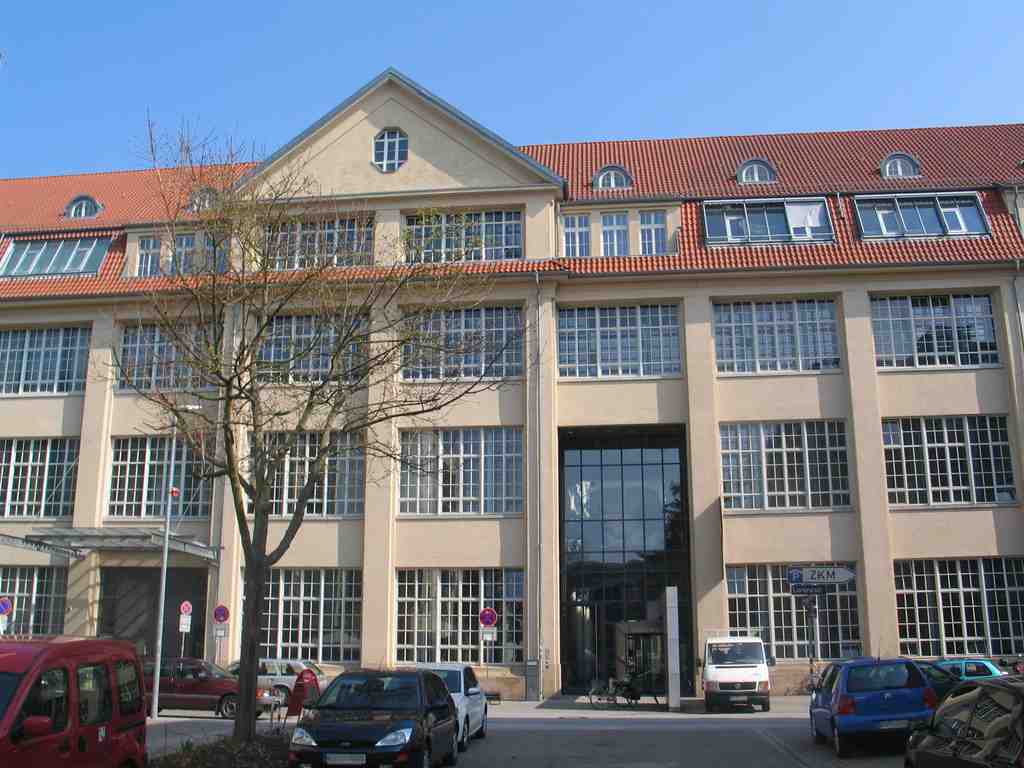
You should be looking at a massive beige facade defined by a strict repeating grid of large industrial windows, topped with a classical triangular pediment featuring a distinct round window.
You are standing in front of the Karlsruhe University of Art and Design, housed within a structure known as Hallenbau A. This colossal industrial building was designed by the architect Philipp Jakob Manz and finished just before the end of the First World War, originally purposed to mass-produce weapons. It carries a heavy, dark history. By the Second World War, this weapons and munitions factory had swelled to the size of a small town, employing up to thirty thousand workers. Inside these very halls, thousands of forced laborers from across Europe were made to produce armaments for the Nazi regime under horrific conditions.
But decades later, a profound shift took place. In 1992, art historian Heinrich Klotz founded this university with a grand vision to create an electronic Bauhaus. The Bauhaus was an influential early twentieth-century German design school that famously combined crafts and fine arts, and Klotz wanted to update that concept for the digital age, merging traditional art with media technology.
Moving the school into this building in 1997 was an act of radical reinvention. It was a conscious moral umwidmung, a German word that means a formal repurposing or rededication. The founders took a space historically dedicated to the mass production of death, and turned it into a laboratory for creativity. Where artillery shells were once manufactured, students now design digital art, film, and scenography.
Yet, even the most visionary artistic utopias have to deal with human nature. Over the past decade, the university became the stage for bitter internal power struggles. A nationwide scandal erupted when an assistant to the rector rose to a prominent position in a right-wing populist political party. The academic world was outraged, leading to his swift removal from leadership duties. But the drama did not stop there. Rectors came and went, their ambitious reform plans repeatedly crashing into stubborn institutional resistance. The peak of this chaos came recently with a Belgian rector named Jan Boelen. After being voted out of office, Boelen sued over procedural errors, won his case in court, and triumphantly returned to his desk... only for the professors to immediately hold another vote and oust him again, this time by a crushing margin of nine to one.
Grand ideals are beautiful things, but they always have to survive the messy reality of the people trying to build them. Take a moment and look closely at the colossal scale of the Hallenbau. Can you sense the ghosts of its industrial past hiding behind the modern art installations?
Feel free to explore the public areas of this fascinating art hub. Whenever you are ready, we will head to the Städtische Galerie Karlsruhe, which is just a short three-minute walk away.




