
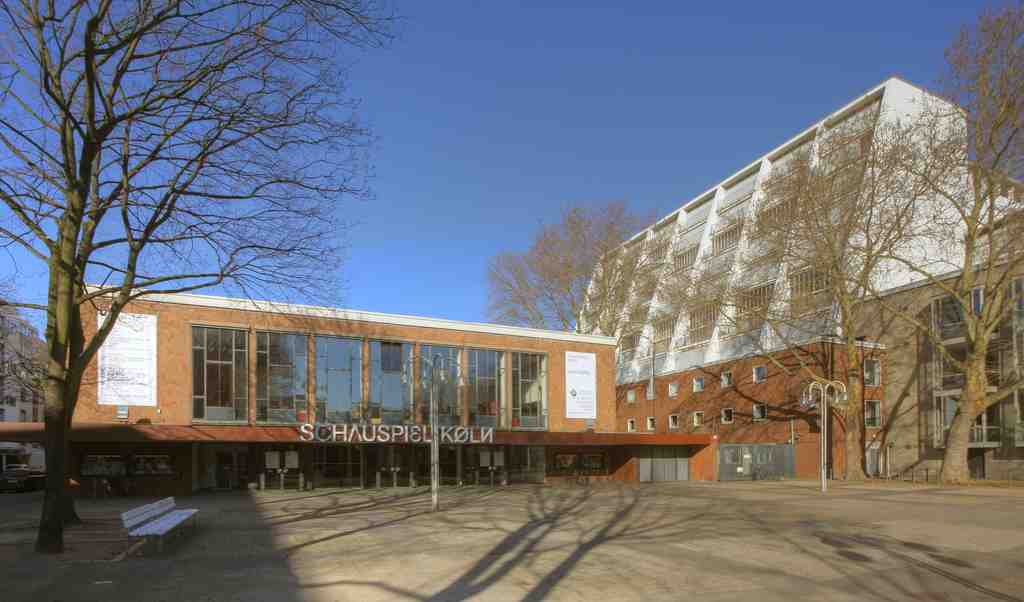
On your left, you will see a striking mid-century structure defined by a wide, flat overhanging canopy displaying the words Schauspiel Köln, fronting a large glass wall framed by solid red brick.
If this building shares a certain aesthetic presence with the Opera House we just visited, there is a good reason for that. Both were designed by the same architect, Wilhelm Riphahn, to form a unified cultural heart for the city. This particular building, the primary stage for straight theater in Cologne, opened its doors in nineteen sixty-two.
The tradition of theater in Cologne stretches all the way back to the Middle Ages, but this institution truly found national fame in the nineteen twenties. It was a place of high drama, both on and off the stage. In nineteen twenty-nine, a production of Bertolt Brecht’s Threepenny Opera was nearly canceled when conservative politicians tried to ban it. It took the intervention of the city's mayor, Konrad Adenauer, who negotiated a slightly softened script so the controversial performance could go ahead.
After the historic theater buildings were destroyed in the Second World War, the company performed in university halls and museum rooms until this permanent home was completed. The new stage quickly built a reputation for pushing boundaries. In nineteen sixty-eight, director Hansgünther Heyme shocked traditional audiences with highly unconventional, controversial stagings of classic texts. Decades later, under the brilliant direction of Karin Beier, the theater reached incredible heights, officially being named Theater of the Year in the German-speaking world in both two thousand ten and two thousand eleven.
Yet, right at the peak of this critical success, the building faced a very real threat of erasure. Planners had decided to tear the Schauspiel Köln down completely to make room for new development during the adjacent opera renovations. But the people of Cologne refused to lose another piece of their history. They launched a massive citizen initiative called Courage for Culture. They argued that preserving the soul of the city was more important than building a cheap, modern facade. Their campaign worked, and the city council officially voted to save and protect the building.
You can view the transformation on your screen. Compare the square in two thousand twelve, when trees were cleared for renovations, to two thousand seventeen, which reveals the faithfully restored original concrete finish.
Since two thousand twelve, the grand hall of eight hundred and thirty seats has been silent, undergoing deep, complex renovations while the acting company performs in old industrial depots across the river. The Schauspiel Köln stands not just as a monument to the dramatic arts, but as a profound testament to the citizens who fought to keep it standing.
Take a moment to appreciate this rescued landmark. Let us move to our final destination when you are ready.




