
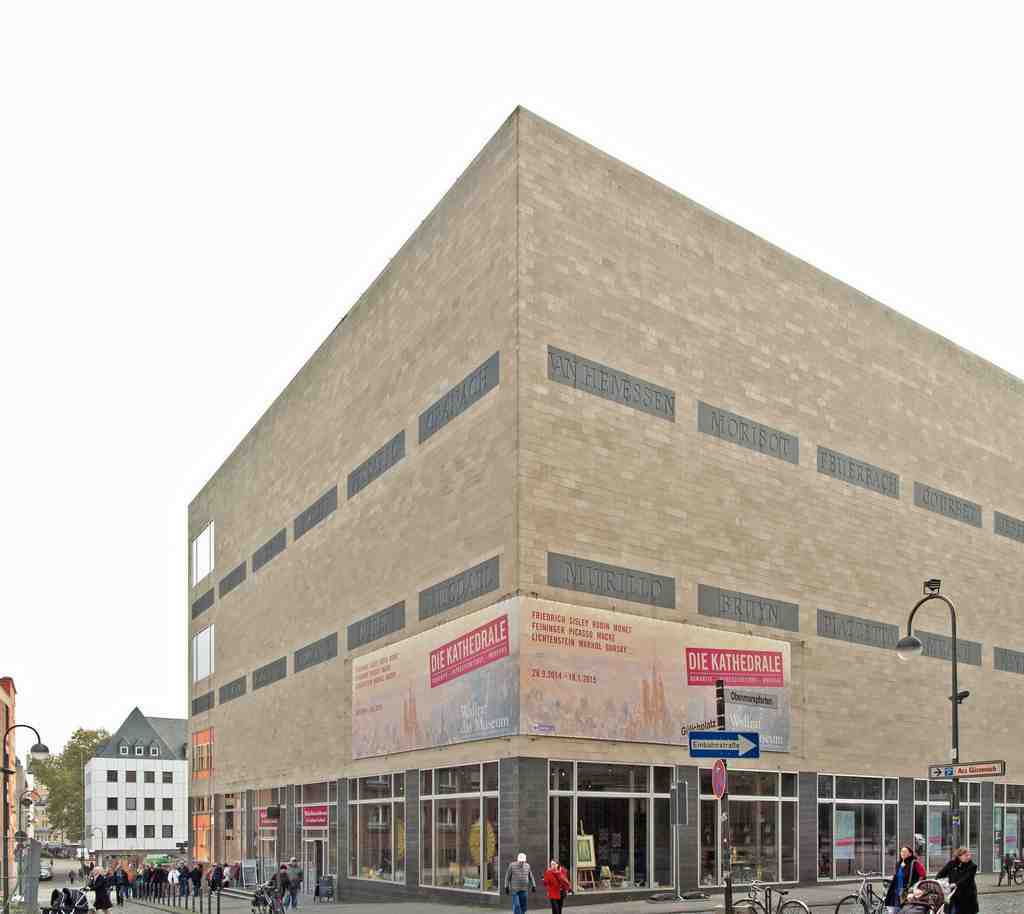
You will spot the museum on your right by its stark, cubic shape formed from pale stone blocks, accented by horizontal bands of darker stone etched with the names of celebrated artists.
This is the Wallraf-Richartz-Museum and Fondation Corboud, the oldest museum in Cologne. Its roots stretch back to a local scholar named Ferdinand Franz Wallraf. In the late eighteenth and early nineteenth centuries, a wave of secularization swept through Europe. This meant countless monasteries and churches were dissolved by the government, and their ancient properties were suddenly seized.
Wallraf watched as centuries of sacred art faced sudden destruction or dispersal. He could not let that happen. So, he began to collect. He gathered up discarded altar panels, illuminated manuscripts, and medieval paintings, determined to save the cultural memory of his city. When he died in eighteen twenty-four, he left his massive life's work to the city of Cologne.
But the city soon realized they had a unique problem. They had a mountain of priceless masterpieces and absolutely nowhere to put them. Enter a wealthy local merchant named Johann Heinrich Richartz. In eighteen fifty-one, Richartz stepped forward and donated one hundred thousand thalers, an absolute fortune at the time, to fund a proper museum building. That generous partnership is why the institution bears both of their names today.
The original building was entirely destroyed during the heavy air raids in the summer of nineteen forty-three, but thankfully, the art had been moved and survived. Today, inside this modern structure designed by architect Oswald Mathias Ungers, which opened in two thousand and one, you will find the world's most extensive collection of medieval painting. Because Cologne largely avoided massive fires and religious iconoclasm, which is the deliberate destruction of religious icons that ravaged other European cities, masterpieces by medieval painters like Stefan Lochner remain perfectly preserved here.
The journey through art does not stop in the Middle Ages. The collection spans all the way to the twentieth century. In two thousand and one, a Swiss collector named Gérard Corboud and his wife Marisol added their immense private collection of Impressionist and Neo-Impressionist art as a permanent loan. Now, the dramatic Baroque shadows of Rembrandt and Peter Paul Rubens share this institution with the vibrant, light-filled canvases of Claude Monet, Pierre-Auguste Renoir, and Vincent Van Gogh. The museum also houses an astonishing graphic collection of more than seventy-five thousand prints and drawings.
If you want to explore the galleries, the museum is open Tuesday through Sunday from ten in the morning to six in the evening, and closed on Mondays.
This austere stone cube protects a fragile, beautiful lineage of human creativity. Whenever you are ready to continue, let us make our way to the next stop.




