
Tiflis Audio-Tour: Kulturelle und historische Juwelen von Didube, Tiflis
Ein Seidengarten verbarg einst königlichen Kummer und eine Kindereisenbahn. Die Paläste und Plätze von Tiflis pulsieren mit Geheimnissen hinter ihren verzierten Fassaden, jede Ecke flüstert Geschichten, die ihrem ruhigen Erscheinungsbild trotzen. Dies ist Ihre Einladung, Tiflis auf einer selbstgeführten Audio-Tour zu erkunden, die dramatische Episoden und verborgene Juwelen enthüllt, die nur wenige Besucher jemals entdecken. Welches brutale Ereignis veränderte das Schicksal des Königreichs Kartli-Kachetien direkt in diesen Straßen für immer? Welche verbotene Liebe trieb die Entstehung eines der opulentesten Paläste Georgiens voran? Und warum löste eine Seidenraupenstation sowohl Skandal als auch wissenschaftlichen Triumph unter der Elite von Tiflis aus? Verfolgen Sie Spuren von schattigen Revolten bis zu großen künstlerischen Revolutionen. Bewegen Sie sich durch Gärten, die für verlorene Lieben gebaut wurden, Paläste, die durch Exil geformt wurden, Museen, die aus Rebellion entstanden sind. Erwarten Sie Wendungen an jedem Wahrzeichen, während Sie sehen, wie diese alte Stadt auf eine Weise zum Leben erwacht, die Sie sich nie vorgestellt haben. Entdecken Sie die Geschichten, die Tiflis verborgen hält. Ihre Reise beginnt jetzt.
Tourvorschau
Über diese Tour
- scheduleDauer 30–50 minsEigenes Tempo
- straighten1.1 km FußwegDem geführten Pfad folgen
- location_on
- wifi_offFunktioniert offlineEinmal herunterladen, überall nutzen
- all_inclusiveLebenslanger ZugriffJederzeit wiederholen, für immer
- location_onStartet bei Muschthaid-Garten
Stopps auf dieser Tour
The building itself has historical value, having once been the palace of Duke Constantine Petrovich of Oldenburg. Designed by Paul Stern, a prominent architect of the time, the…Mehr lesenWeniger anzeigen
The building itself has historical value, having once been the palace of Duke Constantine Petrovich of Oldenburg. Designed by Paul Stern, a prominent architect of the time, the structure exhibits an interesting blend of Gothic and Islamic architectural styles. The interior features contributions by Polish architect Aleksander Rogojski. The palace was a testament to Duke Constantine’s affection for Agrippina Japaridze, whom he met and fell in love with in Kutaisi in 1882. After their elopement, they settled in Tiflis, where he commissioned this palace. In 1927, the Museum of Theatre, established by David Arsenishvili, was relocated to this building. Now, the museum comprises over 300,000 objects that chronicle the evolution of Georgian theater, cinema, circus, folklore, opera, and ballet. Among the notable exhibits is an ancient mask unearthed in Vani, offering a glimpse into classical-era artistry. The museum’s vast collection includes works from Georgian and Russian artists, providing a comprehensive view of regional scenic design evolution. The fine arts depository features portraits, stage decoration sketches, and costumes. Of particular interest are works by Russian Silver Age painters like Konstantin Korovin, Lev Bakst, and Alexander Benua. Additionally, the museum houses a significant collection of Persian Fine Arts, including Qajar miniatures from the 19th century and a painting of King Solomon, revered in both Christian and Islamic traditions. The Art Palace thus serves as a monumental repository of Georgia’s cultural history, offering insight into the artistic and cultural landscape that has shaped the nation. You are currently standing at a location enriched with a deep tapestry of historical and cultural narratives, symbolizing the confluence of love, art, and history.
Eigene Seite öffnen →You are now standing at the landmark commemorating the Kingdom of Kartli-Kakheti, a significant historical union in Georgian history. This kingdom was formed in 1762 by the…Mehr lesenWeniger anzeigen
You are now standing at the landmark commemorating the Kingdom of Kartli-Kakheti, a significant historical union in Georgian history. This kingdom was formed in 1762 by the unification of the two eastern Georgian kingdoms of Kartli and Kakheti. The unification was initiated under the rule of Heraclius II following the death of his father, Teimuraz II. The event marked the first political unification of eastern Georgia in three centuries. Historically, both kingdoms had been under Iranian control since the Peace of Amasya in 1555. However, after the death of Nader Shah of Iran in 1747, Heraclius II exploited the subsequent instability in Iran to assert de facto independence. Although he formally submitted to the newly established Zand dynasty, his kingdom operated autonomously for the next 30 years. One of Heraclius II's noteworthy achievements was the Treaty of Georgievsk in 1783 with the Russian Empire. This treaty formally recognized Russian protection over Kartli-Kakheti, offering nominal security against other powers, particularly Iran, which had long sought dominance over the region. However, the rise of the Qajar dynasty in Iran under Agha Mohammad Khan Qajar led to renewed conflict. In the 1790s, Agha Mohammad Khan Qajar reasserted Iranian control over the Caucasus, culminating in the invasion and sacking of Tbilisi. Heraclius II's subsequent death in 1798 and the assassination of Agha Mohammad Khan further destabilized the kingdom. By 1801, the geopolitical instability and changing dynamics led to the formal annexation of Kartli-Kakheti by the Russian Empire under Paul I, bringing an end to its brief period of political unity and autonomy. This transition was part of a broader pattern of Russian expansion in the Caucasus, confirmed by the Russo-Persian War of 1804-1813, which saw Iran cede its claims to the territory. As you stand here, recognize the historical significance of this site in the ongoing narrative of Georgia’s complex and multifaceted history.
Eigene Seite öffnen →

4 weitere Stationen anzeigenWeniger Stationen anzeigenexpand_moreexpand_less
The Kingdom of Kartli, where you are now standing, represents a significant epoch in Georgian history. This late medieval and early modern monarchy was centered in the province of…Mehr lesenWeniger anzeigen
The Kingdom of Kartli, where you are now standing, represents a significant epoch in Georgian history. This late medieval and early modern monarchy was centered in the province of Kartli with Tbilisi as its capital. The Kingdom emerged in 1478 following the tripartite division of the Kingdom of Georgia. It existed until 1762 when it merged with the Kingdom of Kakheti through dynastic succession under the Kakhetian branch of the Bagrationi dynasty. During much of its existence, Kartli was a vassal to successive Iranian dynasties and, to a lesser extent, the Ottoman Empire. However, it experienced periods of greater independence, especially post-1747. The genesis of the Kingdom of Kartli is marked by intense feudal competition, civil war, and separatism. The disintegration of a unified Georgian kingdom began in earnest after George VIII’s defeat at the Battle of Chikhori in 1463 by the rebellious nobleman Bagrat VI. Bagrat’s subsequent declaration as King of Imereti splintered the Georgian monarchy further. After his defeat in 1465, George VIII was captured, allowing Bagrat VI to claim kingship over all Georgia by 1466. Released from captivity, George VIII formed the rump state of Kakheti. His nephew, Constantine, then emerged as a contender for the throne in Kartli in 1469, leading to additional turmoil. Bagrat VI was continuously challenged until losing control in 1478 when Constantine, aided by local dukes, temporarily restored Kartli's integrity with Western Georgia by 1481, proclaiming himself King of All Georgia. Yet, this unity was short-lived due to ongoing feudal struggles. The complex interplay of regional powers and noble factions defined Kartli’s historical landscape, reflecting the broader fracturing and political instability of the period. As you gaze upon this landmark, consider the turbulence and shifting alliances that shaped the Kingdom of Kartli, an essential chapter in the history of Georgia.
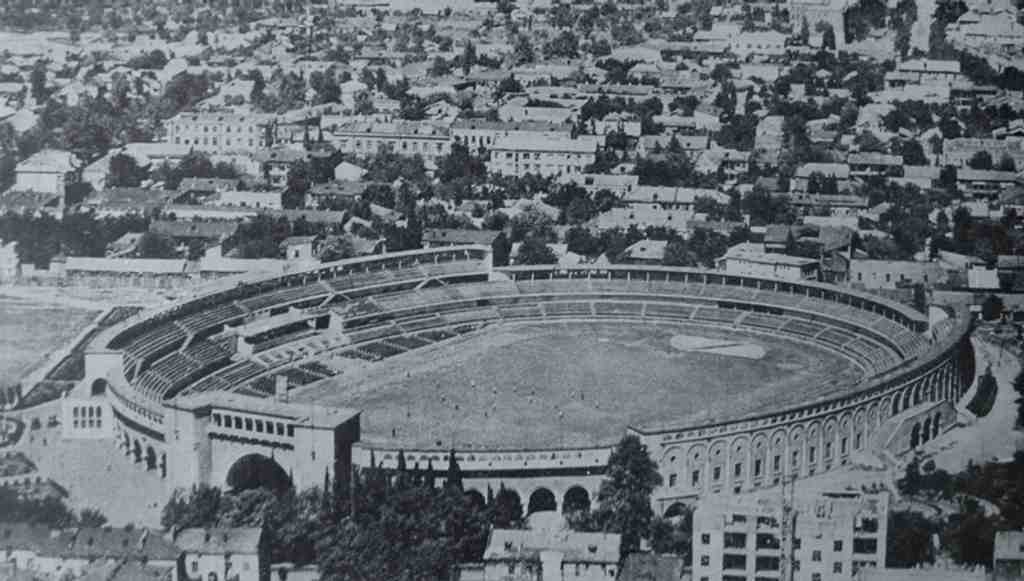
Eigene Seite öffnen →You are now standing before the Central Stadium, a significant multi-purpose venue in Tbilisi, Georgia. Its official designation from 1937 until 1953 was the Beria Dinamo Stadium,…Mehr lesenWeniger anzeigen
You are now standing before the Central Stadium, a significant multi-purpose venue in Tbilisi, Georgia. Its official designation from 1937 until 1953 was the Beria Dinamo Stadium, named in honor of the influential Soviet politician Lavrentiy Beria. Before its closure, this site served as the home ground for FC Dinamo Tbilisi, one of Georgia's foremost football clubs, until they transitioned to the current Boris Paichadze Stadium in 1976. The Central Stadium was capable of accommodating 35,000 spectators, making it a prominent location for various sporting events and gatherings. Though it no longer serves its original purpose, its historical importance remains notable in the annals of Georgian sports heritage.
Eigene Seite öffnen →You are now standing before the Boris Paichadze Dinamo Arena. This landmark, known in Georgian as ბორის პაიჭაძის ეროვნული სტადიონი, is one of the hallmark locations in Tbilisi.…Mehr lesenWeniger anzeigen
You are now standing before the Boris Paichadze Dinamo Arena. This landmark, known in Georgian as ბორის პაიჭაძის ეროვნული სტადიონი, is one of the hallmark locations in Tbilisi. Initially constructed in 1976 by Georgian architect Gia Kurdiani, this stadium has solidified its place as the largest in Georgia with a capacity of 54,202 seats. The stadium's original name was Vladimir Ilyich Lenin Dinamo Stadium, paying homage to the Russian Communist leader. However, in 1995, it was renamed to honor Boris Paichadze, a renowned Georgian football player. Before its construction, Dinamo Tbilisi's home ground was the Central Stadium, which could accommodate approximately 35,000 spectators. The necessity for a larger venue arose due to Dinamo Tbilisi's impressive performances during the mid-1970s. Upon its inauguration, this stadium was among the largest in the Soviet Union, boasting an initial capacity of 74,354. The first match held here was on September 29, 1976, between Dinamo Tbilisi and Cardiff City, resulting in a 3-0 win for Dinamo. The stadium has witnessed many significant events, including Dinamo Tbilisi's triumphs in 1978 and 1979, and hosted 80,000 fans in 1981 to celebrate the team's victory in the European Cup Winners' Cup. The Dinamo Arena has consistently been used for important national and international matches. The record attendance was in 1979 when 110,000 spectators watched Dinamo defeat Liverpool 3-0 in the European Champion Clubs' Cup quarter-finals. The venue was also pivotal for the USSR national football team and hosted memorable matches for clubs like Spartak Moscow and Dynamo Kiev. In 2006, the Dinamo Arena underwent refurbishment, transitioning to an all-seater stadium which adjusted the capacity to its current 54,549 seats. Notably, on August 11, 2015, the stadium hosted the UEFA Super Cup match between FC Barcelona and Sevilla FC. The architectural design has evolved significantly over time. The original 1936 stadium designed by Archil Kurdiani included additions in 1956 that expanded capacity. The current structure, inaugurated in 1976, retained elements from the initial design but enhanced its capacity to accommodate over 74,000 spectators thanks to a complex architectural solution involving a console system supported by 58 pylons. These innovations have allowed the Dinamo Arena to stand as an enduring symbol of Georgian sports and architectural prowess.
Eigene Seite öffnen →



Häufig gestellte Fragen
Wie starte ich die Tour?
Laden Sie nach dem Kauf die AudaTours-App herunter und geben Sie Ihren Einlösecode ein. Die Tour ist sofort startbereit – tippen Sie einfach auf „Play“ und folgen Sie der GPS-geführten Route.
Benötige ich während der Tour Internet?
Nein! Laden Sie die Tour vor dem Start herunter und genießen Sie sie vollständig offline. Nur die Chat-Funktion benötigt Internet. Wir empfehlen den Download über WLAN, um mobiles Datenvolumen zu sparen.
Handelt es sich um eine geführte Gruppentour?
Nein – dies ist ein selbstgeführter Audioguide. Sie erkunden unabhängig in Ihrem eigenen Tempo, wobei die Audioerzählung über Ihr Telefon abgespielt wird. Kein Reiseleiter, keine Gruppe, kein Zeitplan.
Wie lange dauert die Tour?
Die meisten Touren dauern 60–90 Minuten, aber Sie kontrollieren das Tempo vollständig. Pausieren Sie, überspringen Sie Stopps oder machen Sie Pausen, wann immer Sie wollen.
Was, wenn ich die Tour heute nicht beenden kann?
Kein Problem! Touren haben lebenslangen Zugriff. Pausieren Sie und setzen Sie sie fort, wann immer Sie möchten – morgen, nächste Woche oder nächstes Jahr. Ihr Fortschritt wird gespeichert.
Welche Sprachen sind verfügbar?
Alle Touren sind in über 50 Sprachen verfügbar. Wählen Sie Ihre bevorzugte Sprache beim Einlösen Ihres Codes. Hinweis: Die Sprache kann nach der Tour-Generierung nicht mehr geändert werden.
Wo greife ich nach dem Kauf auf die Tour zu?
Laden Sie die kostenlose AudaTours-App aus dem App Store oder von Google Play herunter. Geben Sie Ihren Einlösecode (per E-Mail gesendet) ein, und die Tour erscheint in Ihrer Bibliothek, bereit zum Download und Start.
Wenn Ihnen die Tour nicht gefällt, erstatten wir Ihnen den Kaufpreis. Kontaktieren Sie uns unter [email protected]
Sicher bezahlen mit 


