
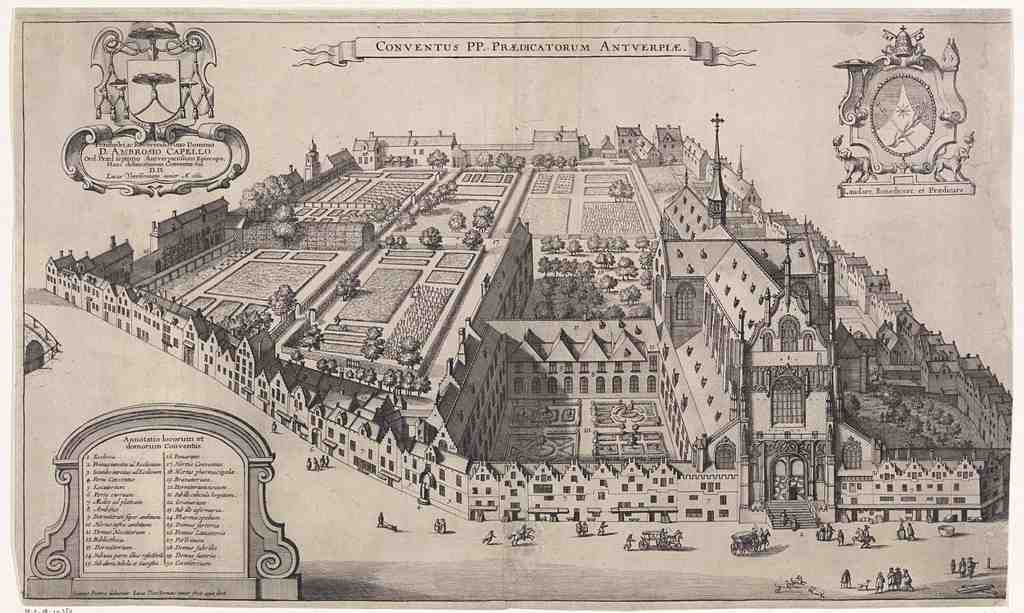
On your left, look for the long red-brick façade with tall rectangular windows and a sober arched entrance, a restrained monastic front that gives little away from the street.
This is the Predikherenklooster, the Preachers’ Monastery, better known as the Dominican monastery of Saint Paul. What survives here is the domestic half of the world that also gave Antwerp its Saint Paul’s Church. From the thirteenth century until seventeen ninety-seven, this was a vast religious estate, stretching across several streets, and home to roughly seventeen hundred Dominican friars. The Dominicans called themselves the Order of Preachers, men meant to teach, argue, persuade, and, when necessary, defend the faith with words rather than swords.
They arrived in Antwerp in twelve forty-three, after Duke Henry the Second of Brabant brought them from Strasbourg. His successor, Henry the Third, and a canon named Hugo Nose gave them land near a place called the Dries. Around twelve sixty-nine, the friars began their first church, and in twelve seventy-six the great scholar and bishop Albertus Magnus consecrated it. Even then, the friars had a knack for stirring strong feelings. Local clergy quarrelled with them over burial rights, because burial meant income and influence. In twelve ninety-nine, Pope Boniface the Eighth stepped in and allowed the Dominicans to bury people in their own church, provided a quarter of the funeral dues still went to the parish priest.
But this monastery did far more than pray. From the fifteenth into the sixteenth century, part of the complex, the Predikherenpand, became one of Antwerp’s liveliest trading spaces. Merchants unrolled costly tapestries across the great hall, and jewellers, goldsmiths, silversmiths, and painters showed their wares here. For a time, this place worked almost like a modern exchange. The city fathers, naturally, wanted that profitable trade under their own control, and in the end they forced the merchants to move elsewhere.
The friars rebuilt boldly too. Their old church flooded at spring tide, so in fifteen seventeen they began a new one on higher ground. Philip the Second attended services there while it still rose stone by stone. Then came the shocks of the age: iconoclasts wrecked altars in fifteen sixty-six, Calvinists seized part of the monastery in fifteen seventy-eight, expelled the friars a year later, turned the church into a Protestant prayer hall, and used part of the convent as a cannon foundry. After Antwerp fell in fifteen eighty-five, the Dominicans returned and patiently rebuilt.
One prior stands out: Michael Ophovius, a formidable preacher and friend of Rubens. Rubens even used his diplomatic connections to help free Ophovius after imprisonment in The Hague. Around sixteen seventeen, Rubens, Jan Brueghel the Elder, and Hendrik van Balen helped buy Caravaggio’s Madonna of the Rosary for the church, though Emperor Joseph the Second later carried it off to Vienna.
This place knew plague as well. In sixteen seventy-eight, the “Haestige Ziekte,” a fast and deadly epidemic, killed twenty-six friars in just three months. And in the old cemetery, the Dominicans buried repentant criminals and converted heretics, souls who died on the edge of respectable society but still sought mercy.
Then came the French Revolution. In seventeen ninety-six, about sixty soldiers drove out the last fifty-three friars. Prior Cornelius Peltiers made a hard, deeply unpopular choice. He accepted French compensation vouchers and even took the revolutionary oath of hatred against monarchy, because that gave him the means to buy back the monastery, church, and garden at public sale in seventeen ninety-seven for three hundred and twenty thousand francs, a sum worth several million euros today. Many called it betrayal. He called it survival, and because of that decision, this place escaped the wrecking ball.
The story did not end there. A school moved into the former monastery in the early twentieth century. Then, in nineteen sixty-eight, fire tore through the complex and left much of it in ruins. In response, a human chain formed outside: neighbours, students, firefighters, and even women from the nearby sailors’ district passed masterpieces by Rubens, Van Dyck, and Jordaens to safety, hand to hand. It is a rather Antwerp ending, practical, unruly, and oddly noble.
If you plan to visit another time, it is usually closed on Mondays, open later on Tuesdays and Thursdays, and keeps shorter hours at the weekend.




