剑桥语音导览:学院庭院与河畔的天才回响
在剑桥这些蜿蜒的街道上,时间扭曲回溯——一个巨大的金色时钟吞噬着分秒,古老的秘密在学院的墙壁间回荡。这不仅仅是观光;这是一次自助语音之旅,让您在大多数游人只看到宁静庭院的地方,揭开隐藏的反叛、传奇的盛宴和令人费解的发明。 在中世纪一次臭名昭著的起义中,谁敢洗劫并焚烧基督圣体学院?为什么数学桥会激发无数关于不可能的工程和大胆学生恶作剧的神话?在圣体钟闪烁的蚱蜢下方,随着每一秒的逝去,又低语着什么萦绕心头的承诺? 漫步于阴影拱门和波光粼粼的河流之间,追寻叛逆学者、神秘科学家和身怀危险秘密的诗人的足迹。每个站点都承载着层层叠叠的故事,它们被掩埋在石头和玻璃之下,等待着每一次转弯后的发现。 准备好追随时间奇特的脉搏了吗?开始您的冒险吧——剑桥的奥秘正等待着您。
导览预览
关于此导览
- schedule持续时间 40–60 mins按照自己的节奏
- straighten4.2 公里步行路线跟随引导路径
- location_on
- wifi_off离线工作一次下载,随处使用
- all_inclusive终身访问随时重播,永久有效
- location_on从 剑桥基督圣体学院 开始
此导览的景点
In the Middle Ages, the college was humble-just one court, a handful of rooms, and lots and lots of rules. No smartphones, of course, but not even running water! The students…阅读更多收起
In the Middle Ages, the college was humble-just one court, a handful of rooms, and lots and lots of rules. No smartphones, of course, but not even running water! The students didn’t even have the right to walk on the pristine lawns. To this day, those lawns are usually reserved for the chosen few. You can almost hear the footsteps of medieval scholars rustling parchment as they hurried to Old Court. Old Court, where you’re standing, is a superstar among quadrangles: it claims to be the oldest continually inhabited courtyard in the entire country-though our friends at Merton College, Oxford, might argue that point. The college couldn’t afford anything grand, so what you’re seeing is pretty much what a scholar or fellow from the 1350s would’ve seen, minus a few modern plumbing upgrades. If you peek through the ancient passageway, you might spot St Bene’t’s Church. The tower of that church is actually the oldest building in Cambridge, built before the Normans even thought about invading England. Now, things weren’t always calm here. In 1381, during the Peasants’ Revolt, an angry mob stormed Corpus, carried away precious silver-and even burned the charter! It was rough being wealthy with so many treasures. The college claimed damages that would today buy you a pretty decent house in the city, or at least a few particularly nice bicycles. One of Corpus’s greatest benefactors was Archbishop Matthew Parker, who brought not just wisdom but also an incredible collection of medieval manuscripts. He was so protective of his books and silver that he set up a rule: if the college ever lost a certain number of items, the entire collection would be whisked away to rival colleges! Nothing like a threat of total loss to keep folks on their toes. (This might be where the phrase “Nosey Parker” comes from. He was very practical-and apparently very nosy.) Of course, this place wasn’t just about pious prayer and bookish pursuits. Christopher Marlowe, playwright and possible spy, was a student here in the sixteenth century. Legend has it he might have spent as much time pulling off cloak-and-dagger deals as writing plays. In fact, during renovations in the 1950s, a mysterious portrait was found dating from the exact year Marlowe was 21. Spooky, right? Moving through the centuries, you’ll find Corpus popping up in all sorts of adventures. It was attacked again in 1688-this time by an anti-Catholic mob. In the English Civil War, while nearly every other college melted down its silver to fund one side or the other, Corpus stayed neutral and kept its treasure. Maybe they just had better hiding places. If you’re thinking this is all drama without any success, think again! Corpus is famous for academic excellence. In 2024, it ranked first in the university for its final-year students. And they know how to throw a party-the Corpus Christi feast day still includes an extravagant dinner, though they’ve stopped parading treasures through the streets. Health and safety, you know. The Eagle Pub, which the college owns, is just around the corner. In 1952, Watson and Crick walked in, announcing, “We have found the secret of life!” after discovering DNA’s structure. Cheers erupted, and the pub still bears a blue plaque. If walls could talk, The Eagle’s would probably give TED Talks. From medieval lanterns and secrets, to the digital age-Corpus’s Parker Library is now online for the world to see, thanks to a partnership with Stanford. Throughout it all, Corpus has remained small, tight-knit, and, as rumor would have it, enormously wealthy in silver and wine (yes, it’s true-they have some of the best cellars). But don’t get any ideas; most of it is locked away, treasure hunter! So, as you stand before these ancient walls, picture all those centuries of scholars, rebels, kings, and poets...and maybe a few ghosts, too, swirling around you. But no matter what, it remains a place of learning, lore, and more than a few hidden stories. Ready? Next, we’ll head toward our second stop-the Mathematical Bridge! Don’t worry, we won’t need any mathematical skills to cross it. Or do we…? Curious about the buildings, student life or the traditions and anecdotes? Don't hesitate to reach out in the chat section for additional details.
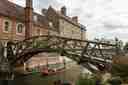
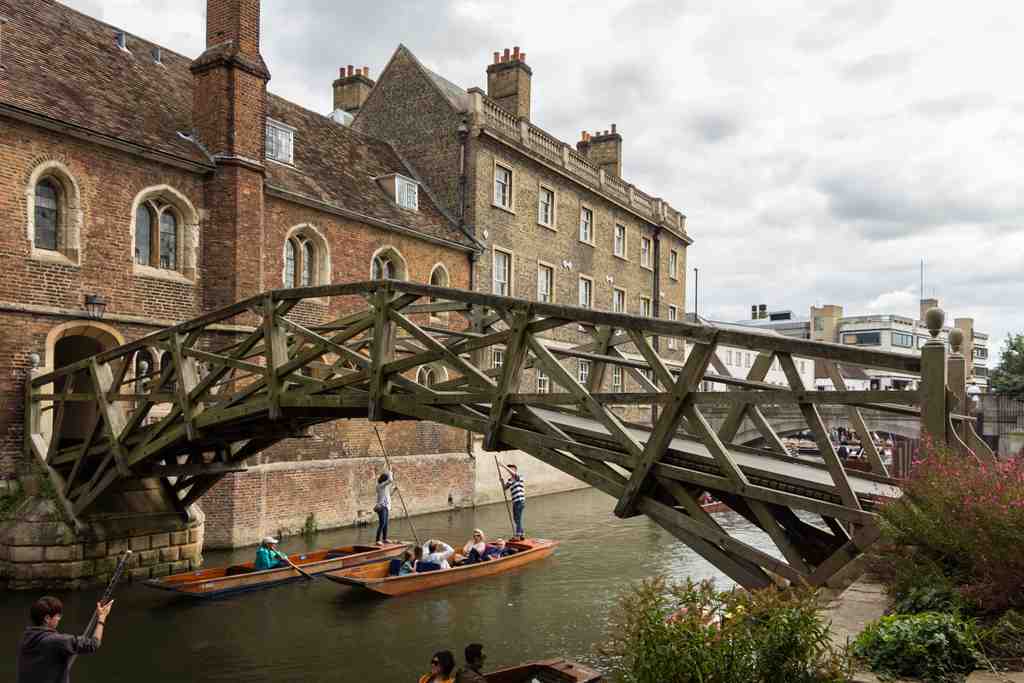
打开独立页面 →Just ahead of you, spanning the river, you’ll spot a curious pale wooden bridge with criss-crossed beams, arching between two old brick university buildings-just look for the…阅读更多收起
Just ahead of you, spanning the river, you’ll spot a curious pale wooden bridge with criss-crossed beams, arching between two old brick university buildings-just look for the zig-zag pattern that stands out against the water and the stone. Now, as you stand here, picture yourself in Cambridge nearly three hundred years ago. The wind tugs at your hat, the river Cam glistens beneath a shy sun, and students in flowing gowns hurry over this very bridge, notebooks clutched under their arms. This is the famous Mathematical Bridge, though its official name is a bit less exciting-simply the Wooden Bridge or Queens’ Bridge. But don’t let that plain name fool you, because beneath your feet is a marvel of clever engineering that’s caused more head-scratching than a maths exam on a Monday morning. Designed in 1749 by William Etheridge and built by James Essex, this bridge looks like a graceful wooden arch, but here’s the trick-there’s not a single curved piece of wood involved! Look closely and you’ll see it’s made entirely out of straight planks, kind of like a giant game of pick-up sticks, but with a lot more rules. The whole thing is held together by an ingenious arrangement: the timbers that run along the arc are pushed together (imagine they’re giving each other a sturdy hug), while the shorter, angled timbers pull everything tight, keeping the whole structure steady and strong. On misty mornings or golden afternoons, it’s easy to believe in the myths that swirl around this spot. The most popular tale? That Sir Isaac Newton-you know, the apple guy-built this bridge without using a single bolt or nut. Of course, everyone loves the idea of Newton fluttering around Cambridge with a stack of wood and a genius glint in his eye, but there’s just one problem: he died over twenty years before the bridge was built. Oops! The real explanation is a bit sneakier; the original bolts were hammered in from the outside, so you couldn’t see them if you were strolling across-which left pranksters to wonder how the whole thing didn’t tumble into the river. That didn’t stop ambitious students. The legend says some tried to take it apart to see Newton’s secret, only to end up with a pile of planks and a headache, unable to piece it back together without resorting to ordinary nuts and bolts. Today, the Mathematical Bridge stands as a tribute not just to brilliant design, but to the playful, puzzle-loving spirit of Cambridge itself-where logic and legend are always walking hand-in-hand. So cross it gently, and maybe give a sly nod to Newton, wherever he is.
打开独立页面 →To spot the Corpus Clock, just look ahead at street level where a giant, rippling gold disc almost as wide as a doorway gleams in the glass, crowned by a menacing metal…阅读更多收起
To spot the Corpus Clock, just look ahead at street level where a giant, rippling gold disc almost as wide as a doorway gleams in the glass, crowned by a menacing metal grasshopper perching on top-trust me, you can’t miss that unsettling bug! Now, as you stand here on the edge of Bene’t Street, with the old stones of Cambridge humming quietly beneath your feet, let me pull you into the extraordinary world of the Corpus Clock-or as it’s more mischievously known, the Chronophage, the time eater! This isn’t your grandmother’s clock with gentle chimes and twirling hands. No, before you is a remarkable creature-a monstrous grasshopper or perhaps an alien locust-peering out over King’s Parade, jaws poised to devour every second of your day. If you listen closely, you might catch its next move: That’s the sound of time slipping away, swallowed bite by bite. The clock’s face is actually a dazzling 24-carat gold-plated disc, about as round as a small dinner table, and entirely hand-crafted. But you won’t see any numbers or tell-tale hands; instead, blue LED lights mark out the hours, minutes, and seconds by briefly glowing through tiny slits, forming three dancing circles that shift around the disc. It’s as if time here is measured by ripples on a golden pond. But the real star of the show-the creature looming above-is called the Chronophage. The very word means “time eater,” and you’ll understand why as you watch: its jaws snap and twitch, gulping down seconds, while its eerie eyelids flicker in random, almost sinister blinks. Legend has it, if you stare long enough, you’ll see it blink twice in rapid succession-but miss it, and well, that moment’s gone forever, just as the clock intends. Invented and funded by John Taylor, a Cambridge alumnus who is clearly no fan of ordinary watches, this clock was unveiled to the world in 2008 with none other than Stephen Hawking himself presiding. Taylor wanted to give life to a message: that time is wild and unpredictable, not neat and regular like in movies. In fact, this clock is only truly accurate every five minutes. In between, it wobbles, stutters, stalls, then suddenly races-just like life itself. Sometimes the lights lag behind, sometimes they leap ahead in a panic, almost as if the clock has a mind of its own. And let’s not forget-to give the whole enterprise a bit of Victorian drama-every hour is punctuated by the sound of a chain clanking into a hidden wooden coffin just behind the clock. A gentle reminder that our glorious moments tick away-right down to the last gloomy second. If you look at the inscription below, you’ll see the Latin: “mundus transit et concupiscentia eius.” It means, “the world passeth away, and the lust thereof”-a haunting little note to make you pause and check your own watch! But how does it work? Well, the magic is all in the mechanics. The Chronophage is powered by the world’s largest grasshopper escapement-a brilliantly clever invention from the eighteenth century, brought roaring-or should I say, chirping?-into the modern day. The grasshopper’s motion, powered by hidden gears and a swinging pendulum, is visible for everyone to see, something John Taylor thought would amaze passersby. And if you think it’s controlled by fancy computers-think again! Everything is mechanical: the gears, the springs, the escapements, all chattering together, with electricity only used to keep the blue LEDs twinkling and the internal motor wound up tight. The creation of this clock took five years, an investment of one million pounds, and a team of two hundred people-engineers, sculptors, scientists, and artists-all working together like the tiniest cogs in a very big, very beautiful machine. The gold disc? Formed using a secret explosive process from Holland. The grasshopper? Sculpted by hand, right down to its twitching golden eyelids. There are even other Chronophage clocks! A dragon version scowls from the Isle of Man, and another stands proudly in Douglas. But this one, right here in Cambridge, remains the most famous and possibly the most unsettling. The Corpus Clock has even made appearances in movies and television, from Bollywood to British TV to Chinese dramas, so you might be gazing at a real celebrity! As you stand here, let the shifting lights and slow, grinding chomps remind you of just how cleverly-and deliciously-time marches on. Just try not to get hypnotized or you might find it’s eaten more time than you planned! Shall we move on before the Chronophage gets hungry again? Interested in a deeper dive into the appearance, mechanics of the clock or the funding and realisation? Join me in the chat section for an insightful conversation.
打开独立页面 →
再显示 12 个站点显示更少站点expand_moreexpand_less
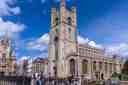
Right in front of you looms a tall, buckskin-colored stone church tower, its corners crowned with little castle-like turrets-just look for the largest, most impressive building on…阅读更多收起
Right in front of you looms a tall, buckskin-colored stone church tower, its corners crowned with little castle-like turrets-just look for the largest, most impressive building on this end of King's Parade! Welcome to the mighty Church of St Mary the Great, or as the locals like to say with a wink, “GSM”-because who wants to confuse it with Little St Mary’s down the road? Now, let’s step back in time together: picture yourself arriving in medieval Cambridge, the air buzzing with voices and the occasional clang of the market. This wasn’t just a parish church, it was the heartbeat of university life-so vital, in fact, that even today, Cambridge University insists its officers don’t live too far away, lest they miss out on any divine inspiration. The story begins before the days of big stone walls: some say a church’s foundations were laid here as early as 1010, but in 1290, disaster struck. One hot summer night, a furious fire swept through and left the congregation staring at ashes. Imagine the tension as suspicions flew-locals blamed the city’s Jewish population and, in the angry aftermath, the synagogue was forcibly shut. What was rebuilt wasn’t only a place for prayer, but for power: by 1352 it had its new name, Great St Mary’s, and a new significance as the official gathering spot for university debates and the all-important University Sermons. Over the years, the church saw more than just worship. Picture a hot-headed mob in 1381, storming the church during the Peasants’ Revolt, tearing up charters, bulls, and deeds-those precious papers fluttering like lost birds. As things calmed, the stone church you see today began taking shape between 1478 and 1519, funded partly by big-name kings like Richard III and Henry VII-probably not out of pure generosity, but hey, every brick tells a story. The passion for grandeur didn’t stop on the outside. Step inside and your eyes are treated to soaring ceilings, stained glass windows by Hardman glowing in the sun, and walls thick with history. Here, even the furniture’s special: there’s a rare moveable pulpit and a font from 1632. Behind the altar, a gleaming sculpture of Christ in Majesty radiates calm-it’s actually quite new, added in 1960. University tradition runs deep in these walls. For centuries, undergraduates crammed in for compulsory sermons, lining the galleries added in 1735. And if your ears are sharp, you’ll know this is where the famous “Cambridge Quarters” ring out from the tower-a tune so catchy, Parliament stole it for “Big Ben.” Those bells aren’t just for show, either: in 1724, a bunch of locals got together to form the Society of Cambridge Youths, now Britain’s oldest bell-ringing society. There’s such pride in the bells that in 2009, a shiny new set was installed thanks to a generous donation, but some originals stayed-so every time you hear that chime, you’re listening to centuries of history overlapping. Music lovers rejoice: the church houses not just one, but two mighty pipe organs. The “University Organ” is the crown jewel-originally built way back in 1698 by the master organ builder everyone called “Father” Smith, then lovingly upgraded and restored over the years, becoming a living museum of British organ pipes. There’s even a second, lighter “Parish Organ,” keeping the parishioners singing sweetly since 1991. The walls here have seen everything-fiery reformers like Erasmus and Martin Bucer preaching up a storm, and centuries later, sombre funerals for the likes of legendary physicist Stephen Hawking. In fact, beneath the south chancel, lie the ashes of Martin Bucer, once dragged out and burned in the marketplace, later reinterred when cooler heads prevailed. If ever there was a spot stacked high with drama, debate, and dignity, this is it. So, the next time someone tells you Cambridge is just brains and books, remind them it’s also bells and bravery, flames and forgiveness-and all under the watchful gaze of St Mary the Great. Now, how about we head to our next stop before the bells start ringing again? Don’t worry, I promise not to make you do any compulsory sermons… or at least, not yet! Seeking more information about the architecture and features, list of vicars or the burials and funerals? Ask away in the chat section and I'll fill you in.
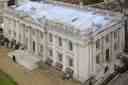
打开独立页面 →Just ahead of you is the Senate House: a grand, rectangular neo-classical building of creamy Portland stone, with impressive columns and large steps leading to the main…阅读更多收起
Just ahead of you is the Senate House: a grand, rectangular neo-classical building of creamy Portland stone, with impressive columns and large steps leading to the main entrance-look for its shining pale façade and stately presence right between King’s College and Gonville and Caius College. Now, take a moment to soak it in-might want to straighten your imaginary academic robes, because you’re standing before Cambridge’s most iconic stage for drama, tradition, and the occasional student prank! The Senate House was born in the 1720s, when the powers-that-be decided to demolish some houses and build a meeting place grand enough for the mighty university. Picture the scene in 1722 as the Vice-Chancellor Thomas Crosse, all pomp and ceremony, placed the first stone -and work began on this shining monument to academia. The architect James Gibbs, humming with ideas (and perhaps a few worries), designed it using Portland stone-the same stone that graces St Paul’s Cathedral in London, so you’re in very good company here. Originally, the university dreamed of making the Senate House just one side of a four-sided quadrangle, but-like many a student essay-it was never quite finished. The building was officially opened in 1730, though the western end kept the builders busy for almost another 40 years. For centuries, the Senate House buzzed with the business of university life, but these days it’s mainly known as the place where Cambridge students transform into graduates. On graduation day, you could peek through these very windows and see students wrapped in black gowns and white collars, hearts thumping louder than the nearby bells. Each college’s Praelector leads their new graduates in a solemn procession, takes them by the right hand, and presents each one before the Vice-Chancellor in traditional Latin-talk about a nerve-wracking oral exam. Picture that: "Dignissima domina, Domina Procancellaria et tota Academia praesento vobis hunc virum..." (which I’ll translate for you: “Most worthy Vice-Chancellor and the whole University, I present to you this man…”). There's a lot of kneeling, handholding, and solemn promise-making-then the new graduate stands up, bows, and heads out the Doctor’s door to finally grab that all-important degree certificate. And, as you might imagine, Cambridge is no stranger to traditions and a little mischief. Every year, when the university posts up degree results, crowds gather by the wall to see the “Class Lists.” The results for the prestigious Mathematical Tripos are still read out loud from that balcony you can see-and as the names echo over the square, piles of results flutter down from above, raining like confetti onto the heads of tense students below. Nerve-wracking-and possibly a little bit of relief for some! But some stories sound like they tumbled straight from a prankster’s playbook. In 1958, the city woke to a most unbelievable sight: a battered old Austin Seven car perched neatly right on the roof, as if parking rules had grown a sense of humor overnight. Turns out, a band of engineering students from Caius College had concocted the ultimate caper. They found the car, stripped it down to make it light, sneaked it through the streets at night, and winched it up using “borrowed” scaffolding. It took the university a week to get it down-so if you think your parallel parking is tough, just imagine! In more recent years, brave (or perhaps bananas) students managed to haul a full Christmas tree onto the roof, fully decorated, just for festive cheer-and to keep the prank tradition alive and well. For all its seriousness, the Senate House has also played host to some big public moments, like the BBC Election Debate in 2017-so you could be looking at a building where history is not just made, but televised. And, for the truly dazzling, on the university’s 800th birthday the building itself was illuminated in a breathtaking light show, scenes from centuries of scholarly adventure flickering over the pale stone. So, whether you’re picturing the hush of an ancient ceremony, the thrill of pranksters scaling the roof under midnight skies, or the cheers of families bursting with pride on graduation day, the Senate House is the beating heart of Cambridge’s greatest stories. Ready to take on the next stop, or do you fancy climbing up to check for any stray cars? (Just kidding! They’ve tightened up the security these days.)
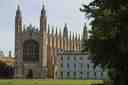
打开独立页面 →To spot King’s College, just look straight ahead for the enormous stone chapel with its spiky towers and giant arched window-it's the building looming over the lawn, impossible to…阅读更多收起
To spot King’s College, just look straight ahead for the enormous stone chapel with its spiky towers and giant arched window-it's the building looming over the lawn, impossible to miss, especially with the sunlight catching its pale stone. Now, let your imagination whisk you back nearly six centuries. Here, in the heart of Cambridge, King Henry VI dreamed up this remarkable place in 1441-a college for “poor scholars,” linked at first only to the boys of Eton. Picture the scene: the king himself, robes fluttering, stepping on muddy old gardens and laying the very first stone of the Old Court. The air crackles with excitement and nervousness. But, as often happens with grand dreams, history had surprises up its sleeve. The Wars of the Roses swept through England, money ran dry, and the king lost his crown before he could finish what he’d begun. The great King’s College project almost became the medieval version of “coming soon-never!” Luckily, royal ambitions like to run in families. About sixty years later, another king, Henry VII, dusted off those plans, seeing not only an architectural opportunity but a way to boost his own reputation as the “new boss.” (Who wouldn’t want their face on the best college in town?) He upped the stakes, expanded plans for pupils, and eventually roped in yet another monarch, Henry VIII, to finish the job during his reign. If you squint, you can still spot the line where stone from Henry VI’s time ends and the darker, newer blocks from later kings take over! But the real showstopper would be the chapel right in front of you. Finished in 1544, it still takes the breath away. Stand close and you’ll see why: this is late Gothic architecture at its wildest-soaring walls, ornate spires, and a window big enough for you to imagine giants reaching through! And yes, that ceiling inside-we’re talking the world’s largest fan vault, like a stone forest branching above your head. King’s College Chapel isn’t just a pretty face. Its stained-glass windows-most from the 1500s-glow with color even on gray days, and the ancient wooden chancel screen is a masterpiece in itself. All this beauty has echoed to the sound of music for centuries-especially the famous Choir of King’s College, whose angelic voices ring out at the Festival of Nine Lessons and Carols, broadcast to millions every Christmas Eve. Rain or shine-even through the dark days of World War II, when the glass was sheltering in cellars-the music never stopped. Of course, life at King’s has had its odd bumps and bursts of mischief. For much of its early history, every student came from Eton; only later did non-Etonians sneak in, and women joined at last in 1972 after over 500 years of college “bachelorhood.” The traditions are still strong; once a year, students gather for a feast to honor their founder-ale, song, and roast dinners galore. Even the great painting inside the chapel, a massive Rubens’ “Adoration of the Magi,” caused its own drama in the 1960s-you see, it was so big that to fit it behind the altar, they had to flatten the floor, sparking polite academic outrage worthy of a soap opera! Beyond all this grandeur, King’s has hosted thinkers, dreamers, poets, and scientists-Alan Turing, John Maynard Keynes, Zadie Smith, and even the man who invented the flush toilet (don’t ever say Cambridge wasn’t at the cutting edge). Its mix of old stones, new ideas, and the hum of student laughter makes it as lively as ever. So as you look up at those spires, feel the layers of ambition, rivalry, and music swirling through the air. You’re standing in a place built on royal dreams, student traditions, a bit of drama, and a whole lot of history. Don’t forget to take a deep breath-imagine the scent of ancient stone and the distant note of a choir-and carry a bit of King’s magic with you on to the next adventure! For further insights on the buildings and grounds, academic profile or the intake and access profile, feel free to navigate to the chat section below and inquire.
打开独立页面 →Look for the enormous, turreted stone building with massive pointed windows and spiked towers rising up in front of you-just ahead lies King’s College Chapel, famous for its…阅读更多收起
Look for the enormous, turreted stone building with massive pointed windows and spiked towers rising up in front of you-just ahead lies King’s College Chapel, famous for its breathtaking Gothic style and gigantic windows. Now, pause for a moment, take a good look at those soaring walls and the intricate towers above the entrance. If Hogwarts and a wedding cake had a baby, you might get something almost as grand as this chapel! Imagine the year is 1446-a time of kings, courtly drama, and a good deal of mud everywhere. King Henry VI himself marches out onto this very spot, places the first stone, and probably tries to look serious for the occasion, even as his cloak gets caught in the wind. Henry’s dream? To build a chapel that would outshine not just his rivals, but time itself. He wanted a university to match Eton (which he’d also founded-talk about an overachiever!) and picked the grandest measurements for this skylit marvel. He brought in Reginald Ely, master architect, to corral the best stonemasons in England-no easy feat when the Wars of the Roses were raging, and everyone was busy picking sides and dodging arrows! But building a chapel in turbulent times isn’t exactly smooth sailing. Work stopped, started, then stopped again-kind of like trying to watch your favorite show with spotty internet. When Richard III took over (the king with the bad reputation and worse bedside manner), only five sections had gone up, and even then, they had to slap on a temporary wooden roof just to keep the rain out. It wasn’t until Henry VII swept in, many years later, that things picked up again. He left enough money behind that after he was gone, the construction didn’t miss a beat. By 1515, the building itself was done, but the story doesn’t end there. Enter the world’s largest fan vault, built by the talented John Wastell. Imagine standing in the middle of the chapel, craning your neck back as the roof curves into delicate stone fans, their ribs spreading like the wings of a giant angel. That ceiling is so high and so intricate, if spiders ever tried to build cobwebs up there, they’d need a GPS to find their way down. But it’s not just about the stonework. Check out those windows-there are 24 gigantic stained-glass windows zigzagging down the sides, and each one is a masterpiece. Venetians and Flemish craftsmen created these stories in glass between 1515 and 1531, filling them with colors so vivid, you’d think sunlight was invented just to shine through here. During World War II, the precious glass was taken down and carefully tucked away for the duration, to keep it safe. The chapel has dodged disaster more times than your average action movie hero. Now let’s talk about drama-above the altar sits “The Adoration of the Magi” by Rubens, but its arrival wasn’t exactly greeted by trumpets and applause. The painting was installed in 1968, and some folks thought it looked out of place, like a stamp trying to outshine the cathedral’s east window. After some rather heated debate, architects added plain shutters, framing the painting so it would feel at home. Unlike a bad haircut, this solution actually improved with time. If you listen closely, you might catch the famous choir rehearsing. The sound is so pure, even the pigeons outside pause to listen. The choir is world famous and their Christmas Eve service has been broadcast by the BBC for decades. Imagine the clear high notes floating up and bouncing off the fan vault, filling every nook and cranny. Despite centuries of upheaval, wars, and even Puritan soldiers training inside (who left graffiti on the walls-medieval mischief at its finest), King’s College Chapel stands as a proud symbol of Cambridge. It’s a building where dreams of kings, the labor of craftsmen, and the music of angels all come together, right before your very eyes. So go ahead, walk up to the door, and let your imagination step inside. You’ll be in some truly grand company. Fascinated by the construction, great windows or the rood screen? Let's chat about it
打开独立页面 →Look ahead for a vast square of golden stone buildings, a grand clock tower, arched windows, and a lovely ornate fountain right in the middle-this is the legendary Great Court of…阅读更多收起
Look ahead for a vast square of golden stone buildings, a grand clock tower, arched windows, and a lovely ornate fountain right in the middle-this is the legendary Great Court of Trinity College. Welcome to the heart of Trinity College, where if history had a postcode, it’d probably be right here! Feel the crunch of gravel underfoot and take a deep breath; you’re standing in what’s reputed to be the largest enclosed courtyard in all of Europe. Look around-the four sides of this mighty court stretch nearly as far as the eye can see, their honey-coloured stones glowing in the sunlight, and every corner whispers with stories of genius, mischief, and tradition. Let’s rewind a few centuries, to when a clever chap named Thomas Nevile became master of Trinity. Nevile fancied things to be a bit more organized, so he had the college’s older buildings shuffled and tucked neatly into this single, magnificent square. Just imagine: in the early 1600s, stone masons, students, and scholars bustling about, the scent of fresh mortar in the air, as Great Court took shape. It’s about 1.8 acres-enough space for a game of cricket, a pop concert, and probably half the city’s pigeon population. Now, cast your eyes northeast. If you were a mathematical genius (or just really great at finding your way to the nearest pub), you’d know that’s E staircase, where Isaac Newton once scribbled his revolutionary ideas. I wonder if he ever stared out these windows, planning to change the laws of nature or pondering if apples should be included in the lunch menu. Just past E comes the mighty Great Gate, started way back in 1490. Above it stands an imposing statue of Henry VIII holding-wait for it-not a sceptre, but a chair leg! Trinity students, it seems, have a long tradition of swapping royal relics for more… domestic items. Onwards along the East Range you’ll find staircases filled with the rooms of fellows; if you’re lucky, you might catch a whiff of pipe smoke, chalk dust, or a faint waft of midnight coffee. Now, on the south side, the Queen’s Gate, named for Elizabeth I-look for its stately curves-invites you to imagine carriages rattling through, bearing young scholars dressed in black robes and nerves. Over to the west, the Great Hall dominates, with its high ceilings and echoes of centuries of laughter. This is where students and fellows would gather for feasts that went on so late, even the candles yawned. Nearby is the Master’s Lodge-a grand home for whoever’s in charge, presumably with a secret stash of biscuits. The north side begins with ancient staircases, followed by King’s Gate, and here’s a treat: Trinity’s famous clock. It chimes every fifteen minutes, and each hour is struck twice-once for Trinity, and once as a tip of the hat to St John’s College, the master’s alma mater. On a quiet day, you can almost feel the passage of time itself, winding through these ancient stones. But the real magic comes from the centre: the ornate fountain. It’s not just for decoration-back in Nevile’s day, this beauty was fed by a pipe all the way from west Cambridge. The sound of trickling water was probably very soothing for students wrestling with Latin or the occasional existential crisis. Ready for a spot of action? Here in Great Court, every autumn, students attempt an Olympic-worthy feat: the Great Court Run. The challenge? Sprint around the entire court-over 330 metres-before the clock finishes striking noon. Don’t be fooled by the film Chariots of Fire; it was recreated at Eton, but the Trinity Run is the real deal, and almost no one’s done it. Not even Harold Abrahams! In 1927, Lord Burghley did it, and since then only a literal handful have managed to beat those famous chimes. Seb Coe tried, Steve Cram gave it a go, and in recent years, runners, winded and wild-eyed, have dashed for victory. The clock’s character even changes with the weather: a chilly day slows it down, making the run just a smidge easier. Meanwhile, organisers recalibrated the running route to make sure the challenge is as tough as ever. There’s also a slightly more chaotic race-imagine students in academic robes and gowns, dashing in all directions for the Caucus Race. The prize? A pint of beer, a little glory, and a lot of jeering from the gathered tourists. And finally, to the north lies the grand chapel, begun by Mary I in memory of her father. Wander through the ante-chapel, where statues of Trinity’s greatest minds stand in silent conversation, and the organ, crafted by Swiss masters, fills the air with music that whispers of centuries past. So take a moment-stand by the fountain, listen for the bells, and imagine the great minds, the racing hearts, and the mischief of centuries. Welcome to the beating heart of Trinity College-it’s never just been about the bricks, but about the brilliance they’ve seen. If you're curious about the description, the great court run or the caucus race, the chat section below is the perfect place to seek clarification.
打开独立页面 →Right in front of you, you’ll see a stately cream-coloured stone building with tall sash windows and an ornate arched doorway crowned by a grand lantern-look for the neat row of…阅读更多收起
Right in front of you, you’ll see a stately cream-coloured stone building with tall sash windows and an ornate arched doorway crowned by a grand lantern-look for the neat row of bicycles leaning against the wall to be sure you’ve found Trinity Hall. Welcome to Trinity Hall, or as the cool Cambridge crowd calls it, "Tit Hall." Don’t worry, you’re not about to join a secret society with a peculiar dress code-this is one of Cambridge’s oldest and most storied colleges, founded back in 1350, at a time when knights clanked in armor and nobody had yet invented iPads or proper sewer systems. Imagine the aftermath of the Black Death; the air thick with worry, church bells ringing for the lost, and every street filled with a nervous hope for renewal. Right through that fateful landscape strode William Bateman, Bishop of Norwich, his mind racing with plans to train new clergymen after losing nearly 700 parish priests. His solution? This very place where you stand, a patch of ancient Cambridge that once belonged to struggling Gonville Hall, chosen to help rebuild England’s soul. Step closer and listen-if these old walls could talk, they’d whisper stories of monks scurrying past in the foggy dawn, nervous students clutching their law books, and the clang of church bells calling people to worship. For almost seven centuries, Trinity Hall has watched the world change. It all began with legal scholars, thanks to Bishop Bateman’s focus on canon and civil law-a tradition that lasted centuries, far outliving powdered wigs and ink-stained quills. Fun fact for you: Cambridge’s colleges were all called “halls” or “houses” in the beginning, but here’s the twist-when good old Henry VIII rolled in next door to build Trinity College, he decided Trinity Hall would stay a "hall." Was it royal punishment? A touch of Cambridge drama? Either way, it’s never, ever “Trinity Hall College.” If you say that in front of the porters, expect an eyebrow raise-and perhaps a quiz on Tudor history. Now, feast your eyes on the elegant face of Front Court. The outside took on a Baroque flair in the 1700s, thanks to Sir Nathaniel Lloyd, who decided the Middle Ages were so last millennium. Thank Lloyd for those grand details, because rumour has it, he wanted his own huge portrait to stare sternly at generations of students from the dining hall wall. He even made sure it was bolted in so nobody could ever remove it-talk about long-term job security! Take a deep breath-you might catch the faint scent of beeswax from the crooky wood-panelled chapel, or even wisp of roast dinner wafting from the dining hall. Somewhere inside the old library, you’ll find rare manuscripts chained to the shelves to stop sticky-fingered scholars from making off with Aristotle under their robes. Elizabeth I herself allowed that library to grow, and the brand-new Jerwood Library, opened in 1999, stares out over the river like a modern student quietly judging its elders for wearing tweed. But Trinity Hall isn’t just ancient: it’s full of life and quirks. There are Junior, Middle, and Senior Combination Rooms buzzing with plans for the next big social, and the college’s societies are a tapestry of serious scholarship and splashy fun. You might hear the shouts of the Boat Club, which once dominated the May Bumps races for years-just imagine rowing that stretch of the River Cam, heart thumping, the finish line in sight. Or you could join the revived Hesperides literary society, whose early dinners once attracted luminaries like T. S. Eliot and a certain spy called Donald Maclean. Of course, life hasn’t always been a rosy stroll by the river. Trinity Hall has faced storms of controversy, especially in recent years, with difficult moments forcing the college to reckon with its past and implement major reforms for its future. Yet with a new Master-Mary Hockaday-and a commitment to change, the college continues to look ahead, learning from every challenge. And don’t forget the stars who walked these same cobbles-think of Stephen Hawking, Nobel-prize winners, prime ministers, philosophers, spies, authors, and even Oscar-winning actresses like Rachel Weisz. Maybe, as you linger here, you’ll feel their echoes, and wonder what stories you’ll leave behind. Just be careful-if you try to bolt your own portrait to the wall, the porters might have a few things to say about that. Wondering about the buildings, student life or the gallery? Feel free to discuss it further in the chat section below.
打开独立页面 →To spot the Wren Library, just look straight ahead for a long, elegant building standing above an open row of arches, with huge windows shining down on the grass of Nevile's Court…阅读更多收起
To spot the Wren Library, just look straight ahead for a long, elegant building standing above an open row of arches, with huge windows shining down on the grass of Nevile's Court and four statues proudly perched along the roof. Now, pause for a moment and breathe in the quiet energy around you. You’re standing before the Wren Library, and you might as well imagine the scent of old books and the gentle shuffle of scholars plotting world-changing ideas. This majestic building was dreamt up by Sir Christopher Wren back in 1676-yes, the very same man who gave London its St Paul’s Cathedral after the Great Fire. When it finally opened in 1695, the people of Cambridge were buzzing: Wren’s design looked like nothing seen before. While libraries were once dark, stuffy places, this one flooded readers with light-those giant windows above you were truly a revolution. In fact, you could say it was the first time students could actually see what they were reading, rather than just guessing. The floor inside drops lower than the outside façade, a clever trick to keep those graceful proportions without squishing the ceiling. Imagine stepping through the ground-floor arches, climbing up, and arriving in a single vast room-sunbeams pouring across shelves lined with treasures. Bookcases march in file beneath the windows, each crowned by intricate limewood carvings, fluttering and curling as if alive, made by the famous Grinling Gibbons. Above those, busts of writers from every age seem to peer down-were they watching for overdue library books, or just daydreaming along with the students? The marble figures on plinths were mostly carved by Louis-François Roubiliac-every face with its own story. And yes, that’s a full-sized statue of Lord Byron, looking rather dashing. He was once offered a spot in Poets' Corner at Westminster Abbey, but let’s just say his wild adventures put off the gatekeepers. Thank goodness, or he’d never have ended up here. Now, lift your eyes to the roof. On the east balustrade, four statues gaze out: Divinity, Law, Physic (that’s medicine), and Mathematics. It’s as if the very foundations of knowledge are keeping watch. The atmosphere inside is hushed, interrupted only by your own footsteps-imagine the whispers of Newton or Francis Bacon echoing underneath the vast ceiling. At the far end, you’d find a towering stained-glass window, designed by Giovanni Battista Cipriani. In this riot of colored glass, Fame herself presents Isaac Newton to King George III (who looks fairly comfortable, considering), while cherubim and a trumpet-blowing lady make it a celebration worth pausing for. In the 19th century, this window was hidden behind thick curtains, so scholars wouldn’t get distracted-honestly, I think they were more worried about staring contests with the bare-breasted muse. The library is bursting at the seams with relics: Newton’s own annotated copy of Principia, medieval manuscripts, the earliest books printed in English, A. A. Milne’s original Winnie-the-Pooh stories, and even Robert Oppenheimer’s own notes on the atomic bomb. The inventory is so rich that you half expect to bump into Winnie-the-Pooh and Isaac Newton debating next to a shelf of Shakespeare’s first folios. Today, most of these treasures have been lovingly digitized, ready for readers from all over the world. Though its doors are sometimes guarded by limited opening hours, a walk by the Wren Library is always worth it. If you listen closely, you might almost hear the pages turning through 300 years of history-a living testament to the curiosity that fuels Cambridge itself.
打开独立页面 →Straight ahead, you’ll spot The Backs-a sweeping stretch of green lawns rolling down to the River Cam, with grand college buildings on one side and a scattering of grazing cows…阅读更多收起
Straight ahead, you’ll spot The Backs-a sweeping stretch of green lawns rolling down to the River Cam, with grand college buildings on one side and a scattering of grazing cows and willowy trees on the other; just follow the river and let your eyes drift across the landscape for this postcard-perfect view. Welcome to The Backs! Right now, you stand at one of England’s most picture-perfect places-so much so, it made the top ten views in the country, handpicked by none other than the chairman of the National Trust. Not too shabby for a bunch of college backyards, right? That’s actually where the name comes from: these are literally the “backs” of Cambridge’s world-famous colleges, unfurling their grassy arms to embrace the River Cam. Imagine, if you will, that it's the 16th century. Things smell a little bit earthier, and the landscape looks nothing like a manicured park. You’d be standing in the middle of pastures dotted with colleges’ fruit trees, and perhaps dodging the odd cow! Cattle are still part of the picture here today-just peek behind King’s College and you might spot their spotted friends munching away, carrying on a tradition hundreds of years old. The tranquility of the river, with the dreamy colleges on one bank and wild meadows on the other, has inspired poets, artists, and daydreamers for centuries. But look a bit deeper, and you’ll uncover some drama simmering beneath that calm surface. In the 1700s, St John’s College called on England’s most famous landscape architect with the grandest nickname, Lancelot “Capability” Brown. His mission? To transform this area into sweeping parkland, complete with lakes and clever clusters of trees. His plan was so epic, it would have meant tearing down old tree-lined avenues, erasing historic boundaries, and even removing three of those beloved bridges. But Cambridge had other ideas-Brown’s grand vision was politely stamped with a big British “no thank you,” preserving the colleges’ quirks and their crisscross of bridges. It’s probably for the best, or Cambridge would have lost its charming jumble of footbridges, from Trinity’s ornate crossing to the Mathematical Bridge at Queens’-each with its own secret story. Now listen closely for the gentle clack of oars and the soft laughter drifting by. The Backs have long been the perfect place for punting-a sort of English gondola ride with less singing and more chance of falling in. But it hasn’t all been smooth sailing, either for punters or for the trees. In the late 20th century, disease swept through those elegant elms lining the water. Suddenly, the beauty of these historic landscapes seemed at risk. Enter the “Backs Committee”-a superhero squad of college gardeners! They banded together, rolled up their sleeves, and started a replanting blitz to keep the scenery lush and leafy. The committee’s work lives on, and so does the endless debate over how The Backs should look in future generations. Should new avenues be planted? More “wilderness” left untouched? Do you want your trees tidy or tangled? Cambridge likes to make its decisions very, very carefully-sometimes over centuries! And the story’s not finished yet. Plans by former Girton College student and landscape architect Robert Myers have mapped out The Backs for the next 50 years: more trees, more wildlife, more gentle screening from passing cars, and fresh green “rungs” to the neat ladder of tree-lined avenues that run across the landscape. It’s a living, breathing, evolving view that’s always checking itself in the mirror and asking how it could look just a little bit better. So, as you take in The Backs with colleges on one side and fields on the other, remember you’re enjoying a view shaped over centuries-by monarchs, gardeners, grumpy cows, and more than a few strong opinions. Sometimes a “back” is really the best side of all! Interested in knowing more about the the name, present-day and future development or the gallery
打开独立页面 →To spot the Bridge of Sighs, look for a beautiful, covered stone bridge stretching gracefully over the Cam with grand Gothic windows and spiky stonework, framed between two…阅读更多收起
To spot the Bridge of Sighs, look for a beautiful, covered stone bridge stretching gracefully over the Cam with grand Gothic windows and spiky stonework, framed between two imposing college buildings-if you see students punting below, you’ve found the right place. Now, as you stand right here, let your imagination drift back to the year 1831. Imagine the air alive with the sound of the river Cam flowing gently beneath, the echo of footsteps on ancient stone, and the low murmur of students caught up in last-minute philosophical debates-or perhaps sneakier mischief! This magical bridge connects St John’s College’s Third Court and New Court, and while its name nods to the Bridge of Sighs in Venice, our sturdy Cambridge version is in a league of its own. Forget gondolas and Italian drama; here you get punts, ducks, and budding geniuses plotting both essays and, well, the occasional prank. Speaking of pranks, legend almost becomes reality with the tangled stories of cars hanging under the bridge. Yes, you heard right-students, armed with nerves of steel and perhaps too much free time, once managed to dangle a car under this very bridge! The first escapade involved hauling an Austin 7 upstream on a structure of four punts and ropes, suspended midair beneath those regal arches. Picture the confusion of anyone punting below that day! A few years later, another group did it again, swinging a three-wheeler underneath. The bridge, as you see, is sturdy enough to survive even the wildest of university imaginations. It’s not all jokes, though-there’s a bit of romance to the stonework, with Queen Victoria herself claiming the Bridge of Sighs was her favourite spot in Cambridge. And, if you linger long enough, you might almost see the shadow of a young Lee Kuan Yew, future Prime Minister of Singapore, pausing for photos beneath these pointed arches, dreaming big dreams. So, while you snap your photos and gaze at the river, just know you’re sharing this Gothic masterpiece with students, scholars, and more than a few troublemakers from history. Cambridge wouldn’t want it any other way!
打开独立页面 →Have a look to your right as you stroll down Park Street-you can’t miss the ADC Theatre’s bold, modern white-and-blue frontage, with large banners and the theatre’s name splashed…阅读更多收起
Have a look to your right as you stroll down Park Street-you can’t miss the ADC Theatre’s bold, modern white-and-blue frontage, with large banners and the theatre’s name splashed in graphic black letters above the entrance. Alright, take a deep breath, and imagine you’re about to walk through those very doors. Welcome to the ADC Theatre: a little slice of theatrical magic that’s seen more drama, laughter, disaster, and triumph than you can shake a script at! The ADC Theatre has been holding the spotlight in Cambridge since 1855-yes, long before mobile phones, reality TV, or even the invention of Marmite-when a group of keen thespians from Cambridge University decided to swap pub back rooms for something a little more glamorous. They raised their pennies and pounds (probably pinched from student loans and midnight snacks), and by 1882, they owned the freehold of the Hoop Hotel, which slowly transformed, with love, sweat, and endless cups of tea, into the very theatre you see today. But this wasn’t just any comfortable Victorian hall. Oh no, in 1933 came a twist worthy of a true cliffhanger-a roaring fire gutted the theatre, leaving not a single velvet seat unscathed. But, like all great stories, the ADC rose from the ashes, rebuilt and reimagined, and reopened in 1935 with a splash of Art Deco showbiz, under the design talents of Harold Tomlinson and W. P. Dyson. If you’re standing outside, you might sense the buzz inside-students, locals, old friends, and starry-eyed newcomers all mingling. There’s space for 228 audience members, the seats wrapping around a stage where dreams grow night after night. Notably, the back row can squeeze in an extra few folks-because who can resist sneaking a friend in at the last moment? And if you fancy catching a show, the front row is step-free and easy to reach thanks to a modern lift, so everyone has a front seat to the show. Now, the ADC isn’t just famous for its stage shows, but its bar-oh, the bar. It opens 45 minutes before curtain-up, and lingers open late into the night, with cocktails themed around the week’s performances. Fancy a Hamlet Highball or a Footlights Fizz? You never know what you’ll find. And for the ultimate party trick, the ADC boasts a safety curtain that defies stage tradition-rather than falling down from above, it rises up from the floor. A bit like a drama student trying to sneak off after a failed audition. Amid the laughter and applause, the ADC has witnessed some who went from footlights to actual limelight. Sir Ian McKellen, Emma Thompson, Stephen Fry, Hugh Laurie, Tom Hiddleston, Eddie Redmayne-many first trod the boards right here, with nerves jangling and dreams bigger than the backstage fridge. It’s a launch pad for funny people too: viral comedian Ken Cheng played here; the Footlights comedy group forged their legends in late-night larks and Sunday bar sets. And a roll call of legendary directors-Sir Peter Hall, Sam Mendes-once gave cues and called ‘lights up’ right behind these doors. Like any great theatre, the ADC has a hunger for reinvention. The 2000s saw a wave of new improvements-a new toilet block (trust me, that really improves the audience’s melodrama), a bar roof terrace, reimagined offices, and best of all, more comfy seating. Accessible lifts meant no one had to scramble up ladders just to turn on the spotlight, and backstage, the green room and set workshop came alive with the whiff of sawdust and anticipation. Every term, the theatre churns out a dizzying selection of shows-two a night during university term time, including late-night laugh riots and one-off drama. Tuesday nights often bring something wild: stand-up, fringe plays, and brand-new scripts hoping for a standing ovation or at least a few awkward giggles. Even in the quieter patch of holidays, city drama groups and local stars keep the stage warm. So here you are, standing where so many neon dreams have flickered to life, outside a building that’s survived disaster, changing fashions, and hundreds of suspiciously sticky cocktail glasses-living proof that the show really must go on! If walls could talk, these ones would probably ask for a second act, and maybe another round at the bar. Ready to catch that next act? Or maybe just daydream that your name will be the next to light up the marquee! Yearning to grasp further insights on the redevelopment, subsequent renovation or the shows? Dive into the chat section below and ask away.
打开独立页面 →In front of you is a grand stone building with a symmetrical face, tall chimneys, and elegant rows of white-paned windows; look for three large arches along the ground floor with…阅读更多收起
In front of you is a grand stone building with a symmetrical face, tall chimneys, and elegant rows of white-paned windows; look for three large arches along the ground floor with hanging baskets-the sign “Bibliotheca Pepysiana” above the center arch will let you know you’ve found the famous Pepys Library. Now, take in the rich honey-colored stone, the neat sash windows, and those arches-this is the very place where one of history’s greatest diaries quietly sleeps between ancient bookcases. Imagine it’s the late seventeenth century. Samuel Pepys, a true lover of books with an infectious curiosity, prowls the narrow streets of London, collecting everything from bawdy ballads to the finest manuscripts, with the energy of a man on a lifelong literary treasure hunt. He winds up with over 3,000 volumes packed with secrets, stories, and scientific breakthroughs-his entire life, catalogued and indexed so meticulously that you suspect even a mouse wouldn’t go missing without a log entry. Pepys’s legacy, though, stretches far beyond books. He planned every detail for their survival-even in his will, he left strict instructions: the collection must never be split, expanded, or neglected. So when his nephew, John Jackson, passed away in 1723, the books arrived here, still in the original cases Pepys fussed over. There’s a touch of comedy to his detail: he wanted the placement of every single book “nicely adjusted.” Talk about someone worried about a case of literary shelf esteem! Inside-sadly, no sneaking in after hours like a 17th-century library ninja-you’d find more than dusty tomes. Here, Pepys’s own six-volume diary basked in its familiar home, revealing not just the horrors of plague and fire, but daily joys and complaints (he’d frankly make a hilarious blogger today). There are naval records he created as Secretary to the Admiralty, filled with tales of warships, including the famous Mary Rose. Newton’s very own Principia rests here too, alongside ballads, manuscripts, and relics from explorers like Francis Drake. The building itself wasn’t easy work either. Built slowly between 1670 and 1703, it’s a masterpiece of classical design, complete with Pepys’s coat of arms, a painted motto nicked from Cicero-“The mind’s the man.” Every stone and sash window speaks of survival, curiosity, and the relentless march of knowledge. So take a moment to picture Pepys himself, perhaps peering down at you from a window, making sure you don’t walk off with any books-or worse, put the biographies next to the ballads. Welcome to the Pepys Library, where every corner hides a story and every book still remembers the hands that turned its pages centuries ago. Now, onward-who knows what other secrets Cambridge is keeping just around the next corner? Seeking more information about the background, the collection or the pepys building? Ask away in the chat section and I'll fill you in.
打开独立页面 →Right in front of you, you’ll see a lovely old brick house with white windows and a modern glass extension tucked to the right-just look for the low wall with the sign “KETTLE’S…阅读更多收起
Right in front of you, you’ll see a lovely old brick house with white windows and a modern glass extension tucked to the right-just look for the low wall with the sign “KETTLE’S YARD” and a quirky round window. Welcome to Kettle’s Yard, where art and homeliness shake hands and promise never to let go again! Picture this: it’s 1956, and Jim Ede, a former Tate Gallery curator, has just moved into what used to be four tiny cottages with his wife Helen. You can almost hear the clatter and chatter as the walls are knocked through and twirled into shape-. Jim didn’t just want a house, oh no! He dreamed of a place where art would feel at home, a little less "gallery hush," a little more "living room warmth." So, imagine wandering in as a student back in the 1960s. Jim himself might greet you by the door, perhaps offering a cup of tea, all while the sunlight dances on sculptures by Henry Moore or canvases by Joan Miró. Pretty soon, he’d be leading you on a personal tour, swapping gallery ropes for good stories and found pebbles! Over the years, friendships with artists turned the collection into a sparkling time capsule of British avant-garde art-think Brâncuși, Barbara Hepworth, Winifred Nicholson, and more. By 1966, Jim handed over the whole magical place to Cambridge University, but he and Helen continued to potter about here for years; the spirit of their hospitality lingers in every nook. When the collection outgrew its home, a striking modernist gallery grew onto the original house in 1970-less like adding an extension and more like making space for art to stretch its legs. Fast forward to 2018, after a huge £11 million makeover, Kettle’s Yard burst into life again, with a new café, a welcoming shop, and sunny courtyards-don’t worry, though, the house itself is exactly as the Ede family left it. Step closer, and you might notice the balance of glass, stone, and brick, where old and new meet like old friends whispering secrets. The garden outside rustles in the breeze, just as it did decades ago-. Inside, every corner lets you sense Jim’s gentle touch, where art objects mingle with shells, stones, and flowers in sunlight, making the whole place feel less "museum," more "soulful retreat." Kettle’s Yard isn’t just about looking at art-it’s about feeling it, living with it, and sharing its wonders. As you stand here, maybe you’ll hear music drifting from a live performance or the friendly chatter of visitors. Some even call it “the Louvre of the pebble”-so whatever you do, keep your eyes peeled for the next little marvel waiting around the corner!
打开独立页面 →
常见问题
如何开始导览?
购买后,下载 AudaTours 应用并输入您的兑换码。导览将准备好立即开始--只需点击播放并按照 GPS 引导的路线行驶即可。
导览期间我需要互联网吗?
不需要!开始前下载导览并完全离线享受。只有聊天功能需要互联网。我们建议在 WiFi 下下载以节省移动数据。
这是导游带领的团体游吗?
不是--这是自助语音导览。您按照自己的节奏独立探索,通过手机播放音频解说。没有导游,没有团体,没有时间表。
导览需要多长时间?
大多数导览需要 60-90 分钟才能完成,但您完全控制节奏。随时暂停、跳过站点或休息。
如果我今天无法完成导览怎么办?
没问题!导览具有终身访问权限。随时暂停和恢复--明天、下周或明年。您的进度已保存。
有哪些语言可用?
所有导览均提供 50 多种语言版本。在兑换代码时选择您的首选语言。注意:导览生成后无法更改语言。
购买后我在哪里访问导览?
从 App Store 或 Google Play 下载免费的 AudaTours 应用。输入您的兑换码(通过电子邮件发送),导览将出现在您的资料库中,准备下载并开始。
如果您不喜欢该导览,我们将退款。请联系我们 [email protected]
安全结账使用