Beyoğlu Audio Tour: Spires, Squares & Stories of Istanbul
On these Beyoğlu streets, empires lost their grip while neon lit up old stone, and Galata Tower kept watch like a silent rival to the skyline. This self guided audio tour leads from Taksim Meydanı through Beyoğlu to Galata Tower and beyond, unlocking rebellions, scandals, political battles, and forgotten moments most visitors walk past without noticing. What erupted in Taksim when crowds turned a square into a battlefield and the city held its breath. What secret messages and vanished suspects once haunted the tower and its shadowed lanes. Why did a single song in Beyoğlu spark a scandal so specific it changed who could perform, where, and at what hour. Move downhill through back streets and grand avenues, following echoes of power, danger, and desire. Each stop reframes Istanbul with sharper edges and brighter light. Press play and let the watchful tower pull the city open.
导览预览
关于此导览
- schedule持续时间 40–60 mins按照自己的节奏
- straighten3.5 公里步行路线跟随引导路径
- location_on
- wifi_off离线工作一次下载,随处使用
- all_inclusive终身访问随时重播,永久有效
- location_on从 Taksim Republic Monument 开始
此导览的景点
Look for the tall pink-and-green stone monument in the middle of the open plaza, with bronze figures clustered under a big arched canopy on each side. You’re standing by the…阅读更多收起
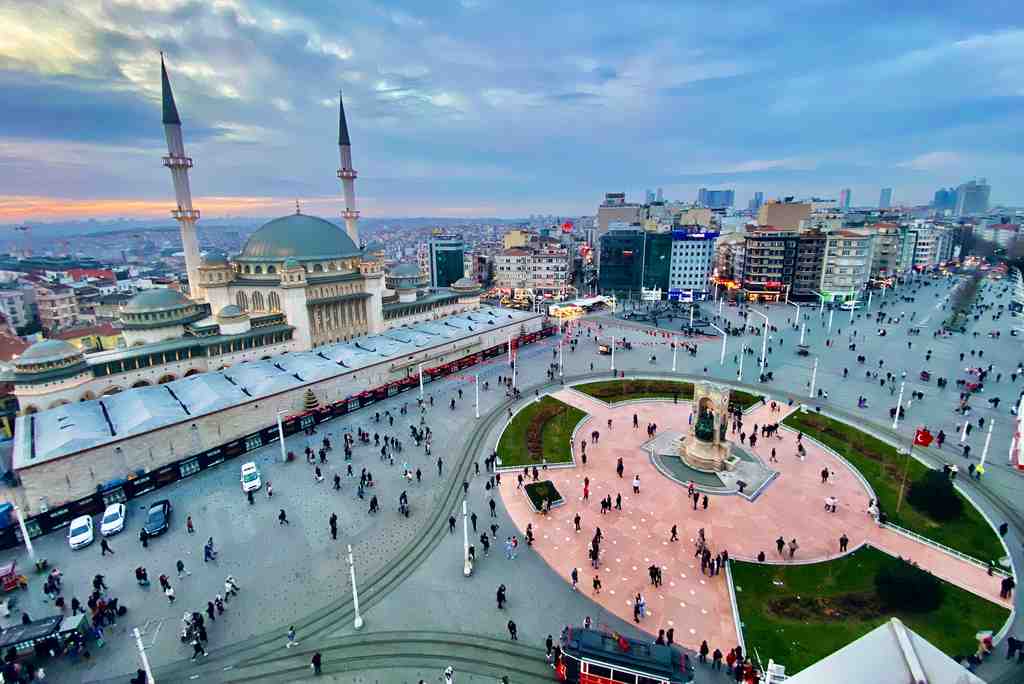
Look for the tall pink-and-green stone monument in the middle of the open plaza, with bronze figures clustered under a big arched canopy on each side. You’re standing by the Taksim Republic Monument, finished in 1928-basically Istanbul’s way of putting the new Turkish Republic into 11 meters of marble and bronze and saying, “Okay, everyone, gather ‘round.” The sculptor was Pietro Canonica, an Italian brought in after a major international competition, because when you’re reinventing a country, you don’t exactly shop modestly. A commission led by Istanbul deputy Hakkı Şinasi Paşa officially placed the order in 1925, and after about two and a half years of work, this 84-ton heavyweight traveled from Rome to Istanbul by ship. No pressure, right? Take a slow walk around it and you’ll notice it’s built like a little stage set into stone arches-traditional architectural curves holding very modern political messaging. One face shows the struggle of the War of Independence; the other shifts to the Republic era: Atatürk in civilian clothes, alongside İsmet İnönü and Fevzi Çakmak, surrounded by soldiers and ordinary people. It’s not subtle, and it’s not meant to be. This was an era when monuments were part public art, part public lesson-figures you could literally point at during ceremonies in the square. Now lean in for the detail most people miss: behind Atatürk on the Republic side, you’ll find two Soviet figures-Mikhail Frunze and Kliment Voroshilov-quietly acknowledging Soviet support during the independence struggle. It’s gratitude in bronze, tucked into the crowd. The base and the whole setting were designed by architect Giulio Mongeri, with striking marbles-pink from Trentino-Alto Adige and green from the Suza area. Canonica even designed it like a fountain, because “Taksim” comes from water being distributed from here. But the fountain idea never fully happened-money ran short, the last payment couldn’t be made, and the water feature stayed mostly a dream. Even revolutions have budgets. When you’re set, Taksim Square is a 0-minute walk heading northwest.
打开独立页面 →Ahead of you is a wide, open plaza with the Republic Monument set in the middle, and if you glance left you’ll spot a big domed mosque with two tall minarets watching over the…阅读更多收起
Ahead of you is a wide, open plaza with the Republic Monument set in the middle, and if you glance left you’ll spot a big domed mosque with two tall minarets watching over the square. Welcome to Taksim Square-part meeting point, part transit hub, and part open-air stage where Istanbul keeps rewriting its own script. Today it feels like a giant shared living room: people cutting across the paving stones, the occasional nostalgic red tram gliding nearby, and an endless hum from buses, taxis, shops, cafés, and hotels radiating out in every direction. But the square’s name gives away its oldest job, and it’s wonderfully practical. “Taksim” means “distribution.” In the Ottoman era, this area wasn’t a famous plaza at all-it was where water got managed. A reservoir and a small stone distribution building, a maksem, sat here to “divide up” water brought from the forests up north. In the early 1730s, Sultan Mahmud the First pushed a water system from the Belgrad Forest through a network of channels and structures, ending right here-then the water was sent out toward the surrounding neighborhoods. Istanbul may be a city wrapped in water, but fresh drinking water was always the hard part. So yes: one of the most iconic squares in Turkey is, at its origin, basically a municipal plumbing triumph. Try working that into a postcard. For a long time, this still wasn’t really a “square.” If you could time-travel back to when the main street of Pera-today’s İstiklal Avenue-reached this point, the urban world would more or less stop, and beyond it you’d hit open ground with few trees and not much structure. Over the 1800s, the area took on a distinctly state-and-military vibe with barracks and training grounds. The place even gave its name to Talimhane-“training house”-a reminder that soldiers drilling here was once normal background noise. The big transformation into a true city square came with the Republic era. The Republic Monument-right there at the center-arrived in 1928 and suddenly Taksim wasn’t just a junction or a blank space; it became a symbolic front yard for the new Turkey. Ceremonies, parades, grandstand seating, lights, and choreographed public life turned this into a national stage. And like any stage, it has seen drama. From the 1960s onward, the square became a focal point for mass politics-sometimes hopeful, sometimes grim. In 1969, clashes during protests against the visiting U.S. Sixth Fleet led to deaths in an event remembered as “Bloody Sunday.” The worst tragedy came on 1 May 1977, when gunfire and panic during a massive Labor Day rally caused 34 deaths and many injuries-an open wound in the square’s memory. Taksim also keeps physically reinventing itself. Parts of the traffic were pushed underground with pedestrianization work largely completed in 2013, and the square’s redesign has continued to be debated, voted on, and reshaped-because Istanbul never met a public space it couldn’t argue about passionately. When you’re set, Atatürk Cultural Center is a 3-minute walk heading east.
打开独立页面 →On your left, look for the big, modern glass-fronted building with a grid-like metal screen glowing in pink and purple light-that’s the Atatürk Cultural Center, or AKM. AKM sits…阅读更多收起
On your left, look for the big, modern glass-fronted building with a grid-like metal screen glowing in pink and purple light-that’s the Atatürk Cultural Center, or AKM. AKM sits right on Taksim Square like Istanbul’s living room for the performing arts: opera, ballet, theater, concerts, even big congress-style events-plus exhibition spaces and a cinema. The city has a thousand places to buy a simit, but only a few that can swallow an opera production whole, orchestra and all. The story starts with ambition and patience. The first version of this building began in 1946, but like so many big public projects, it ran into the classic obstacle: no money. Work stalled, the project changed hands, and eventually architect Hayati Tabanlıoğlu took over and pushed it forward. After 23 years-yes, twenty-three-it finally opened in 1969, originally called the Istanbul Cultural Palace. For the debut, the program went big: a ballet by Ferit Tüzün and Verdi’s Aida. Not exactly a “soft launch.” Then came the plot twist. In 1970, during a performance of Arthur Miller’s play The Crucible, a fire ripped through the building and left it badly damaged. No one died, but the loss was still brutal: along with the hall itself, items brought from Topkapı Palace for an upcoming production-objects linked to Sultan Murad the Fourth, including a robe, a valuable Quran, and a painting-were destroyed. The cause of the fire was never pinned down, which only adds to the unease. A modern cultural temple, burned mid-performance, for reasons nobody could confidently name. Tabanlıoğlu restored it, and in 1978 AKM reopened-stubbornly-continuing for decades as the home base for Istanbul’s state theater, opera and ballet, and symphony. Architecturally, the original AKM wore the clean, practical lines of the 1950s: less ornament, more purpose. Inside, it was a serious machine for stagecraft, built with a big hall, deep stage, and the kind of backstage mechanics that let productions transform fast. But buildings age, and AKM became a national argument as much as a venue. It was closed from 2008 to 2018, pulled into lawsuits, restoration debates, and the political turbulence around Taksim. Eventually the old structure was demolished in 2018, and the new AKM rose from the same spot-opened in 2021, on October 29, Turkey’s Republic Day. Fitting date, considering AKM has always been as symbolic as it is practical. Today’s complex is larger and more multipurpose: a major opera hall, a sizable theater, and the extras that keep a cultural center alive between showtimes-galleries, a library, cafes, and more. When you’re set, Galatasaray Museum is a 12-minute walk heading north.
打开独立页面 →
再显示 10 个站点显示更少站点expand_moreexpand_less
On your right, look for the elegant white, four-story corner building with arched ground-floor windows and lots of ornate trim-right where the street opens up and the foot traffic…阅读更多收起
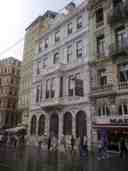
On your right, look for the elegant white, four-story corner building with arched ground-floor windows and lots of ornate trim-right where the street opens up and the foot traffic bunches around the corner. This is the Galatasaray Museum, and if you’re wondering why a museum needs to sit right on one of Istanbul’s busiest strolling streets, that’s kind of the point: Galatasaray is not just a school or a sports club here-it’s a whole identity, with a memory longer than most family photo albums. The origin story starts in a surprisingly weird place: a stuffed mammoth. In 1868, as the Ottoman Empire pushed modernization reforms during the Tanzimat era, Galatasaray High School restarted its activities with fresh energy and big ambitions. And along comes a gift from Napoleon III of France: an actual taxidermied mammoth. It helped spark the idea of a natural history museum at the school. So, in an oddly charming way, Galatasaray’s “museum instinct” began with prehistoric branding-nothing says “serious institution” like a giant extinct animal in the hallway. Fast-forward to 1909. Imagine a meeting room, people speaking French-because that’s what elite education sounded like in late Ottoman Istanbul-and the General Assembly of Galatasaray Sports Club is talking about the future. Not tactics, not transfer gossip: they set a goal to create a museum corner to keep the club’s memories safe. It’s a sweet idea, and also a very practical one. Sports glory is thrilling, but it’s also fragile-medals get lost, photos fade, and yesterday’s heroes become “wait, who was that again?” By 1912, the club’s founding figure, Ali Sami Yen, makes it real and opens the first Galatasaray Museum in Kalamış. Picture the early collection: cups and medals won up to that point, along with historic photos, documents, jerseys, and plaques. Not polished and corporate-more like a proud, carefully guarded treasure chest. Then comes the tension. After World War I, rumors spread that the club’s memorabilia might be confiscated. Istanbul is in turmoil, authority is shifting, and “ownership” can become a very flexible concept. Ali Sami Yen doesn’t wait around to find out. By a General Assembly decision dated May 15, 1919, the museum is transferred to Galatasaray High School-essentially placing the club’s memories into the safest vault they had: the school itself. You can almost feel the urgency there-like someone quietly moving the family silver before the knock at the door. Today, the collection has been enormous-775 cups and medals in total. Space, of course, is the permanent enemy of every museum. In 2018, Galatasaray opened a newer museum at the Ali Sami Yen Sports Complex, and many trophies and plaques were moved there. But this Beyoğlu location still keeps a selection on display-enough to remind you that this club didn’t just win in one sport and call it a day. Inside, the museum is organized like a life story. The first floor follows Galatasaray High School from its founding to the present, with student uniforms, classroom tools, and photographs-everyday objects that somehow make history feel more personal. The second floor is where the sports pride lives: key trophies, famous shirts like Metin Oktay’s jersey, and loads of photos and gear. The third floor is mainly administrative-because even legends need paperwork. And yes, the trophy list is outrageous: football league titles, cups, super cups, major European wins like the UEFA Cup in 2000 and the UEFA Super Cup the same year-plus basketball, volleyball, rowing, water polo, swimming, even esports. Basically, if it can be competed in, Galatasaray has tried to win it, frame it, and store it somewhere. When you’re set, Beyoglu is a 4-minute walk heading southwest.
打开独立页面 →Ahead of you is Beyoğlu’s hillside skyline: a dense stack of pale, weathered buildings climbing up from the water, with the Galata Tower’s cone-topped stone cylinder rising like a…阅读更多收起
Ahead of you is Beyoğlu’s hillside skyline: a dense stack of pale, weathered buildings climbing up from the water, with the Galata Tower’s cone-topped stone cylinder rising like a landmark punctuation mark above the rooftops. So, welcome to Beyoğlu-also known by its older name, Pera. And that name is wonderfully blunt: in Greek, “Pera” basically meant “the other side,” as in, “over there, across the Golden Horn from the historic peninsula.” Not poetic, not subtle, just practical. Istanbul has always been good at this: give a place a name that tells you exactly how to find it. “Beyoğlu,” though, is where the neighborhood gets its little mystery. The story goes it comes from “the son of a bey,” and depending on who you ask, that might point to a converted prince from Trabzon who settled here after embracing Islam, or to Luigi Gritti-the son of a Venetian diplomat-who reportedly lived in a mansion near Taksim. Either way, the name carries a whiff of politics, privilege, and a good amount of gossip, which honestly fits the district perfectly. For a long time, this wasn’t the city’s glamorous front room. In the early 1500s it was more gardens and vineyards than storefronts-green, quiet, and only lightly built up. The big shift came as people spilled uphill from Galata: Christians, foreigners, merchants, and especially diplomats. Embassies clustered here, and what would become İstiklal Avenue-once called the “Grand Rue de Pera”-started to form the spine of a very European-looking neighborhood inside an Ottoman capital. By the 1700s, Beyoğlu had spread along the tunnel-to-Galatasaray stretch, sprouting side streets like veins. Cemeteries sat off to one side, embassies to the other, and European influence kept turning the volume up. Buildings increasingly went stone and brick-partly fashion, partly fire safety, partly a district trying on modernity in the mirror. The 1800s is when Beyoğlu really hit its stride. As Ottoman trade expanded and transportation improved, this became a serious international business hub-bankers, traders, shipping people, the kind of crowd that reads contracts for fun. It also became a place to live a certain lifestyle: Paris-inspired clothes, theaters staging the same big-name plays you’d see in Europe, and the newest urban comforts-tramways, gas, water-often run through long contracts held by foreigners or minority communities. Like I said: politics and privilege, with paperwork. In the early 1900s, the focus shifted strongly toward the Galatasaray-to-Taksim stretch, helped by the electric tram linking up toward Şişli in 1913. Mansions with gardens could be replaced by apartments, and those apartment facades started flirting with Art Nouveau curves-because if you’re going to modernize, you might as well do it stylishly. After the Republic, Beyoğlu stayed a cultural heavyweight for a while-cinemas, theaters, restaurants, pastry shops, galleries-then later lost some shine as the city grew outward and tastes changed. But it never went quiet. Even today, the energy hangs in the air: commerce, culture, and that constant, slightly chaotic Istanbul motion. Ready for Pera Palace? Walk west for about 3 minutes, go up the stairs, and it’ll be on your right.
打开独立页面 →Look to your right for a big, pale stone, grand old building with long rows of wrought-iron balconies stacked floor after floor like a fancy layer cake on a street corner. This…阅读更多收起
Look to your right for a big, pale stone, grand old building with long rows of wrought-iron balconies stacked floor after floor like a fancy layer cake on a street corner. This is Pera Palace, opened in 1895-built for a very specific kind of traveler: the one who stepped off the Orient Express and still expected life to come with linen, silver, and a little drama. The train started running Paris-to-Istanbul in 1888, and Istanbul needed a hotel that could greet European high society without making anyone feel like they’d fallen off the edge of the map. So here it rose in Tepebaşı, in the Pera district-nicknamed “little Europe” back then-looking out toward the Golden Horn like it owned the view. The architect was Alexandre Vallaury, a Levantine Istanbullu with serious credentials. He also designed landmarks like the Ottoman Bank and the Archaeology Museum, and here he blended styles the way Istanbul blends continents: Neo-Classical order on the outside, Art Nouveau flair in the details, and an Orientalist mood where it wanted to feel a bit like a stage set. The building sits on a big rectangular footprint and rises nine floors, including two basement levels-essentially a vertical city block of comfort. But the real flex in 1895 wasn’t just marble and manners. It was electricity. Outside the palaces, electric power was rare in Istanbul-Sultan Abdülhamid II worried wires could be used for assassinations, so permission went to only a few privileged places. Pera Palace was one of them. It also became famous for two other “firsts”: one of the earliest spots with continuous hot running water, and Istanbul’s first electric elevator. Imagine stepping inside after days of soot and steam travel, and instead of hauling trunks up stairs, you glide upward in a powered lift like the future just tapped you on the shoulder. Hotels like this don’t just host guests-they absorb secrets. Pera Palace hit its golden age up to World War I, drawing Ottoman elites, Levantines, and visitors chasing that cosmopolitan Istanbul buzz. Then war and occupation years tangled ownership and management into a messy relay: operating rights handed over, debts piling up, sudden exits. By 1923, the property ended up registered to the Treasury, then passed through bank ownership and private hands again. Later, a benefactor named Misbah Muhayyeş left his wealth to charities, and pieces of the hotel’s furnishings were even donated to Topkapı Palace-because in Istanbul, even the furniture likes to have a second career. The most iconic room is 101-known for hosting Mustafa Kemal Atatürk starting in 1917. He stayed here repeatedly, treating it like a base between war and politics, and the room became a museum space in 1981, filled with personal items like clothing and glasses. Another legend lives upstairs too: Agatha Christie is said to have stayed here in the late 1920s and early 1930s, with room 411 tied to the “Murder on the Orient Express” mystique-complete with whispers about a missing diary that still refuses to behave like a normal historical fact. In the modern era, careful restoration kept the historic character-down to that famous old elevator-while upgrading the bones so the place can still function as a hotel, not just a beautiful time capsule. When you’re set, Neve Shalom Synagogue is about an 8-minute walk heading southwest.
打开独立页面 →On your right, look for a pale, low-key facade with a long band of Star of David latticework near the top and a wide row of black metal doors marked with gold stars. This is Neve…阅读更多收起
On your right, look for a pale, low-key facade with a long band of Star of David latticework near the top and a wide row of black metal doors marked with gold stars. This is Neve Shalom Synagogue-its name in Hebrew means “Oasis of Peace,” which is a hopeful thing to call a place in the middle of a busy city street. You’ll find it here on Büyük Hendek Street in Karaköy, in the old Galata area where Istanbul’s Jewish community grew in the late 1930s. More people meant more prayers, more weddings, more bar mitzvahs-life stuff-so the community made a bold, practical decision: they cleared a Jewish primary school in 1949 and built a new synagogue on the site. The building you’re looking at was finished in 1951, designed by two young Turkish Jewish architects, Elyo Ventura and Bernar Motola. The opening ceremony, on March 25 that year, was a major moment-formal, crowded, and led by Turkey’s Chief Rabbi at the time, Rafael David Saban. Neve Shalom went on to become Istanbul’s largest and central Sephardic synagogue, especially active on Shabbat and the big holidays. But its story also carries real pain. During a Shabbat service in 1986, gunmen attacked and 22 people were killed-an atrocity later linked to Abu Nidal. There was another attempted bombing in 1992 that, thankfully, caused no casualties. In 2003, car bombs hit the city and Neve Shalom was struck again, part of an attack investigators said was too sophisticated to be purely local. Ready for Galata Tower? Just walk southeast for about 3 minutes.
打开独立页面 →Coming up on your right is Galata Tower-one of those buildings that doesn’t just “sit” in Istanbul, it kind of supervises it. You’re looking at a stone cylinder in a Romanesque…阅读更多收起
Coming up on your right is Galata Tower-one of those buildings that doesn’t just “sit” in Istanbul, it kind of supervises it. You’re looking at a stone cylinder in a Romanesque style, about 62 and a half meters tall. It’s planted on a hill, and it has that classic cone roof that makes it look like it’s wearing a very serious hat. The tower gets its name from this neighborhood-Galata-and for most of its life it’s been exactly what you’d want on a strategic hill: a watchtower, a warning system, and sometimes, frankly, a place you didn’t want to end up. The story really kicks off with the Genoese. Back in 1267, they set up a colony here on the north side of the Golden Horn, allied with the Byzantines-at least on paper. Over time, the Genoese expanded their control, occasionally in ways the Byzantines did not exactly approve of. By the mid-1300s they were fortifying this hill with walls and towers, and in 1348 this main tower went up as the crown of that defensive system. In those days, it was known as the “Tower of the Holy Cross,” because there was a cross on top. The point wasn’t just to admire the view; it was to control it-especially if anyone tried to come at the colony from land. Not long after, trade rivalries turned into open fighting between Byzantines and Genoese. The war ended in 1349, and the Emperor officially left the hill-this hill-to Genoese control. It’s a very diplomatic way of saying: “Fine, keep the tower.” Then 1453 happens. Constantinople falls to the Ottomans, and the Genoese in Pera hand over the colony without a fight. The tower and the fortifications take some damage, but Sultan Mehmed the Second orders the destruction stopped, and repairs begin. One symbolic change really says it all: the cross is replaced with the Ottoman flag. Same tower, new boss. Nature also had its say. The big 1509 earthquake hits Istanbul hard, and the tower is damaged-then repaired by 1510. If you look carefully at the tower’s body, there are horizontal brick bands that mark later rebuilding phases. Basically, the tower wears its repairs like scar tissue: not pretty, but honest. And the job description kept changing. In the sixteenth and seventeenth centuries it was used as a prison for war captives and also as storage for shipyard supplies-practical, grim, and very on brand for an empire that ran on logistics. Later, it becomes a fire tower. In a city full of wooden buildings, spotting smoke early was the difference between “minor incident” and “there goes the neighborhood.” Fires hit the tower too-1794 and 1831 both force major repairs and redesigns. At one point the upper section even turns into a coffeehouse, which is a pretty Turkish solution to disaster: rebuild it, then serve tea. In 1875, a storm knocks down the roof, and new upper levels are added so it can keep reporting fires and even help with communications. Fast forward to modern times: big restorations in the 1960s, exterior work again around 1999-2000, and by 2013 it’s in the UNESCO World Heritage tentative list as part of a wider Genoese trade-route story. In 2020 it’s reorganized as a museum and exhibition space. Today there are 11 levels, with an elevator up to the sixth floor, then stairs to exhibitions and, finally, the viewing terrace. Inside, you’ll find displays on the tower’s history and Istanbul itself-plus a nod to the legendary flight of Hezarfen Ahmed Çelebi, who is said to have glided from here across the Bosphorus. Whether that happened or not, it’s the kind of tale a city like this insists on keeping. When you’re set, Ashkenazi Synagogue of Istanbul is a 3-minute walk heading southwest.
打开独立页面 →On your left is the Ashkenazi Synagogue of Istanbul-quiet, modest, and still very much alive. It sits close to the Galata Tower, but its story starts with a different kind of…阅读更多收起
On your left is the Ashkenazi Synagogue of Istanbul-quiet, modest, and still very much alive. It sits close to the Galata Tower, but its story starts with a different kind of landmark: a community trying to hold onto home. Austrian Jews founded this congregation in 1900, building on the memory of an earlier “Austrian Temple” that stood here from 1831. Back then, the neighborhood would’ve sounded like a mash-up of languages-Turkish on the street, and inside, prayers in the Ashkenazi rite. Then came 1866: a massive fire tore through and destroyed that first building, and with it, a big piece of local Jewish life. Today, this is the only active Ashkenazi synagogue in Istanbul that welcomes visitors for weekday mornings and Saturday services. It still hosts weddings and bar mitzvahs-moments of joy that outlast the city’s disasters and drama. Since 2003, Rabbi Mendy Chitrik has led the congregation, keeping a small but resilient tradition going. When you’re set, St. George’s Austrian High School is a 3-minute walk heading north.
打开独立页面 →On your right is St. George’s Austrian High School-Sankt Georg to the people who’ve survived its German homework. From the street, it feels a little like a quiet embassy of…阅读更多收起
On your right is St. George’s Austrian High School-Sankt Georg to the people who’ve survived its German homework. From the street, it feels a little like a quiet embassy of education tucked into Karaköy: Istanbul noise outside, disciplined order inside. The story starts in 1882, when Austrian Lazarist priests founded the school for German-speaking Catholic kids living in the Ottoman Empire. Picture the late 19th century: steamships in the Golden Horn, merchants shouting prices, and here-behind these walls-students learning in a European-style classroom, preparing for lives that stretched between empires. It was one of several mission-founded schools in Istanbul, but Sankt Georg’s twist is how it kept reinventing itself every time history slammed a door. World War I was the first hard slam. After the Ottomans and Austria lost, the occupying forces ordered the school shut down. Teachers were sent back to Austria, and the place went quiet. Then, almost like a reset button, the Turkish Republic was founded in 1923 and the school reopened-no longer a mission school in spirit, but gradually something that had to fit a modern, secular national system. History wasn’t done with it, though. In 1938, Austria was annexed by Nazi Germany, and suddenly this Austrian school was treated as a “German school.” Not exactly the kind of rebranding a school asks for. When Turkey’s relations with Germany froze during World War II, the school was closed again in 1944. If these walls could talk, they’d probably ask for a nice, boring decade. In 1947, it reopened yet again, and over time it settled into the hybrid identity it has now. Today it’s regulated by Turkey’s Ministry of National Education. Nearly all the students are Turkish, but a big chunk of the administrators and teachers are Austrian, officially appointed from Austria. Inside, it runs like a bilingual bridge: a full year of intensive German prep, then many core subjects-math, science, philosophy, arts-taught in German. Turkish literature, history, and geography are taught in Turkish, which makes sense: you can’t understand Istanbul with just good grammar. Students can walk out with a Turkish diploma, and also sit for the Austrian Matura exam-the kind of qualification that opens doors across Austria and much of Europe, a bit like the International Baccalaureate in terms of recognition. And there’s a charming detail: alumni reunite each April for “Strudeltag,” basically “Strudel Day,” because if you’re going to be nostalgic, you might as well do it with pastry. Ready for Church of SS Peter and Paul, Istanbul? Just walk northwest for 2 minutes.
打开独立页面 →Look to your left for a modest stone-and-plaster entrance squeezed between buildings, with a pale cross on top and a Latin sign above blue-gray double doors. This is the Church…阅读更多收起
Look to your left for a modest stone-and-plaster entrance squeezed between buildings, with a pale cross on top and a Latin sign above blue-gray double doors. This is the Church of Saints Peter and Paul-easy to miss at first glance, which is funny, because it’s been quietly refusing to disappear for about five and a half centuries. You’re standing in Karaköy, in old Galata, where every alley feels like it has paperwork in three languages and at least one secret. The story starts with a hard reset. In 1475, Sultan Mehmed the Conqueror converted the Dominicans’ Church of San Paolo in Galata into a mosque. So the friars did what displaced communities always do: they adapted, packed up what mattered, and moved. Just a couple hundred meters east-still under the watchful bulk of Galata Tower-they set up in a house with a chapel on land tied to a Genoese family, the Zaccaria. Think of it like an early long-term lease with very specific house rules. Those rules were… thorough. The Zaccaria family kept patron rights, watched the accounts, and could even push to remove clergy accused of misbehavior-basically, medieval oversight with a side of moral auditing. The friars, in return, paid for repairs, held memorial masses for the family, and offered a blessed candle on Candlemas. It’s the kind of agreement that sounds quaint until you realize it kept the place alive. By the early 1600s, the small chapel grew into a larger church and monastery. Then international politics stepped in: an imperial decree placed the complex under French protection, and Venice even chipped in an annual subsidy-until a very human argument about art and ownership. The church held a prized icon of the Virgin, in the Hodegetria style, originally from a Dominican church in Caffa, Crimea. In 1640, when another Dominican church inside the old city was converted into a mosque, the icon was moved here for safekeeping. Then came fire-because Galata loves a dramatic plot twist. In 1660, the church and monastery burned down so completely that, by Ottoman law, the land reverted to the state. The icon survived, though, which feels like the point of the story. With European powers leaning in, a new church was allowed in 1702. Venice later stopped paying when the Dominicans refused to hand the icon over. Around that time it was partially repainted-the Virgin’s mantle ended up decorated with French fleur-de-lis-so today, only her face and chest may be truly original. History, like Istanbul, is a layered renovation. The building you’re near now is the 1840s rebuild by the Fossati brothers-Swiss-Italian architects with a talent for making sturdy, elegant things in a city that keeps testing them. Inside, it’s a basilica plan, with side altars and a choir dome painted sky blue with gold stars. And the rear wall? It’s literally backed into the old Genoese ramparts-this church is half sanctuary, half historical receipt. It also served one of Beyoğlu’s Levantine parishes, keeping meticulous birth, marriage, and death records-an unglamorous but priceless window into the waves of European immigrants who first landed here in Galata. Today it still serves community life, especially the local Maltese, with Italian-language masses. When you’re ready, the Italian Synagogue is a 3-minute walk heading southwest.
打开独立页面 →On your right, look for the tall, peach-colored facade rising above a plain wall, with a big dark-green arched gate and a round rose window staring down at the street. This is…阅读更多收起
On your right, look for the tall, peach-colored facade rising above a plain wall, with a big dark-green arched gate and a round rose window staring down at the street. This is the Italian Synagogue of Istanbul, also called Kal de los Frankos-basically “the synagogue of the Franks,” a catch-all nickname Istanbul used for Western Europeans. It sits up here in Beyoğlu, just north of the Golden Horn, tucked onto Şair Ziya Paşa Street where the city feels like it’s always mid-conversation: footsteps, engines, a little echo bouncing off stone. In the 1800s, Italian Jews in Istanbul formed their own congregation-Comunità Israelitico-Italiana di Istanbul-keeping community ties alive far from home. And then comes the hard reset: in 1931, the original building was demolished. What replaced it leaned into Gothic Revival style, giving you those pointed windows and that dramatic circular window-like the building dressed up formally, even if the street outside is in casual mode. Ready for Arap Mosque? Just walk southwest for 5 minutes.
打开独立页面 →On your left, look for the long, reddish-brown brick-and-stone building with tall arched windows and a calm courtyard out front, where a domed stone fountain sits under the…阅读更多收起
On your left, look for the long, reddish-brown brick-and-stone building with tall arched windows and a calm courtyard out front, where a domed stone fountain sits under the trees. This is Arap Mosque-Arap Camii-and it’s one of those Istanbul places that politely refuses to fit in. Most mosques you’ve seen in the city speak the language of domes and big sweeping curves. This one? It has the straight-backed posture of a medieval Western church, because that’s exactly what it started as. The story stretches back far before the Ottoman era. In the Byzantine period, there was a church on this spot-possibly dedicated to Saint Irene-and today only a scrap of that early wall survives, like a torn corner of an old letter. Later, during the Latin Empire, when Crusader rule reshuffled Constantinople’s religious map, a small chapel dedicated to Saint Paul was built here in 1233. Then came the Dominicans. In 1299 a Dominican friar named Guillaume Bernard de Sévérac bought a house nearby and set up a monastery with a dozen friars. A few years later, the Byzantine emperor Andronikos II pushed the Dominicans across the water to Genoese-controlled Pera, and in 1325 they built a larger church here-officially dedicated to San Domenico, though locals kept calling it by the older Saint Paul name. Medieval neighborhoods are like that: the official name shows up late and leaves early. Now, take a look at the building’s vibe. That tall tower? It began life as a bell tower, then got a conical top and became a minaret-basically a wardrobe change with excellent timing. The pointed, Gothic-style windows and the portal feel more Italian than Istanbul, which makes sense: the design followed the churches of mendicant orders you’d see in Italy. Even the brickwork tells on itself, mixing local Byzantine-style bands of brick and stone. After 1453, Galata changed hands and so did this building. Between 1475 and 1478, under Sultan Mehmed II, it was converted into a mosque with relatively modest tweaks and called the Galata Mosque-also known as the “Great Mosque.” Soon after, Sultan Bayezid II reassigned it to Muslim refugees fleeing Spain after the Inquisition in 1492. Their arrival gave the building its lasting nickname: the “Arab Mosque,” a label tied to new neighbors and forced migration, not architecture. Fire and repair kept rewriting details: after the Great Fire of Galata, renovations in the 1730s swapped some Gothic touches-like windows and the entrance-toward a more Ottoman look. In the 1800s, more repairs, and that courtyard şadırvan, the ablution fountain, was added in 1868-practical, elegant, and a nice reminder that worship involves water as much as words. One more twist: restorations in the early 1900s uncovered Genoese tombstones under the floor-14th to 15th century-now housed in the Istanbul Archaeology Museum. So yes, even the floor was keeping receipts. And if you spot an inscription claiming the mosque was founded in 715? That’s a later, well-meaning mistake-an Ottoman-era legend that mixed up sieges and dates. Istanbul loves a good story, even when the calendar disagrees.
打开独立页面 →
评论
常见问题
如何开始导览?
购买后,下载 AudaTours 应用并输入您的兑换码。导览将准备好立即开始--只需点击播放并按照 GPS 引导的路线行驶即可。
导览期间我需要互联网吗?
不需要!开始前下载导览并完全离线享受。只有聊天功能需要互联网。我们建议在 WiFi 下下载以节省移动数据。
这是导游带领的团体游吗?
不是--这是自助语音导览。您按照自己的节奏独立探索,通过手机播放音频解说。没有导游,没有团体,没有时间表。
导览需要多长时间?
大多数导览需要 60-90 分钟才能完成,但您完全控制节奏。随时暂停、跳过站点或休息。
如果我今天无法完成导览怎么办?
没问题!导览具有终身访问权限。随时暂停和恢复--明天、下周或明年。您的进度已保存。
有哪些语言可用?
所有导览均提供 50 多种语言版本。在兑换代码时选择您的首选语言。注意:导览生成后无法更改语言。
购买后我在哪里访问导览?
从 App Store 或 Google Play 下载免费的 AudaTours 应用。输入您的兑换码(通过电子邮件发送),导览将出现在您的资料库中,准备下载并开始。
如果您不喜欢该导览,我们将退款。请联系我们 [email protected]
安全结账使用