
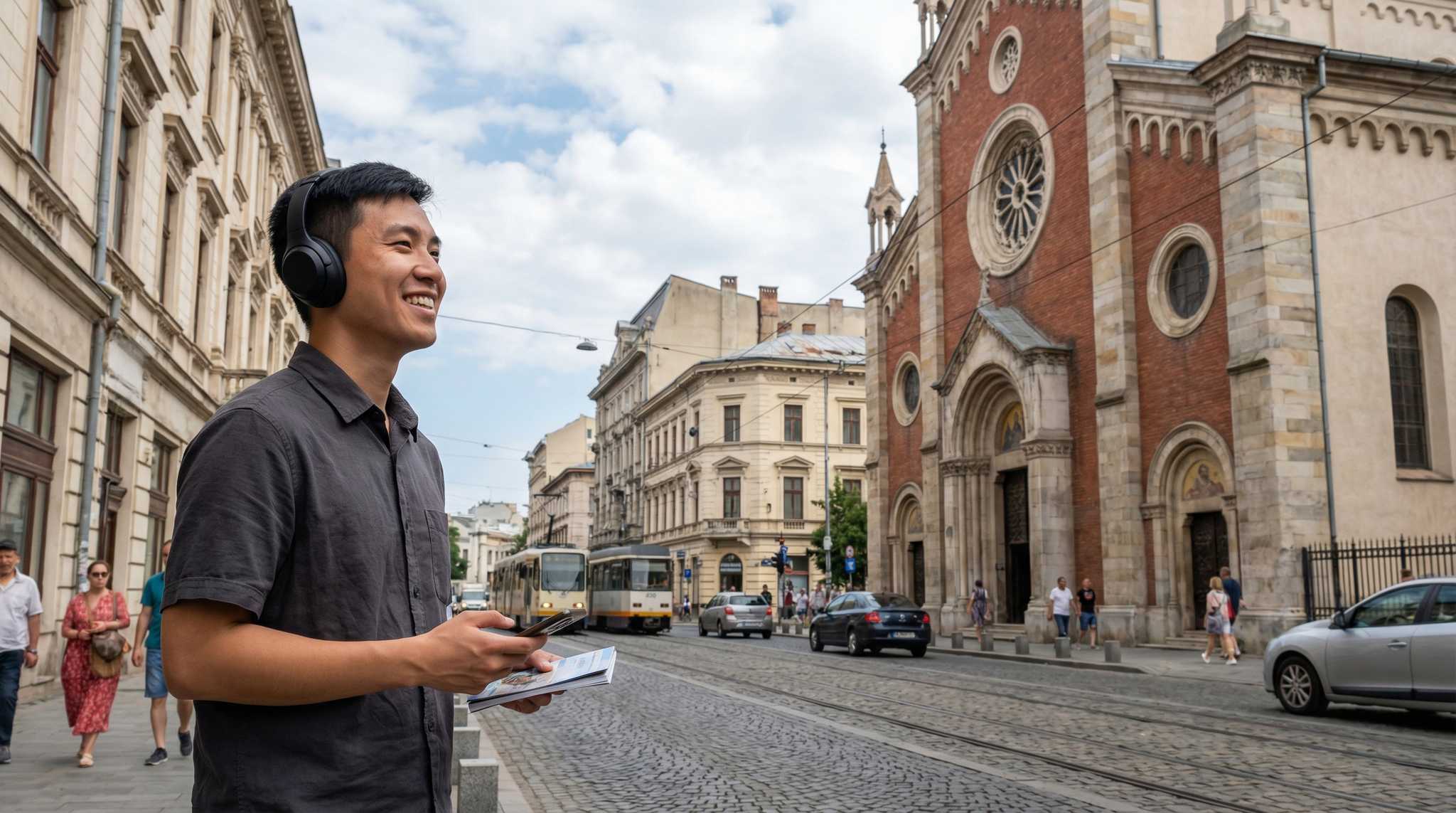
布加勒斯特语音导览:皇家阴谋与革命的隐秘回响
通过一次引人入胜的旅行,探索布加勒斯特丰富的遗产,带您领略这座城市最具标志性的地标。从国家军事圈宫殿开始,这是一座展示罗马尼亚军事历史和宏伟的建筑瑰宝。然后,步入布加勒斯特皇家宫殿的优雅之中,那里等待着皇室的辉煌和迷人的故事。当您探索迷人的塔楼角落时,沉浸在这座充满活力的城市所特有的历史与文化的独特融合中。这次旅行完美地展现了布加勒斯特的过去和现在,为每一位旅行者带来难忘的体验。
导览预览
关于此导览
- schedule持续时间 40–60 mins按照自己的节奏
- straighten3.6 公里步行路线跟随引导路径
- location_on
- wifi_off离线工作一次下载,随处使用
- all_inclusive终身访问随时重播,永久有效
- location_on从 布加勒斯特的意大利教堂 开始
此导览的景点
To spot the Italian Church in Bucharest, look for a striking building made entirely of red brick, with a tall square tower and an octagonal dome rising up behind - it looks almost…阅读更多收起
To spot the Italian Church in Bucharest, look for a striking building made entirely of red brick, with a tall square tower and an octagonal dome rising up behind - it looks almost like a slice of northern Italy landed right here on Nicolae Bălcescu Boulevard! Now, as you stand in front of this marvelous church, let me paint you a picture - not literally, of course, I left my paintbrush at home, but with words! Imagine the year is 1915 and Bucharest is buzzing with excitement, but with a dash of uncertainty hanging in the air. World War I was rumbling across Europe, and yet, right here, a group of passionate Italians had a dream bigger than a plate of spaghetti - they wanted a church of their own. Led by two determined architects, Mario Stoppa and Giuseppe Tiraboschi, and even with support from Italy’s own Baron Carlo Fasciotti, they set out to build a sanctuary that would remind all the Italian families in Bucharest of home. This church was designed in a style you might see if you wandered into a fairy tale Lombard village in northern Italy. Thick red brick walls, a dome smack dab in the center, and a tower holding not one, not two, but three bells, just waiting to wake up the whole neighborhood on Sunday morning! Step inside - well, okay, maybe just peek through the windows for now - and you’d see sunlight dancing off stained glass and mosaics, flickering colors onto the pews like some kind of Romanesque disco ball. But here’s a twist in the tale: the church was finished in a rush and consecrated in July 1916. Imagine the laughter and nervous chatter as locals and dignitaries gathered, the scent of fresh brick in the air, while just beyond the city, the world was at war. Yet, inside these walls? It was all hope, prayers, and probably some delicious Italian singing (I can only imagine opera rehearsals echoing off these stones). So, next time you hear those bells ringing, remember - they’re not just calling to mass, they’re telling a story over a century in the making. Pretty amazing, right? Ready for our next stop?
打开独立页面 →To spot the Corner of Tower, look straight ahead for a tall, multi-level stone structure with a recognizably chunky square base topped by smaller and smaller layers, each with…阅读更多收起
To spot the Corner of Tower, look straight ahead for a tall, multi-level stone structure with a recognizably chunky square base topped by smaller and smaller layers, each with railings and windows, soaring above the neighboring buildings. Imagine yourself standing right here about 300 years ago, the air filled with the deep, resonant sound of bells echoing over the city. This is where the mighty Turnul Colței-or the Corner Tower-once stood, like the grand old doorman of Bucharest. Back in the early 1700s, this tower was the city’s tallest point, stretching nearly 54 meters into the sky, and serving as the proud bell tower of the Colțea Monastery. This wasn’t just a bell tower for any old church-oh no, it was the “skyscraper” of its time, with a booming bell forged in 1775 that weighed as much as a small car: about 1,700 kilograms! The base of the tower was as tough as a Romanian grandma, reminding folks of the fortified monasteries, while the upper floors gracefully reached upward, inspired by German and Swedish style. The real eye-catcher was its fancy Brâncovenesc decorations-a sculpted balcony with stone lions poking their faces out, and a swirling balustrade. Rumor has it, those ornaments were so beautiful that you could almost swear the lions watched you walk by. But hold onto your hat, because the Corner Tower was also a survivor of disaster and drama: on one fateful day in October 1802, the ground rumbled beneath Bucharest’s feet. A massive earthquake-imagine, 7.7 on the Richter scale!-shook the city, knocking church spires and roofs to the dusty ground, while waves of smoke from burning wooden buildings rolled through the streets. The proud Corner Tower crumbled under the tremor, its mighty bell crashing down and, tragically, landing right on top of a shopkeeper sheltering inside. The bell itself was carted off to Sinaia Monastery, still ringing through history but from a new home. After that, the Corner Tower became a bit of a patchwork, with repairs and wooden upper floors. For a time, it doubled as Bucharest’s own fire lookout. If you looked up at dawn, you’d see the silhouettes of watchful guards scanning the skyline for plumes of smoke. Earthquakes in 1829 and 1838 battered it further, until the city quietly started thinking the unthinkable: should it come down? Sure enough, in the late 1800s, as Bucharest grew wider and wagons turned into carriages, the city needed more space. The tower, once the pride of Colțea, now stood in the way of modern boulevards. In August 1888, despite the protests of citizens and local writers, the shaky old Corner Tower was taken down. Some folks-like the fiery Barbu Ștefănescu Delavrancea-were heartbroken, comparing its demolition to losing a part of the city’s soul. You could almost hear his pen scratching out, “A colivar would not understand what this tower meant!” But all is not lost! Under the asphalt of today’s boulevard near here, the old tower’s stone foundations still sleep quietly, a little piece of history beneath your feet. They say traces of the original walls were once marked with white stones, visible for decades before progress covered them up. Even now, if you listen to the city-or maybe stare at an old photograph-you might sense that long-lost tower, crowned by baroque turrets and giant clock faces, peering down at the modern world from the past. There’s even a dash of mystery-was the tower partly built by Swedish soldiers stranded here after a mighty battle in far-off Poltava? Some tales say yes, imagining sturdy Swedes in foreign uniforms, their painted forms once so threatening to the Ottoman rulers that the artwork had to be scrubbed away! In its day, the Corner Tower loomed in stories, too. Writers wished friends to “live as long as Colțea Tower,” and poets saw its shadow in the moonlight. It was even a spot where the voivode Mavrogheni dragged a miserly moneylender, “promising” to drop him off the balcony if he didn’t pay up! So, as you stand here, take a second to picture the bustling old city, the clang of a 1,700-kilo bell, the distant horse carts, and the mighty tower keeping an ever-watchful eye-until time and earthquakes persuaded Bucharest to grow forward, layer over layer, just like the city itself. Curious about the archaeological excavations, traditions and histories or the colta's tower in literature? Don't hesitate to reach out in the chat section for additional details.
打开独立页面 →You’re looking for a grand, cream-colored building with a slate-tiled roof topped by decorative domes, standing proudly behind a statue of a mounted King Carol I right at the…阅读更多收起
You’re looking for a grand, cream-colored building with a slate-tiled roof topped by decorative domes, standing proudly behind a statue of a mounted King Carol I right at the bustling intersection. If you’re standing here, just imagine the soft scent of old books and maybe even a faint echo of turning pages drifting through the air-because this place is more than just a pretty facade! Meet the “Carol I” Central University Library of Bucharest, a literary powerhouse with a story full of royal ambition, scholar-fueled passion, a spot of disaster, and, of course, an epic comeback. Picture this: way back in the 19th century, when the University of Bucharest was fresh on the scene, the poor students had no real library to call their own-only a borrowing corner in the Central State Library. It worked, but it was a bit like trying to stuff all of your textbooks under a single desk; things got crowded! In 1895, all of that changed, thanks to King Carol I, who was absolutely committed to giving knowledge a beautiful home. He bought this very plot of land and dreamed up a library designed by a French architect, Paul Gottereau. Imagine those first days in spring 1895, when the doors swung open and the first books (only 3,400 of them!) lined the shelves, practically vibrating with excitement. The library quickly became the heart of academia in Bucharest. With each passing year, its collection grew at lightning speed-by 1914, there were over 31,000 volumes, and by 1970, more than two million books! Teachers and professors were the unsung heroes here, donating books to sprout all-new niche libraries, including everything from Slavic languages to the secrets of animal physiology. It’s almost as if every professor wanted their own little slice of literary immortality. But not every chapter is peaceful. During the Romanian Revolution of 1989, the library suffered a heartbreaking blow-a devastating fire claimed over half a million books and nearly 4,000 precious manuscripts. You can almost sense the sorrow that must have hung in the air. Yet, just like a hero in a novel, this building didn’t let tragedy write its ending. By 2001, after a massive restoration effort, the library reopened-brighter, smarter, and more modern than ever. Today, this gorgeous building stands not just as a vault of knowledge but as a living testament to resilience. And thanks to the Romanian Royal Family, it even boasts a royal decoration. So, whether you’re a bookworm, a history buff, or just someone who loves a good comeback story, take a moment to soak in the atmosphere… and maybe tip your hat to King Carol I!
打开独立页面 →
再显示 11 个站点显示更少站点expand_moreexpand_less
Look straight ahead for a striking, curved limestone building with ornate detailing and rows of grand windows-right at the corner, facing the park near Revolution Square-you can’t…阅读更多收起
Look straight ahead for a striking, curved limestone building with ornate detailing and rows of grand windows-right at the corner, facing the park near Revolution Square-you can’t miss its elegant, old-world façade with the words “Athénée Palace” welcoming you in gold. Let’s set the scene here, right outside the legendary InterContinental Athénée Palace Bucharest. Take a good look at this imposing building; can you imagine gliding through its revolving doors back in 1914, under sparkling chandeliers, the whole place buzzing with a sense of excitement and, dare I say, secrets? Because if these walls could talk, they might just demand a tip after spilling such top-secret stories. Back when it first opened, this was the last word in style. Designed by French architect Théophile Bradeau, it showed off the swirling lines of Art Nouveau-a style as fashionable then as a selfie stick at a music festival today. In fact, it was the first building in Bucharest made with reinforced concrete: strong enough, apparently, to hold up under a century of scandals, shellings, and more than a few black-market currency transactions. Picture the lobby in its early years: ornate gold pillars shining in the lamp light, marble underfoot, red velvet settees pushed slyly into the shadows. Somewhere near the entrance, the low hum of visitors blended with the clinking of teacups -that is, if anyone was actually drinking tea and not plotting espionage. You see, during the years leading up to World War II, the Athénée Palace wasn’t a hotel; it was Europe’s very own “Spy Central.” Intelligence agents, politicians, and mysterious adventurers came from every corner of the continent. One British journalist called it “the most notorious caravanserai in all Europe” and, trust me, that was not his TripAdvisor review. Here were British spies lounging in plush armchairs while the Gestapo lurked behind newspapers. In the 1930s, A. L. Easterman described chandeliers glittering over marble, and “deep settees... inviting conspiracy”-as if the furniture itself was whispering, "Lean in close, I won't tell." While some guests sipped cocktails, others were trading secrets far more potent. During World War II, the danger wasn’t just talk. In 1944, American bombs fell nearby, shaking the very walls just behind you, and the hotel was battered but not beaten. By 1945, it was fully remodeled; if resilience were a sport, the Athénée Palace would’ve taken the gold. Then came the Communist era, and if you thought it was mysterious before, just wait. Nationalized by the government in 1948, the hotel became one giant surveillance trap. Every phone call you made-even payphones blocks away-was eavesdropped on, while the friendly doorman at the entrance could have been a colonel in disguise. The sweet lady bringing you fresh towels? She was more likely memorizing your documents for the secret police than checking your pillow mints. There were bugs in every room, and the whole place buzzed with the kind of tension you’d find in a James Bond movie-except here, even the bartender was probably on the payroll. They say the prostitutes in the lobby-yes, those well-dressed ladies-were all dutifully reporting not just the contents of their clients’ pockets, but perhaps even their dreams. If you wanted privacy as a guest, you’d have better luck whispering to the chandelier. Over time, new wings were added-although getting all that modern structure to bind itself to the original concrete was one of Bucharest’s great puzzles. It was remodeled in the 1980s and then, during the 1989 Revolution, it didn’t escape violence; the square just beyond was a flashpoint, and chaos thundered outside these doors. The hotel itself shut its grand doors in 1994 for a final bit of rest. But in the spirit of classic comebacks, a $42 million renovation brought the Athénée Palace roaring back to life by 1997. Since then, it’s worn different names-at one point Hilton, now InterContinental-but it’s always been a symbol of elegance, intrigue, and just the faintest whiff of scandal. Standing here, you’re right where kings, spies, revolutionaries, and writers once lingered. So, keep your ears open-because at the Athénée Palace, you never know who might be listening!
打开独立页面 →Look around you-this was once called Palace Square, with elegant buildings all around. It was only in 1989, after a dramatic turn of events, that it earned the name Revolution…阅读更多收起
Look around you-this was once called Palace Square, with elegant buildings all around. It was only in 1989, after a dramatic turn of events, that it earned the name Revolution Square. If you listen closely, you might almost hear the distant echoes of a crowd and the whirring of helicopters overhead. Why helicopters? Well, get ready for a scene straight out of an action movie. That tall, official-looking building nearby was once the headquarters of the Romanian Communist Party. On December 22, 1989, Nicolae Ceaușescu, the Communist dictator, tried to calm an angry crowd from its balcony. Instead, the crowd turned into a sea of voices that grew louder and louder-so loud that Ceaușescu and his wife realized the only way out was up. They fled the chaos below by helicopter, right from the rooftop! Imagine trying to sneak away from a party, but with the whole country watching. Not your usual exit, right? The drama doesn’t stop there. Picture the square decades earlier: proud statues stood here, like King Carol I riding his horse, sculpted by Ivan Meštrović. When the Communists came to power, down came the statue-and poor Meštrović never got compensated. Fast forward to 2005, and the King makes a comeback! Only this time, some folks whispered it looked suspiciously like Meštrović’s original-plagiarism drama, right here in bronze. The new statue was finally unveiled in 2010. And let’s not forget the emotional rollercoaster of August 1968, when Ceaușescu bravely condemned the Soviet invasion of Czechoslovakia, making crowds cheer. But by December 1989, when he tried to recreate that earlier glory, things fell apart, and that’s what led to Romania’s freedom-right where you’re standing. So, welcome to Revolution Square-a place where history unfolded in shouts, cheers, chaos, and courage. Let’s keep going-the next stop is full of royal stories!
打开独立页面 →In front of you is a grand, U-shaped neoclassical building with cream-colored walls and tall, arched windows-look straight ahead, just past the trees and fence, and you’ll spot…阅读更多收起
In front of you is a grand, U-shaped neoclassical building with cream-colored walls and tall, arched windows-look straight ahead, just past the trees and fence, and you’ll spot the Romanian flag fluttering from its central rooftop. Welcome to the Royal Palace of Bucharest, where history has more twists and turns than a royal ballroom dance! Take a stroll closer, and imagine carriages rumbling up to these majestic doors, delivering guests to glittering banquets and royal celebrations-though if you’re expecting a balcony wave from the king, you’ll notice this palace breaks the rules by having a bold central column instead. The architects wanted to symbolize the unity and strength of Romanian monarchy, or maybe they just liked to keep things interesting. Let’s rewind time a bit. Two centuries ago, this very spot belonged to the impressive Golescu House-a home so big that in 1815, with its 25 rooms, locals probably joked “they must host the entire city for tea!” Over generations, noble families and even ruling princes inhabited these halls. By the mid-1800s, this was where the mighty Alexandru Ioan Cuza, unifier of the Romanian Principalities, laid his weary head-and not just him but Domnitor Carol I too, whose story is deeply interwoven with every stone you see here. One fateful winter night in 1926, fire crackled through the original palace, sending smoke into the frosty air and leaving only dreams behind. Undeterred, King Ferdinand brought in a Czech architect and, later, Queen Marie herself personally oversaw the building of a brand-new palace-all elegant lines, stately columns, and a grand presence finished in 1937. The marble halls, sweeping staircases, and lavish rooms awaited royal footsteps and official ceremonies. But if you thought palace life was only ballgowns and fancy hats, think again! On a tense day in September 1940, not far from where you’re standing now, the 19-year-old King Michael solemnly swore loyalty to Romania-while looming outside this building were the storms of war and political intrigue. Unseen by most passersby, legends even whisper of a hidden tunnel linking the palace to the nearby Kretzulescu Church, a royal shortcut to seek divine intervention or, perhaps, to dash off for a secret escape when things got dramatic. Then, tragedy struck in August 1944. Echoes of explosions ripped through the city as German bombers targeted the palace in revenge for changing allegiances during World War II. The building became uninhabitable overnight; the royal family’s residence behind the palace was leveled to the ground. Imagine the confusion-and the quick scramble for shelter. With Cotroceni Palace also damaged by earthquake, King Michael found himself knocking on his aunt’s door for a place to stay-a king but suddenly, a house guest! All the grandeur was swept away when the communists took over in late 1947 and forced King Michael into exile. The crown’s symbols vanished, and the palace’s new official name, the “Palace of the Republic,” aimed to erase royal memories. Here, you might’ve seen party officials plotting the nation’s course, foreign delegations in shiny black cars, or, perhaps, long lines of citizens filing in to pay their last respects to soviet-endorsed leader Gheorghe Gheorghiu-Dej, whose body lay in state in 1965. Even the once-private concert hall became a public cinema, buzzing with the excited chatter of moviegoers. Another dramatic chapter came in 1989, during the revolution. Flames once again threatened priceless treasures as the palace was set ablaze. Imagine the confusion, rushing feet, and the desperate hope that the artwork inside would survive. After years of careful restoration, as the smoke cleared and freedom dawned, the palace slowly regained its dignity, brick by brick, painting by painting. Today, you’re not just standing outside the symbol of monarchy, but also the proud home to the National Museum of Art of Romania. And if you listen closely, who knows? Maybe you’ll hear a faint echo of royal footsteps on marble, or the barely-suppressed giggles of secret passage explorers. This palace, more than any other, is where Romania’s history crisscrosses like a prince’s waltz partner-sometimes graceful, sometimes a bit clumsy, but always unforgettable. Now, shall we dance our way to the next stop?
打开独立页面 →To spot the National Museum of Art of Romania, look straight ahead for an enormous, elegant yellow building with rows of tall arched windows and a Romanian flag right on top,…阅读更多收起
To spot the National Museum of Art of Romania, look straight ahead for an enormous, elegant yellow building with rows of tall arched windows and a Romanian flag right on top, stretching across the boulevard like a palace ready for a royal parade. Welcome to the National Museum of Art of Romania! You’re now standing before what was once the Royal Palace-yes, royalty! Imagine the faint jingle of crowns and the soft sweep of ballgowns, right where today’s art lovers snap selfies. The grand entrance before you has welcomed everyone from kings and queens to curious schoolchildren and, well, now you! But beware: if you gaze too long at its stately neoclassical pillars, you might start to feel a bit regal yourself. Let’s travel back to 1948, a year when the city buzzed with change and ambition, and the impressive palace just in front of you was chosen to become the heart of Romanian art. Here, the country gathered its most prized paintings, sculptures, and treasures-many of them once enjoyed by King Carol I himself. Can you picture royal couriers and museum workers, arms full of priceless paintings, making their way from the cool halls of Peleș Castle in Sinaia to this palace in Bucharest, almost like an ultra-fancy moving crew? The museum’s storerooms soon brimmed not only with the king’s own collection, but masterpieces from Ana Simu’s gallery, the Brukenthal Museum in Sibiu, and even the very first art museum in Bucharest, which began in a monastery school all the way back in 1836. If these walls could whisper, they’d spin tales of quiet artists and ambitious collectors alike. Since 1948, more than 70,000 works have found a home here, divided between two spectacular galleries. On one side lies the National Gallery-where Romanian painting royalty like Grigorescu, Andreescu, and Aman mingle with the likes of Brâncuși, their canvases splashed with color and history. On the other, the European Art Gallery is a journey through the grand salons of Europe, with works ranging from the 14th century to the wild, bold brushstrokes of the 20th. And what a collection it is! You’ll find Italian Renaissance masterpieces-imagine the solemn drama of Antonello da Messina’s “Crucifixion,” the gentle serenity of Domenico Veneziano’s “Madonna and Child,” and mystical moments painted by Jacopo Bassano and Tintoretto. Want a bit of Spanish flair? The legendary El Greco awaits, with fantastic works like “Saint Maurice” and “The Adoration of the Shepherds,” finished near the end of his life-rumor has it he painted them with a mysterious speed and a heart full of passion. The Dutch corner pops with vibrant seasons thanks to Pieter Brueghel the Younger’s “The Four Seasons” and Rembrandt’s dramatic, shadowy “Haman Begging for Esther's Mercy.” The Germans also make an appearance-Lucas Cranach the Elder’s “Venus and Cupid” and Hans von Aachen’s “The Three Graces” are here, their faces watching guests with ageless curiosity. Oh, and let’s not forget the French! Discover delicate portraits and dreamy landscapes from Mignard to Monet, Renoir, and even Paul Signac-these paintings practically wink at you with every brushstroke. The Romanian Modern Art Gallery upstairs is an adventure through 11 rooms, each one a time capsule. You’ll see the dignified faces of old noble families, glowing in portraits from the early years, and then, as you wander, step into more daring times-avant-garde experiments, surreal shapes by Marcel Iancu and Victor Brauner, and finally, the poetic, almost magical sculptures of Brâncuși himself. The 20th century fills the later halls: interwar painters stir with drama and tension while modern masters like Camil Ressu and Ion Țuculescu fill your imagination with bold, modern colors. The museum isn’t just about quiet contemplation either. In 2005, for example, the walls echoed with the footsteps of art lovers from all over Europe as “Shadows and Lights: Four Centuries of French Art” made history, bringing 77 masterpieces, from Poussin to Picasso, under this very roof-setting the museum abuzz with excitement and a bit of Parisian flair. So as you gaze at this grand palace, let yourself imagine the nights when the halls glowed with candlelight, and days that echoed with the laughter of artists, collectors, and perhaps a royal ghost or two. Art, after all, is timeless-and here in Romania’s most cherished museum, every moment is painted with a bit of magic. Interested in a deeper dive into the historian, european art gallery or the gallery of modern romanian art? Join me in the chat section for an insightful conversation.
打开独立页面 →To spot the Memorial of Rebirth, just look up ahead in the plaza for a tall, white marble obelisk with a dark, spiky metal “crown” perched high on top-trust me, it stands out like…阅读更多收起
To spot the Memorial of Rebirth, just look up ahead in the plaza for a tall, white marble obelisk with a dark, spiky metal “crown” perched high on top-trust me, it stands out like a giant toothpick in a sea of classic buildings. As you stand here in Revolution Square, picture the winter of 1989, when this very spot cracked with the cry of “Libertate!” as tens of thousands risked everything to topple a dictator. Now, rising before you is the Memorial of Rebirth-one of the most fiercely debated monuments in Bucharest. Imagine a cold wind whipping around this 25-metre marble pillar, while crowds pressed in, hoping for a brand new Romania. The memorial’s designer, Alexandru Ghilduș, gave the city this striking pillar clutching a steel “crown,” meant to point to Romania’s sky-high hopes after communism. But if you ask some locals, they’ll smile and joke that it looks an awful lot like an olive on a toothpick, or, my personal favorite, “the impaled potato.” Back in August 2005, when this memorial was unveiled, the atmosphere was charged-not with celebration, but with controversy. You see, everyone agreed Romania’s 1989 revolution, which claimed around 1,500 lives, deserved to be remembered. But the Memorial of Rebirth? Let’s just say it didn’t win any popularity contests. Artists and critics frowned, scratching their heads at the pillar’s abstract shape. They felt the monument, as bold and tall as it is, didn’t quite capture the pain and courage spilled here for freedom. Even the mayor at the time admitted, “It’s a question of taste. I personally don’t like it. I don’t understand its symbolism.” Not exactly a ringing endorsement, is it? The designer, Ghilduș, was actually more famous for chairs and lamps than for big, dramatic sculptures. This only fueled the gossip-imagine hiring a lamp-maker to build your country’s greatest tribute to revolution! The Urbanism Committees rejected the idea, but their advice was ignored and, well, here you are, in the shadow of the marble “vector with a crown.” That shadow hasn’t always been a peaceful one, either. Despite its team of round-the-clock guards, the memorial has weathered more than just criticism. In 2006, the mysterious figure “V” from the movies appeared graffiti-style on the monument’s west side. Then, as if the universe agreed it needed a stronger message, in 2012, a bold street artist hurled bright red paint at the “potato”-now it looks like it’s eternally bleeding. Fun fact: that paint is practically unreachable, so it’s become an odd, haunting reminder of the blood spilled in 1989. The marble under your feet cost a pretty penny-about €1.2 million’s worth of hopes and arguments, all laid out so Romanians never forget: this is where Ceaușescu’s regime fell, beyond all the odd nicknames, jokes, and stray graffiti. In its own strange way, the Memorial of Rebirth captures Romania’s wild leap from dark years into uncertain, fragile freedom. And hey, while it might never win any beauty pageants, you’ve got to admit-it makes for an unforgettable photo stop.
打开独立页面 →Look straight ahead for a huge rectangular building with a dome-shaped roof and tall, arched windows-it’s sitting right behind a wide green space and a swirl of busy parking…阅读更多收起
Look straight ahead for a huge rectangular building with a dome-shaped roof and tall, arched windows-it’s sitting right behind a wide green space and a swirl of busy parking spots. Now, take a deep breath and imagine standing here in 1960. There’s a definite buzz in the air-a scent of concrete dust, fresh paint, and a hint of nervous energy, because Sala Palatului has just been completed! Built during Romania’s communist era, this grand hall was supposed to show the world how serious Bucharest could be, a place not just for local meetings, but for international drama, diplomacy, and plenty of power suits. Right behind you sits the old royal palace-now the National Museum of Art-but Sala Palatului was all about new ideas, big declarations, and maybe the occasional dramatic pause. Picture shiny black cars rolling up and delegates stepping out-maybe they’re here for a United Nations meeting, a population summit, or even the World Energy Congress. Flashbulbs popping, translators whispering, and, in the background, the soft echo of shoes tapping across the enormous marble foyer, which is so big you could practically get lost there (if you don’t watch out for the art exhibitions!). This isn’t just a grown-up playground, though. Imagine the main hall inside, like a cavern, with thousands of seats waiting to soak up music or applause-the tension so strong, you could probably bounce a violin bow off it. Fast-forward to today and Sala Palatului is just as lively, but with a soundtrack! If these walls could sing, they’d have an epic playlist: Tom Jones, The Gipsy Kings, Pink Martini, Slash from Guns N’ Roses, and even the legendary Duke Ellington Orchestra. One day you might hear roaring applause for a dramatic violin solo, the next, people dancing in their seats to Macy Gray or the Budapest Gypsy Symphony Orchestra. This place isn’t just concrete and glass-it’s where history thumps, hums, and sometimes belts out a power ballad. So as you stand here, let your imagination fill the silent air with echoes of the world’s biggest stars and the electric excitement of decades gone by.
打开独立页面 →Right in front of you, you’ll spot a grand building with a long row of tall columns, proudly centered behind two large evergreen trees, and the words “CERCUL MILITAR NATIONAL”…阅读更多收起
Right in front of you, you’ll spot a grand building with a long row of tall columns, proudly centered behind two large evergreen trees, and the words “CERCUL MILITAR NATIONAL” emblazoned across the top-just look ahead and a little upwards to find this monumental sight. Now, take a deep breath and imagine the bustle of early 1900s Bucharest. In the middle of this city, right where you’re standing, there used to be a marshy spot and the remnants of the old Sărindar Monastery. Today, it’s one of the city’s crown jewels-a palace that’s seen soldiers, royalty, and enough history to fill an army’s worth of diaries! But before this became the beating heart of Romania’s military culture, it was the humble ground of monks and worshippers. As you look up at its majestic façade, think of the first shovelful of earth dug in 1911-an effort that required a unique foundation of oak pillars driven deep beneath the swampy ground. That’s right-if you listen closely, you can almost hear the echo of those long-ago construction teams, following the advice of famed engineers Saligny and Radu to keep the palace from sinking into the soggy earth. The man with the architectural vision was Dimitrie Maimarolu, who teamed up with Victor Ștefănescu and Ernest Doneaud for what would become a national treasure. And let’s not forget the sculptor Ion Schmidt Faur, who gave life to the two mighty eagles up top-silent, stone guardians who have watched over generations of Romanian officers. Picture it: 1912, the palace rises from muck and ambition-but soon, war rears its ugly head. By 1914, the place is “finished,” at least on the outside, but within those tall columns, work halts as World War I sweeps into Romania. People called this palace “the architectural jewel of the country”-and yet, in 1916, enemy troops arrived, and officers evacuated in a hurry. When they returned in 1919, what they found was a ransacked shell. But Romanians are nothing if not resilient! Repairs began, and by 1923, with King Ferdinand I and Queen Marie presiding, they officially opened the palace’s grand doors. Over the years, the palace changed names and roles. The communists decided “Cercul Militar” sounded too fancy, so they called it “Casa Centrală a Armatei,” only for the original title to return after the revolution of 1989. Today, it’s the headquarters for Romanian military culture-so don’t worry, you’re not about to be drafted as you walk by! Step inside (even if just in your imagination) and you’ll find a treasure trove of rooms: the sweeping marble staircase that seems made for grand entrances, watched over by the art piece “Gornistul,” a tribute to Romania’s creative soul. The Marble Hall glitters with corinthian columns, domed ceilings, and military symbols-a fantasy of Roman-inspired design starring marble, gold, and echoes of trumpets past. There’s the quaint Moorish room, with wooden paneling and decorations covered in thin sheets of gold, and the Byzantine Hall, with arches, frescos, and painted Romanian heroes-all standing guard in frieze and color. For a twist on the classic, the palace also boasts a Gothic Hall with Bavarian-style floors and sharp arched windows that look better suited to Dracula than a parade of generals. Forget about vampires, though-the Norwegian Room is pure Viking chic, with ship-shaped chandeliers and carved beams that look like something out of a Norse legend. In the 1950s, the Army’s restaurant filled these chambers with the clatter of cutlery and lively banter, and even today, there’s an active military library inside. By 2020, the government revamped how some services ran, to keep up with modern times-because even palaces need to stay in shape! On the very spot you’re standing, there’s also a commemorative plaque for the Sărindar Monastery. Built in 1652 and once seen as Bucharest’s heart, it finally fell to earthquakes and time, but its memory still lingers-blessed and remembered on this site. If you walk up the stairs or stroll the gardens, you’re literally retracing centuries of devotion, power, and pride. And just when you thought the story was over-2018 brought a new wave of restoration, replacing windows, reviving stone sculptures, and making sure lightning (literal or figurative!) couldn’t strike twice. So, as you stand before this palace, remember: beneath those stone eagles and columns, there’s a foundation of oak, a history of resilience, and enough legends to march through the centuries-plus, if you listen hard enough, maybe the faint sound of a bugle calling soldiers to dinner! Interested in a deeper dive into the historical stages, the palace halls or the bust of architect dimitrie maimarolu? Join me in the chat section for an insightful conversation.
打开独立页面 →To spot the Telephones Company Building, look for a tall, cream-colored structure right in front of you with a squared-off tower and rows of narrow windows, crowned by a…阅读更多收起
To spot the Telephones Company Building, look for a tall, cream-colored structure right in front of you with a squared-off tower and rows of narrow windows, crowned by a red-and-white communication tower on the roof. Welcome to the buzzing heart of Bucharest’s telecom story-the Telephones Company Building! Right now, you’re standing before what was once the city’s tallest skyscraper, soaring 52 and a half meters into the sky. Imagine it’s the early 1930s and Bucharest is caught in the grip of the Great Depression. The radios crackle with international news, and the world feels both distant and very close-if only you could pick up a phone and call, except, well... phone lines are finicky, unreliable, and rarer than a polite taxi driver in rush hour. That’s where this marvel comes in. To modernize, Romania struck a dramatic deal with the American banking giant J.P. Morgan-gulp!-essentially mortgaging a slice of the country’s future for a 20-year telephone monopoly to ITT, a colossal U.S. telecom company. In return, Bucharest got its first voice bridge to the world-and this dazzling building to house it all. The design was the brainchild of architect Edmond Van Saanen Algi, a Romanian with Dutch roots. In less than two years, workers turned the old Oteteleșanu Mansion-once a fancy beer garden and lively bar competing for the city’s elite-into a glimmering monument of Art Deco cool. Step back in time: 1934-cars rumble past, city folks in elegant coats march into the building, and up on the steel skeleton (crafted by Resita’s proud steelworks), King Carol II himself comes to snip the ribbon. The buzz of new telephones echoes from its halls-it’s as if the building itself is alive with voices. Over the years, the Telephones Company Building proved itself a survivor. It stood tall against earthquakes-rumbling in 1940, 1977, 1986, and 1990 (no time for weak knees)-and even Allied bombings in World War II. Each time, people probably looked up and wondered, “Is it still standing?” like checking your WiFi after a storm. Over decades, the mansion passed from American to Romanian hands, survived regime changes, revolutions, and nationalization. And, rumor has it, the original plans vanished-like a bad cell signal just when you need it-so modern engineers had to redraw every detail by hand for renovations in the 1990s. Today, the building stands, not just as Telekom Romania’s office, but as a living, humming monument to Bucharest’s dreams of connection-a testament to how a city can weather almost anything with a little steel, stubbornness, and maybe a few frantic phone calls. So, next time your phone drops a call, remember: this is where Bucharest learned the art of staying connected-one ring at a time!
打开独立页面 →To spot Casa Capșa, look to the corner of Calea Victoriei and Edgar Quinet Street, where you'll see an elegant cream-colored building with large windows, ornate trims, and the…阅读更多收起
To spot Casa Capșa, look to the corner of Calea Victoriei and Edgar Quinet Street, where you'll see an elegant cream-colored building with large windows, ornate trims, and the golden name "Capșa" shining at the top beneath a decorative dome. Welcome to Casa Capșa, a place so drenched in stories, sugar, and scandal that even the walls might be buzzing from all the intrigue! Imagine yourself standing here in the middle of old Bucharest, right at the intersection of high society and delicious temptation. While today it looks like an elegant Parisian palace dressed in Neoclassical grandeur, back in the late 1600s this corner was home to the houses and gardens of a certain nobleman, Radu Slătineanu. But let’s jump to the fragrant, bustling year of 1830-when Italian chef Eronimo Momolo, fresh out of the kitchen of Prince Grigorie Ghica, decided to buy this very spot. He turned the ground floor into a lively tavern famous for its exotic, Italian-Oriental meals. Upstairs? That was the sparkling ballroom-where laughter and music would fill the air during Bucharest’s most spectacular dances. Fast forward to 1868, and the plot thickens as two brothers, Constantin and Grigore Capșa, step into the scene. They swept in to establish a confectionery, and soon “La doi frați, Constantin și Grigore Capșa” was the talk of the town. Picture fancy mustaches, sugar-dusted pastries, and debates over politics-but only if you were part of the elite! In those days, artists and dreamers were strictly NOT allowed. Only the last of the old boyars, influential journalists, and powerful politicians could claim a table, plotting campaigns and whispering secrets behind thick velvet curtains. But let’s not get ahead of ourselves. In 1886, Grigore Capșa added the hotel next door, and only five years later, Bucharest got its very own Café Capșa-the ultimate meeting spot for those in love with culture, caffeine, and a hint of mischief. The Café became so famous across Europe that it inspired candy factories and chocolate shops far beyond Romania’s borders. By 1869, Casa Capșa was supplying not just the Romanian royal family but the courts of Serbia and Bulgaria too. It didn’t stop there. The Capșa family was obsessed with perfecting their craft. Each morning, whatever pastries were left from the previous day were sold at cost to the staff, ensuring only the freshest treats greeted the city’s elite. And Grigore’s heirs-ever the perfectionists-would travel regularly to Paris. They’d return with samples of the newest confections, eager to introduce something extraordinary to Bucharest. Some kitchens were full of dazzling French talent, like Chef Manchosse and pastry wizard Georges Leroy, who first introduced the legendary “truffe” bonbons to the city. Through wars and revolutions, Casa Capșa evolved with the times. During World War I, you might have heard the clinking of officers’ cutlery-only they were Bulgarian, not Romanian, as the military commandeered the venue! By the roaring 1930s, Capșa was back in business, hosting extravagant banquets where, by tradition, every important visitor would be greeted with a brand-new Capșa specialty-perhaps the “joffre” sweets, created in honor of Marshal Joffre’s 1920 visit. And what about the artists forbidden in its early days? After the Second World War, Café Capșa became THEIR kingdom! Every writer, journalist, painter, and free-thinker in Bucharest could be found here, strategizing over strong coffee and endless cigarettes. The poet Virgil Carianopol said that to become a “real” writer you needed the Café Capșa’s blessing-no publisher required. And Tudor Arghezi simply called it “the only intellectual place on Calea Victoriei.” Not too shabby for a coffeehouse, right? With nationalization in 1948, Capșa’s golden age seemed at risk, but after the fall of communism, it was restored once again. Today, with its beautiful café, luxurious hotel, and irresistible sweets, Casa Capșa continues to be the place where Bucharest’s history tastes as rich as its chocolate. So, if you’re looking for more than dessert-maybe a side of revolution, legacy, or literary inspiration-Capșa is your address.
打开独立页面 →Look to your right: you’ll spot the Stavropoleos Church by its small size, elegant arches, and colorful painted icons wrapping around its brick and stone walls, peeking out from…阅读更多收起
Look to your right: you’ll spot the Stavropoleos Church by its small size, elegant arches, and colorful painted icons wrapping around its brick and stone walls, peeking out from behind a wrought iron fence. Now, let me whisk you back to the heart of old Bucharest, where tales spin around every stone! Stavropoleos Church may look peaceful now, but oh boy, this beauty has survived three centuries of rattles, shakes, and-believe it or not-excellent real estate investments. Picture the year 1724: horses are clip-clopping down dusty streets, and a shrewd Greek monk named Ioanichie Stratonikeas stands surveying his inn’s courtyard. While others poured their money into taverns, Ioanichie had bigger dreams, founding not just a church but an entire monastery, right in the middle of the busy city. Back then, the place buzzed with the rowdy noise of travelers pulling up for food, rest, and gossip. The church, however, was always a haven: its walls thick, its halls scented with beeswax and incense, and its domes echoing ancient prayers. “Stavropoleos”-try saying that three times fast!-means “the City of the Cross” in Greek, a name fitting for a church that has hosted more drama than a reality TV show. Over the centuries, earthquakes rocked Bucharest and toppled the church tower more than once. But just like your favorite action hero, it always got back up, dusted itself off, and went on. On solemn days, the bells tolled across the city, and the images of saints on these very walls watched floods, fires, and the endless rumble of change. Inside, the air is thick with history. Even today, an echo of mystical music floats in the air, thanks to the choir singing old Byzantine tunes. Not only that, but a secret team of book-and-icon-restorers is busy at work behind closed doors, piecing together sacred texts and saving gorgeous, centuries-old paintings-think of them as the Indiana Joneses of Orthodox art! Wow, what a journey-from a bustling monastic inn to a silent survivor surrounded by modern Bucharest. And if you’re feeling lucky, maybe you’ll catch a glimpse of the ghostly innkeeper Ioanichie himself, still checking that his beloved church stands strong. Ready to continue our adventure? The heart of the historic center awaits!
打开独立页面 →To spot the Historic Center of Bucharest, just look straight ahead for lively streets lined with grand old buildings, ornate facades, and crowds of locals and tourists strolling…阅读更多收起
To spot the Historic Center of Bucharest, just look straight ahead for lively streets lined with grand old buildings, ornate facades, and crowds of locals and tourists strolling beneath the fading glow of the setting sun. Ah, welcome to the heart of old Bucharest! As you stand here, let your imagination run wild-picture centuries of footsteps echoing along these cobbled streets, the stories of merchants, revolutionaries, poets, and travelers weaving together across time. The Historic Center stretches about half a square kilometer, but, believe me, you could fit centuries of history into every corner and alleyway. You’re in a place once walked by princes and rogues, in a neighborhood nestled at the very western edge of Sector 3-though, rumor has it, you can trade a good story for a good drink anywhere in these streets! Above your head, you can see elegant stone columns and carved details on the facades, whispering tales from a time when Calea Victoriei and Bulevardul Regina Elisabeta formed the northern border, keeping the northern winds-and maybe a few noisy politicians-at bay. To the east, Bulevardul Hristo Botev lines the edge, while the south is hugged by Bulevardul Corneliu Coposu and Splaiul Independenței, with Calea Victoriei closing the western gates like the final brushstroke on a masterpiece. But what truly sets this place apart? Here you’ll find the legendary Curtea Veche, the Old Princely Court where Vlad the Impaler set up shop. There’s Hanul lui Manuc, an inn famous for its gossip and drama, and not one, but two famous churches-Stavropoleos and Saint Anton-each with their own secrets. Every building you see is a living monument, officially declared historic in 2010 and protected like a precious time capsule. The beating heart of Romania, Kilometre Zero, stands in Saint George’s Square-a simple marker, but if you stand still you might feel the whole country humming beneath your feet. There are three grand entrances, quiet passages, five busy squares, and forty-eight storied streets-Lipscani, Franceză, Doamnei, and many more-each with its own flavor, and more legends than your grandmother at bedtime. Take a deep breath; smell the roasted coffee and hear the laughter spicing up the night air. This isn’t just a collection of old buildings. It’s a living, breathing story, one you’re now part of-so don’t be shy, take a stroll, get lost, and remember: in Bucharest’s historic center, every step is a new chance for adventure! Interested in knowing more about the delimitation, historical monument or the streets in the historic center
打开独立页面 →
常见问题
如何开始导览?
购买后,下载 AudaTours 应用并输入您的兑换码。导览将准备好立即开始--只需点击播放并按照 GPS 引导的路线行驶即可。
导览期间我需要互联网吗?
不需要!开始前下载导览并完全离线享受。只有聊天功能需要互联网。我们建议在 WiFi 下下载以节省移动数据。
这是导游带领的团体游吗?
不是--这是自助语音导览。您按照自己的节奏独立探索,通过手机播放音频解说。没有导游,没有团体,没有时间表。
导览需要多长时间?
大多数导览需要 60-90 分钟才能完成,但您完全控制节奏。随时暂停、跳过站点或休息。
如果我今天无法完成导览怎么办?
没问题!导览具有终身访问权限。随时暂停和恢复--明天、下周或明年。您的进度已保存。
有哪些语言可用?
所有导览均提供 50 多种语言版本。在兑换代码时选择您的首选语言。注意:导览生成后无法更改语言。
购买后我在哪里访问导览?
从 App Store 或 Google Play 下载免费的 AudaTours 应用。输入您的兑换码(通过电子邮件发送),导览将出现在您的资料库中,准备下载并开始。
如果您不喜欢该导览,我们将退款。请联系我们 [email protected]
安全结账使用 


