都灵语音导览:圣萨尔瓦里奥的回响、寺庙与小径
在都灵瓦伦蒂诺城堡的古老阴影下,秘密在寂静的拱门和阳光普照的庭院中徘徊——故事远比明信片所暗示的更离奇。 这个自助语音导览将带您穿梭于圣萨尔瓦里奥热闹的街道,并沿着维托里奥·埃马努埃莱二世大街前行,揭示一个超越日常的世界。每一站都揭示了大多数旅行者从未听过的传说和故事。 在政治叛乱前夕,什么令人震惊的消息在瓦伦蒂诺城堡中回荡?为什么艺术家们曾不惜一切代价在都灵展览馆的璀璨大厅里?以及哪项就在维托里奥·埃马努埃莱二世大街旁的奇特实验,让历史学家们困惑了几十年? 当您从宏伟的大道走向秘密角落时,追溯隐藏的联盟、未解之谜和创新的脉搏。每一步都解锁了都灵不安分的精神及其重塑自我的倾向。 开始这段旅程——敢于踏足秘密久候之地。下一个发现就在前方。
导览预览
关于此导览
- schedule持续时间 40–60 mins按照自己的节奏
- straighten3.7 公里步行路线跟随引导路径
- location_on
- wifi_off离线工作一次下载,随处使用
- all_inclusive终身访问随时重播,永久有效
- location_on从 维托里奥·埃马努埃莱二世大街 开始
此导览的景点
Before this was a wide thoroughfare, this land was shaped by the House of Savoy, the historic royal family of the region. They had a beautiful summer residence nearby, the…阅读更多收起
打开独立页面 →Welcome to Corso Vittorio Emanuele II, a vast paved avenue framed by long rows of arched stone porticos, which are continuous covered walkways built right into the architecture, all stretching endlessly toward a towering monument centered in the far distance.
Before this was a wide thoroughfare, this land was shaped by the House of Savoy, the historic royal family of the region. They had a beautiful summer residence nearby, the Valentino Castle, and the sprawling royal park surrounding it completely dictated the early layout of this area. The very first roads here were just modest carriage paths meant to gently skirt the northern edges of those grand royal gardens.
But as the city burst beyond its ancient boundaries, a grand vision took hold, sparking a massive wave of 19th-century urban expansion. This colossal street was carved out, extending an incredible four point two kilometers across the city as a bold, undeniable symbol of rapid modernization. Connecting the new railway station to the river, it transformed quiet dirt tracks into an elegant artery lined with commercial spaces, pulling Turin into a brand new industrial age.
If you look far down the avenue, you can spot that distant monument we noticed earlier. That is King Vittorio Emanuele the Second. The locals affectionately call him Barba Vigiu, or Uncle Vittorio. He sits perched atop a dizzying thirty nine meter pedestal. Now, the official reason for this towering height is deeply serious. His son, King Umberto the First, paid for this massive structure as a moral apology to the city. Turin was heartbroken when Vittorio's remains were taken away to the Pantheon in Rome, rather than being buried here in the family's traditional resting place.
However, the people of Turin have a much more entertaining theory about that tall statue. The king was widely notorious for his many romantic affairs. Rumor quickly spread among the citizens that the monument was built so ridiculously high just so the stone king could peer straight through the highest attic windows and directly into the bedrooms of the surrounding apartments.
This magnificent avenue reveals a society moving away from private aristocratic boundaries and hurtling toward a loud, deeply connected future. Let us keep walking down the Corso toward the first signs of social friction in this new era. We are heading to the Church of San Giovanni Evangelista, just a three minute walk away, to see how everyday people found their footing as their world rapidly shifted.
On your left, you will see the Church of San Giovanni Evangelista, standing tall with its striking facade of alternating horizontal red brick and yellow stone stripes, a central…阅读更多收起
打开独立页面 →
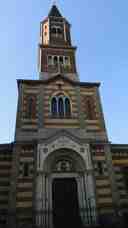
San Giovanni Evangelista (Torino)Photo: Matteo Aresca 05, Wikimedia Commons, CC BY-SA 4.0. Cropped & resized. On your left, you will see the Church of San Giovanni Evangelista, standing tall with its striking facade of alternating horizontal red brick and yellow stone stripes, a central arched door topped with a bright golden mosaic, and a high square bell tower reaching into the sky. As you stand before it, let us reflect on the human stories hidden behind these grand walls. Stepping away from the wide boulevard of Corso Vittorio Emanuele II, we find ourselves in the heart of San Salvario, a district that grew rapidly and chaotically in the nineteenth century. The construction of the nearby Porta Nuova train station drew thousands of working class families, turning this area into a bustling, overcrowded hub. Seeing this flood of poor, abandoned young boys, the famous local priest Saint John Bosco, affectionately known as Don Bosco, decided to build a youth hospice and school here to help them. But progress often comes with a quiet social cost. To build his vision, Don Bosco had to buy up many small plots of land, an area that was already home to a community of local washerwomen. When these women first heard a priest was buying the land, they mistakenly thought he was building them a beautiful new washhouse, but when they realized they were actually being evicted, they cried out that it must be the end of the world. Don Bosco had to engage in a tense diplomatic battle, finally offering them a significant financial payout to convince them to leave their homes. It is a melancholic reminder that as a society reaches toward the future, some of its most vulnerable residents are pushed aside. You might wonder why Don Bosco built such a massive, imposing church for a simple youth shelter. The answer lies in both rivalry and duty. Just down the street, the Waldensians, a long persecuted Christian minority that had just been granted civil rights, had built their own temple and opened schools to Catholic children. Don Bosco felt a competitive urge to create an alternative to keep the neighborhood youth in his faith. Furthermore, his superior, Archbishop Lorenzo Gastaldi, practically ordered him to build a monumental church worthy of this elegant avenue. Though Don Bosco worried about the enormous cost, he bowed his head and accepted the challenge. He relied completely on the charity of the public. Local newspapers printed the names of donors, including one father who gave one hundred lire, which would be roughly five hundred dollars today, simply asking for prayers for his loved ones in return. With these funds, the architect Edoardo Arborio Mella designed the building in the Lombard Romanesque style, an architectural nod to the thirteenth century defined by the heavy, solid brickwork and rounded arches you see on the facade today. Consecrated in eighteen eighty two, the church survived the decades, though it bore the heavy scars of the twentieth century. In August nineteen forty three, devastating Allied air raids severely bombed the church and the boys center, demanding years of painful reconstruction. The church is open every day from seven in the morning to noon, and again from five to seven in the evening, if you would like to see the restored interior. For now, let us take a short three minute walk to our next stop, the Waldensian Temple, to see how another marginalized group finally found its voice in this changing city.
Here stands the Waldensian Temple, an elegant pale stone building defined by a deeply arched entrance and flanked by two slender, octagonal towers reaching upward. For centuries,…阅读更多收起
打开独立页面 →
Inside the Waldensian Temple of Turin, a 'Posto Occupato' (Occupied Seat) is dedicated to raising awareness against violence against women (2024).Photo: Cris77, Wikimedia Commons, CC BY-SA 4.0. Cropped & resized. Here stands the Waldensian Temple, an elegant pale stone building defined by a deeply arched entrance and flanked by two slender, octagonal towers reaching upward. For centuries, this beautiful sight would have been completely impossible.
The Waldensians are members of a Christian movement that actually predates the Protestant Reformation, and for hundreds of years, they faced intense persecution. Before 1848, they were strictly forbidden from residing or worshipping openly in Turin. The few who lived here had to quietly attend services inside foreign embassy chapels just to practice their faith.
But the city was beginning to evolve from a rigid center of royal power into a more open, modern community. The breaking point came with the Albertine Statute of 1848, a historic decree that finally granted the Waldensians civil rights and the freedom to worship openly.
And the people who helped build this temple had truly fascinating lives. Take Charles John Beckwith, for example. He was an English general who had lost a leg fighting in the famous Battle of Waterloo. Instead of retiring quietly, he dedicated his entire life, and his personal fortune, to championing the Waldensian cause. He teamed up with Giuseppe Malan, an influential Waldensian banker who personally financed the purchase of this very land. Together, they were out here every single day, overseeing the construction.
However, there was a political catch. The government allowed them to build, but insisted the temple could not look like a traditional Catholic church from the outside. So, the architect, Luigi Formento, cleverly designed an eclectic exterior. He blended those pointed neo-Gothic towers with rounded neo-Romanesque windows, masking its traditional religious nature while giving it a proud, towering dignity. If you look closely at the sides of the building, you might spot a carving of an open Bible resting on a cross, a quiet but firm declaration of their reformed faith to the street below.
Inside, the space is organized around a soaring central hall, known as the nave, which leads to a remarkably high, two-tiered wooden pulpit. Since there were no microphones in the nineteenth century, this dramatic height allowed the pastor's voice to project clearly to the entire congregation, ensuring the preaching of the Bible remained the absolute center of the service.
Like its neighbors, the temple withstood the trials of the Second World War. Then, in 2015, something truly incredible happened. Pope Francis walked through those doors, becoming the first pontiff in history to visit a Waldensian temple. He formally asked for forgiveness for the centuries of inhuman treatment the Catholic Church had inflicted upon them, marking a profoundly triumphant moment of healing and unity.
That transformative decree of 1848 opened doors for many other communities as well, which leads us perfectly to our next stop. We are going to take a short two-minute walk over to the Synagogue of Turin. And just so you know, the temple opens its doors to the public on Sundays from 11:15 AM to 12:15 PM.
再显示 9 个站点显示更少站点expand_moreexpand_less
Before you is the Synagogue of Turin, an imposing stone structure defined by its striking horizontal stripes, two square towers topped with silver onion domes, and a beautiful…阅读更多收起
打开独立页面 →
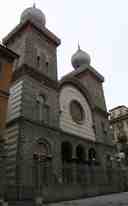
The prominent Synagogue of Turin with its Moorish Revival architecture, horizontal stone stripes, and distinctive square towers. Photographed in 2007.Photo: Olevy, Wikimedia Commons, CC BY-SA 3.0. Cropped & resized. Before you is the Synagogue of Turin, an imposing stone structure defined by its striking horizontal stripes, two square towers topped with silver onion domes, and a beautiful circular rose window right in the center. The story of this congregation mirrors what we just explored at the Waldensian Temple. In 1848, the Albertine Statute finally granted civil rights to minority faiths, giving the Jewish community the freedom to establish a visible, prominent presence here in the capital. But their first attempt at building a temple went wildly off script. In 1859, the community hired architect Alessandro Antonelli, a man utterly consumed by architectural and scientific megalomania. Antonelli became obsessed with pushing the limits of masonry and gravity, unilaterally altering the design during construction to raise the dome higher and higher until it reached a dizzying one hundred and sixty seven meters. As the budget completely spiraled out of control for a building that looked less like a synagogue and more like a towering monument to one man's ego, the Jewish community wisely pulled the plug. They sold the unfinished, legendary fiasco to the city, and in a twist of irony, that failed synagogue became the Mole Antonelliana, the towering iconic symbol of Turin. Forced to start over, the community hired Enrico Petiti, who finished this beautiful Moorish Revival building, a design inspired by historic Islamic architecture, in 1884. But the peace did not last. In the tense autumn of 1941, fascist arsonists attacked the building. Young members of the community took turns standing guard outside to protect it. Among those brave sentries was twenty two year old Primo Levi, the future author and Holocaust survivor. Despite their protection, the sanctuary was completely incinerated by an Allied bomb in 1942. The app has a neat side by side showing what this place looked like in ruins back in 1942 compared to today. Under the guidance of Chief Rabbi Dario Disegni, the community meticulously rebuilt. Down in the basement, they created a smaller sanctuary, the Tempio Piccolo, using ornate Baroque furnishings saved from an abandoned nearby town. Down there, they hold treasured eighteenth century wedding contracts, called ketubbot. Fascinatingly, these contracts are written using the Hebrew alphabet, but when read aloud, the words are actually in the local Piedmontese dialect, a beautiful secret language of a deeply rooted people. Today, this square is named Piazzetta Primo Levi, honoring the man who once stood right where you are. From grand architectural ambitions to the quiet resilience of faith, this city has constantly reshaped itself. Now, we are going to explore how that same drive shaped scientific inquiry, as we take a short seven minute walk to our next stop, the Botanical Garden of Turin.
Here is the Botanical Garden of Turin, easily spotted by the grand, steeply pitched dark roof with small dormer windows rising behind the gnarled, twisting branches of the mature…阅读更多收起
打开独立页面 →
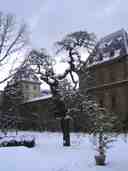
A peaceful view of the Botanical Garden of Turin during the winter, showcasing its grand architecture behind the mature trees. (2004)Photo: Clematis, Wikimedia Commons, CC BY-SA 3.0. Cropped & resized. Here is the Botanical Garden of Turin, easily spotted by the grand, steeply pitched dark roof with small dormer windows rising behind the gnarled, twisting branches of the mature trees in the foreground. \n\nAlong the banks of the Po River, the wild, untamed environment of the water margin was slowly gathered, categorized, and brought under strict human order. This very ground was once a simple, practical vegetable plot belonging to King Vittorio Amedeo the Second of the House of Savoy. But in 1729, it was purposefully transformed. The unruly riverbank gave way to a controlled environment for scientific study, turning a royal food source into a living laboratory where the chaos of nature was neatly labeled and confined to perfectly measured beds. \n\n The garden began by focusing on medicinal plants, but under the guidance of its early directors, its ambitions grew far beyond the city. Take Vitaliano Donati, who took over in 1750. Donati was not a man content to sit quietly in a greenhouse. He traveled the world seeking rare botanical species. The King even sent him to Egypt to collect natural and archaeological wonders. Donati actually shipped back three stone statues from a temple in Karnak, which formed the very first seeds of Turin's famous Egyptian Museum. But his adventuring carried a heavy cost. In 1762, while sailing toward India on another collecting mission, Donati died at sea. \n\nDecades later, in 1801, the garden fell under the care of Giovanni Battista Balbis, a man whose life was pure drama. In his youth, Balbis was a Jacobin revolutionary, a member of a radical political movement that fought to overthrow the monarchy. After a failed conspiracy, he fled into exile, only to return as a military doctor marching over the treacherous, high-altitude passes of the Alps alongside Napoleon's army. After surviving the battlefields, Balbis abandoned politics entirely to devote himself to the quiet peace of these plants. Under his devoted care, the garden blossomed, adding nearly two thousand new species. But history has a long memory. When the monarchy was eventually restored, Balbis was punished for his revolutionary past. He was stripped of his public offices and forced into his third and final exile, leaving his beloved plants behind. \n\n The garden has endured its own quiet tragedies over the centuries. During the First World War, severe fuel shortages left the delicate glass greenhouses completely without heating. Tragically, countless priceless, centuries-old exotic plants froze to death, lost forever. \n\nToday, the garden is a space of education and care, even featuring a special path with braille markers so that visually impaired visitors can touch and experience the living plants. If you wish to wander the grounds, they are open Monday through Friday from eight AM to eight PM, Saturdays until two PM, and closed on Sundays. \n\nNow, let us trace the footsteps of the royals who once walked these riverbanks. We will continue our journey to Valentino Castle, which is just a seven-minute walk away.
Leaving the quiet beauty of the botanical garden behind us, you have arrived at Valentino Castle. Look for the grand U shaped white stucco palace surrounding a vast courtyard…阅读更多收起
打开独立页面 →
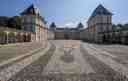
A sweeping exterior view of Castello del Valentino, an impressive UNESCO World Heritage site with its signature steep slate roofs (2021).Photo: Jeanne Griffin, Wikimedia Commons, CC BY-SA 4.0. Cropped & resized. Leaving the quiet beauty of the botanical garden behind us, you have arrived at Valentino Castle. Look for the grand U shaped white stucco palace surrounding a vast courtyard paved with swirling cobblestone patterns, all crowned by steep dark slate roofs.
This is Castello del Valentino, and its very name is steeped in mystery. Some old records suggest it comes from the local geography, describing a small valley with a stream. But another, much more romantic legend tells us that relics of Saint Valentine himself were once kept in a tiny church right where you are standing. It is said that every February fourteenth, local nobles would gather here for a lavish party where every lady would affectionately call her chosen knight, Valentino.

A vintage view of the vast courtyard from around 1923, showcasing the castle's harmonious blend of French and Italian architectural styles.Photo: Mario Gabinio, Wikimedia Commons, CC BY 3.0 it. Cropped & resized. Whatever its true origins, this site soon became the crown jewel of the royal family's presence in the area. In the seventeenth century, a French princess named Maria Cristina of Bourbon married into the family and received this estate as a wedding gift. When she became a young widow and Regent of the Duchy, she poured her heart into transforming the building into a magnificent riverside pleasure palace.
She missed the architecture of her homeland, so she demanded those steep, French style slate roofs you see above you. They were so utterly foreign to local Italian builders that they had to invent a clever architectural trick, building a false attic space under the roofline just to make the sharp angles look harmonious to Piedmontese eyes.

A shadowy night view of the castle's right wing portico from 1935, perfectly evoking the chilling legends that surround Madama Cristina's reign.Photo: Mario Gabinio, Wikimedia Commons, CC BY 3.0 it. Cropped & resized. But a dark, lingering mystery surrounds Madama Cristina. Rumors whispered that she used the palace for secret trysts, disposing of her unfortunate lovers by tossing them into the nearby Po River, or even down a hidden well lined with sharp blades. Though historians dismiss these tales, they birthed a persistent legend that her ghost still haunts these halls, sometimes appearing as a veiled lady or simply as a sudden, unexplained scent of floral perfume in an empty room.

The opulent Hunting Room on the noble floor, photographed in 1926, reflecting the elegant interior halls that evolved through the centuries.Photo: Mario Gabinio, Wikimedia Commons, CC BY 3.0 it. Cropped & resized. As the centuries passed, this regal estate evolved, mirroring the profound shift in the city itself, moving away from an exclusive fortress of kings and queens into a dynamic, open hub of learning, science, and public life. In the nineteenth century, it housed military regiments, and later, advanced hydraulic laboratories for the study of fluid mechanics. It was even inside these very walls, in 1863, that a group of mountaineers founded the prestigious Italian Alpine Club.
The castle suffered deeply during the Second World War when bombings collapsed large sections of the roof. Yet, out of that tragedy came a breathtaking discovery. The blasts and subsequent restorations uncovered original seventeenth century fresco portraits of Madama Cristina and her husband, paintings that had been sealed under layers of plaster for hundreds of years.

Bathed in sunlight in 2023, the restored Valentino Castle now proudly serves as a lively campus for university architecture students.Photo: TorinoDoc, Wikimedia Commons, CC BY 4.0. Cropped & resized. Today, it is a protected heritage site and a bustling home for university architecture students, open to visitors from 7:30 AM to 9:00 PM on weekdays, and 8:00 AM to 4:00 PM on Saturdays, though it is closed on Sundays. Let us continue our walk now, stepping just two minutes away into the wider green embrace of Valentino Park.
Notice the curving paved pathway bordered by low stone edging that winds through rolling lawns and a striking conical tree with golden-green foliage. Welcome to Valentino Park,…阅读更多收起
打开独立页面 →
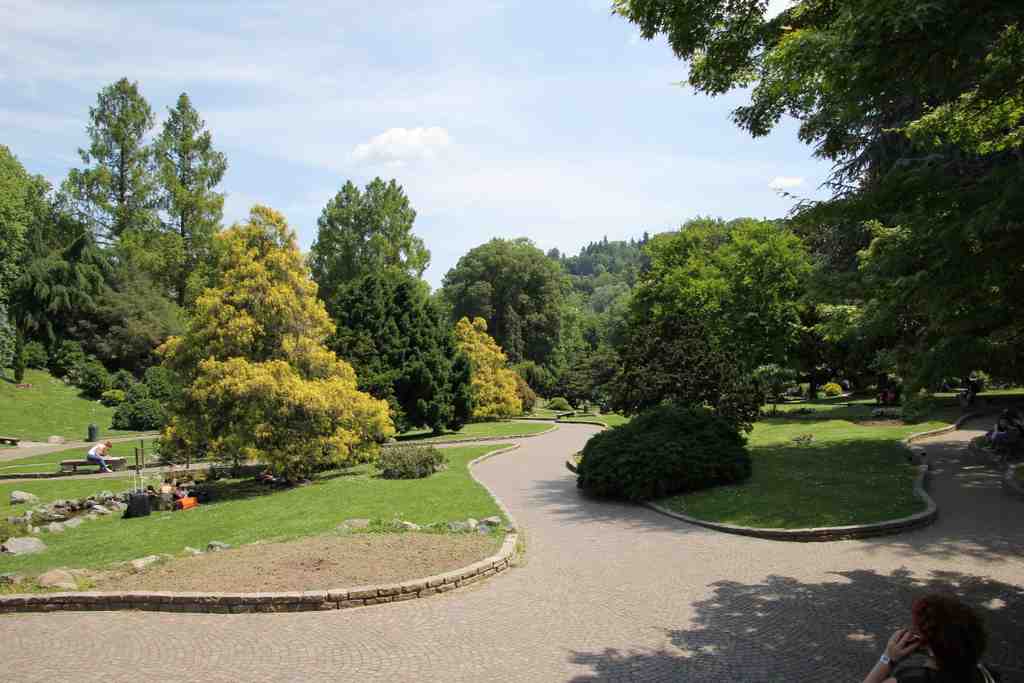
Sequoia nel Giardino roccioso - TorinoPhoto: Mannivu, Wikimedia Commons, CC BY-SA 4.0. Cropped & resized. Notice the curving paved pathway bordered by low stone edging that winds through rolling lawns and a striking conical tree with golden-green foliage. Welcome to Valentino Park, or as the locals lovingly call it in Piedmontese, el Valentin. Just a couple of minutes ago, we admired the Valentino Castle, and now we are stepping into its grand backyard. But this space is no longer just for royalty.

Veduta del Valentino presso TorinoPhoto: unknown author, Wikimedia Commons, Public domain. Cropped & resized. Once upon a time, this vast expanse along the river was the exclusive summer playground for the royal family. Today, it belongs to the people. It is a beautiful compromise, a place where the wild, unpredictable waters of the Po River meet the elegant, carefully planned structure of the city. Long before it was deliberately manicured by a French landscape architect in the nineteenth century, ancient legends whispered through these trees. Local myth says that Phaethon, the son of the sun god Apollo, lost control of his father's fiery sun chariot and crashed right here into the river. To save the earth from burning, Zeus struck him down with a thunderbolt. Phaethon's grieving sisters were transformed into the tall poplar trees that still line the water's edge today.

Torino veduta a volo d’uccello degli edifici dell’Esposizione NazionalePhoto: Antonio Bonamore, Wikimedia Commons, Public domain. Cropped & resized. As Turin grew, this park became a vibrant stage for the city's grandest ambitions. It is a place of delightful, unexpected surprises. For example, you might be walking along the river and suddenly find yourself staring at the middle section of a real World War One submarine, the Andrea Provana. After a tragic engine explosion in nineteen twenty seven, instead of scrapping the vessel, the city brought its central hull here for a world expo, and it simply never left.
The park also holds a thrilling, roaring past. In nineteen fifty five, these quiet pathways were transformed into a high speed Formula One street circuit. The legendary Italian driver Alberto Ascari dominated the grueling race in his sleek Lancia car. But that same event held a heartbreaking story of what might have been. A young driver named Mario Alborghetti was supposed to make his grand debut here. When his custom built race car was not finished in time for the Turin race, he entered a different competition in France instead, where he tragically lost his life in a fatal crash on the track. It is a poignant reminder of the fragile line between glory and tragedy. Valentino Park is open twenty four hours a day, every day, offering a quiet, living sanctuary whenever you need it. Take your time enjoying the winding paths and the gentle shelter of the trees. When you are ready, we will point ourselves toward our next destination, the Turin Meteorological Station Physics of the Atmosphere, which is just a nine minute walk away.
Look up at the sturdy, multi-story brick and concrete building with its flat roof, marked by a slender metal weather mast pointing up toward the sky. We just stepped away from…阅读更多收起
打开独立页面 →Look up at the sturdy, multi-story brick and concrete building with its flat roof, marked by a slender metal weather mast pointing up toward the sky.
We just stepped away from the sprawling green paths of Valentino Park, and right here at the University of Turin, we find the perfect spot to see how a city of kings grew into a modern testing ground for natural science. Up on the roof of the Physics Department sits the Turin Meteorological Station Physics of the Atmosphere.
This station was activated in 1991 by Professor Arnaldo Longhetto. He was a deeply cultured, quietly ironic man who had a true passion for the skies. Longhetto fought for decades to revive the study of atmospheric physics here in Turin, bringing a hands-on, experimental spirit to the university.
But the story of tracking Turin's skies actually has a wonderfully scrappy past. Right after the Second World War, scientists were evicted from their old historic observatory towers in the center of town. Desperate to keep their climate records going during the chaotic postwar years, the physicists got creative. They built a grossa capannina... a massive wooden structure resembling a giant, slatted birdcage... and they literally hung it out of a first-floor window. That precarious, dangling wooden box kept their climate monitoring alive until modern facilities could be built.
Today, the instruments on this roof serve a very specific, modern purpose. They measure the urban heat island effect. This is a scientific term for how densely packed buildings, asphalt streets, and human activity trap warmth, making the city center noticeably hotter than the surrounding countryside. Because this building sits right on the boundary between the dense urban grid and the open park, it is the perfect laboratory to watch the clash between human engineering and natural cooling.
You can see the city's power to change its own climate in the station's records. Back in February 1956, before the city expanded so heavily, a rural station nearby recorded a staggering minus twenty five degrees Celsius. The local rivers froze solid. But today, wrapped in the concrete blanket of the urban heat island, this rooftop station rarely records such extreme freezing temperatures, even during severe cold snaps. The city is literally warming itself.
Yet, nature still holds surprises. During the solar eclipse in August 1999, the moon blocked ninety percent of the sun over Turin. The station's sensitive instruments captured the exact moment the atmosphere responded to the sudden midday darkness. The temperature plummeted instantly, and the wind shifted, simulating a rapid, eerie plunge into night. It was a beautiful reminder that no matter how much we build, we still live under the command of the sky.
Behind all these fascinating insights is the quiet, daily labor of technicians and researchers... people who dedicate their lives to recovering and digitizing decades of weather data so we can understand our changing world.
Now, from the clear, open data of the skies, our exploration of Turin's scientific legacy is about to take a turn toward the shadows. Just a four-minute walk from here, we will arrive at the Cesare Lombroso Museum of Criminal Anthropology, where we will uncover a much darker, controversial chapter of scientific history. Let us keep walking.
Notice the heavy rusticated stone facade featuring a tall, arched wooden doorway flanked by a gleaming golden plaque. We just left the meteorological station, where scientists…阅读更多收起
打开独立页面 →Notice the heavy rusticated stone facade featuring a tall, arched wooden doorway flanked by a gleaming golden plaque. We just left the meteorological station, where scientists looked up at the sky to understand the natural world, but here, the focus was turned downward, into the darkest corners of the human mind. Turin was rapidly changing from a grand royal capital into a gritty testing ground for new ideas in society and science, and some of those ideas were deeply unsettling.
In the late nineteenth century, a physician named Cesare Lombroso walked these very streets, convinced he had unlocked the secret of human evil. He developed the flawed, highly controversial theory of criminal atavism, the idea that criminality was an inherited, biological trait visible in a person's physical features. This disturbing pursuit culminated in a massive, morbid collection of skulls, brains, and murder weapons that was first opened to the general public during the 1884 General Exhibition. It was presented to society as a triumph of modern reason, but looking back, it feels more like a dangerous form of nineteenth century scientific ambition.
Lombroso's obsession was absolute. He even kept the skull of an impoverished elderly shepherd named Giuseppe Villella on his desk as a macabre paperweight. Lombroso famously claimed Villella was a ferocious, agile bandit, and that a small indentation at the base of his skull proved that criminals were simply evolutionary throwbacks to primitive man. Modern historians have entirely dismantled this dramatic tale. Villella was no master criminal. He was just a poor, hungry man arrested for stealing some cheese and a couple of young goats, and he died of illness in prison years before Lombroso claimed to have performed his supposedly groundbreaking autopsy.
Lombroso also acquired the remains of David Lazzaretti, a peaceful mystic who led a proto-socialist religious community in Tuscany before police shot him. Lombroso labeled Lazzaretti a perfect specimen of religious madness, displaying his vibrant processional banners alongside parts of his body preserved in jars of formaldehyde. It was a cold, clinical reduction of a deeply complex human life.
Yet, there is a glimmer of light in this building's history. Lombroso's son-in-law, Mario Carrara, later directed the museum. In 1931, Carrara committed a rare act of immense bravery. He refused to swear the mandatory oath of loyalty to the fascist regime, stating his duty was to impartial science, free from political coercion. He was expelled, losing his professorship and his clinic, but he did not surrender. Instead, he turned his own home into a secret safe haven for the anti-fascist resistance.
The museum is open Monday through Saturday from ten in the morning until six in the evening, though it is closed on Sundays, should you wish to confront this dark chapter yourself. But for now, let us leave this heavy history behind and walk back toward the green expanse of the park. We are going to transition from controversial science to a celebration of modern athletic triumph, at the site of the 1997 IAAF World Cross Country Championships, which is about a nine minute walk away.
Notice the flat printed commemorative sign defined by its bright yellow shield shape, featuring a bold blue abstract silhouette of a runner and a twisting ribbon in the colors of…阅读更多收起
打开独立页面 →Notice the flat printed commemorative sign defined by its bright yellow shield shape, featuring a bold blue abstract silhouette of a runner and a twisting ribbon in the colors of the Italian flag.
You might have noticed by now that Turin loves a good experiment. As we walk through this city, we constantly see its ongoing evolution from a strictly controlled royal domain into a testing ground for daring new ideas. In nineteen ninety seven, the city decided to experiment on this very ground, turning this polished urban space into a grueling theater of physical endurance for the World Cross Country Championships.
Cross country is typically a rough sport meant for muddy rural fields and wild, tangled woodlands. Bringing it into the neat, orderly heart of Parco del Valentino was a massive gamble. The organizers essentially forced wild nature over rigid city control. For three weeks, workers hauled in thick sod, laying a massive carpet of imported grass directly over the park's paved asphalt avenues. They created a visually stunning, incredibly demanding circuit with a punishing two hundred and fifty meter climb on each lap, forcing athletes to constantly disrupt their rhythm as they transitioned across these natural and artificial surfaces.
The stakes were also completely unprecedented. This was the first time the athletics federation offered official prize money, turning a contest of national pride into a high stakes professional showdown. The senior individual winners were promised forty thousand dollars. That prize proved to be a powerful motivator. In the men's race, Kenyan star Paul Tergat was fighting for redemption. On the final lap, Moroccan runner Salah Hissou surged aggressively, looking like he might break Tergat. But in the final two hundred meters, Tergat dug deep. He later admitted the thought of that forty thousand dollars pushed him over the edge to secure his third consecutive world title by just three seconds.
But perhaps the most captivating sight on this imported turf came from the junior women's race. Kenyan runners Rose Kosgei and Prisca Ngetich flew over this hybrid, unnatural course and dominated their competitors entirely barefoot. They did not wear running spikes, which are specialized shoes with sharp metal pins used for gripping the dirt. They ran purely on raw, astonishing talent, completely captivating the European crowd.
Meanwhile, the senior women's race sparked a rivalry that defined the next decade of distance running. A young British runner named Paula Radcliffe tried a bold strategy, attempting to exhaust everyone early. She was hunted down by Ethiopian Olympic champion Derartu Tulu, whose explosive final sprint left Radcliffe with silver. Yet, their fierce battle here forged a deep mutual respect.
For others, like Ireland's Sonia O'Sullivan, placing a distant ninth on this manufactured grass was the harsh humiliation she needed to completely overhaul her training, leading to double gold the very next year.
Turin has a habit of inserting strange, unexpected worlds right into its center. From this manufactured cross country wilderness, we will walk just two minutes to find another completely fabricated reality, the Medieval Village of Turin.
Notice the sprawling complex of red brick towers, defensive stone walls topped with notched, tooth like gaps called crenellations, and a multi story fortress sitting right on the…阅读更多收起
打开独立页面 →
The sprawling, red-brick Medieval Village sits proudly on the banks of the Po River in this 2017 view, perfectly mirroring 15th-century architecture.Photo: Ugeorge, Wikimedia Commons, CC BY-SA 4.0. Cropped & resized. Notice the sprawling complex of red brick towers, defensive stone walls topped with notched, tooth like gaps called crenellations, and a multi story fortress sitting right on the riverbank. It looks like a pristine, untouched slice of the fifteenth century, does it not? But I have a secret to share. It is entirely, wonderfully fake.

A vintage view of the village from the 1898 General Exhibition, reflecting the experimental architectural ambitions of its creators.Photo: Mario Gabinio, Wikimedia Commons, CC BY 3.0 it. Cropped & resized. Turin was constantly reinventing itself during this era, testing new boundaries in culture, society, and industry, and this place perfectly captures that experimental spirit. This entire medieval village was constructed from scratch as a temporary pavilion for the 1884 exhibition. Talk about obsessive architectural ambition. A Portuguese former merchant turned architect named Alfredo d'Andrade led a team of intellectuals across the region, obsessively measuring and copying real medieval ruins. The public thought they had lost their minds. One newspaper even mocked them, saying the Portuguese architect was building a new Tower of Babel.

A large historical gathering in the village square in 1899, evoking the extravagant theatrical inauguration that originally brought the illusion to life.Photo: Basso A., Wikimedia Commons, CC BY 3.0 it. Cropped & resized. But their dedication was absolute. One team member, Vittorio Avondo, had actually purchased a genuine ruined castle with his own money just to study its architecture. Thanks to his intense passion, the village was built with staggering precision. When it opened, the inauguration was pure theater. Guests drifted down the river in boats, dressed in extravagant costumes as fairies, friars, witches, and even Hercules, completely surrendering to the illusion.

The beautiful interior houses and courtyards of the village, pictured in 2017, which were mercifully saved from demolition.Photo: App71296, Wikimedia Commons, CC BY-SA 4.0. Cropped & resized. The project cost an absolute fortune. They spent over 548,000 lire, an astronomical sum back then that would be equivalent to several million dollars today. Originally, all these beautiful houses were supposed to be demolished when the exhibition ended. But the public fell so deeply in love with this theatrical dream that the city of Turin purchased the whole complex for a bargain of just 100,000 lire, saving it from destruction. It narrowly escaped ruin again during the Second World War when heavy bombing tore through the southern section. The city almost bulldozed the wreckage, but thankfully chose to meticulously restore it instead.

The imposing entrance to the village in 2021, whose walls hold the memories of historic craftsmen despite recent closures.Photo: Angelacol82, Wikimedia Commons, CC BY-SA 4.0. Cropped & resized. For over a century, the village felt truly alive because real artisans worked and lived inside these walls. Sadly, that tradition recently met a heartbreaking pause. In early 2024, a massive modern restoration project required the village to close for two years. The last historic craftsmen, like the blacksmith Mastro Corradin and the printer Mastro Cerrato, whose print shop had operated there since 1947, were painfully forced to pack up their tools and leave the only homes they knew. Still, the walls remain, holding onto the memory of those master craftsmen and the wild imaginations of the men who built them. Now, we are going to make a leap from this beautiful, fake medieval fantasy into genuine, breathtaking modernism. Take a lovely four minute walk with me to our final stop, the Turin Exhibitions building.
We just stepped out of the charming illusions of the Medieval Village, and now, we stand before something entirely different. Before you is a massive pale concrete facade shaped…阅读更多收起
打开独立页面 →
The striking pale concrete facade of Torino Esposizioni, standing as a testament to modern urban architecture in 2021.Photo: Mastrocom, Wikimedia Commons, CC BY-SA 4.0. Cropped & resized. We just stepped out of the charming illusions of the Medieval Village, and now, we stand before something entirely different. Before you is a massive pale concrete facade shaped into a strict rectangular grid, proudly displaying the words TORINO ESPOSIZIONI in large letters near the top. This monumental complex is the ultimate twentieth-century culmination of Turin's urban expansion. We have seen this city evolve from an aristocratic fortress into a vibrant, modern canvas of ideas, and this building is a perfect testament to that journey.

The principal facade of the Palace of Fashion, captured around 1937 during the early days of its Rationalist design.Photo: Mario Gabinio, Wikimedia Commons, CC BY 3.0 it. Cropped & resized. It began in the nineteen thirties as the Palace of Fashion, designed by architect Ettore Sottsass Senior. He built it in the Rationalist style, an architectural movement that stripped away heavy historical decorations in favor of clean lines, simple geometric shapes, and pure function. It was meant to showcase Italian design to the world, but destiny had other plans. In nineteen forty-three, the complex was heavily bombed. Its vast concrete underground spaces even served as makeshift air-raid shelters for terrified families.
But Turin is a city that rebuilds. In the late nineteen forties, the brilliant engineer Pier Luigi Nervi was brought in to resurrect the ruins. He used an innovative material called ferrocemento, a type of reinforced concrete that allowed for incredibly thin, strong, and flexible structures. Working day and night, Nervi vaulted a massive new roof over the main hall in record time. The people of Turin called it the Miracle of Nervi. Seeing this immense structure rise from the ashes gave the wounded city a profound sense of hope and renewal. As Turin's industry boomed, the complex needed even more space. But with the beautiful park right here, they could not build outward. The solution came in nineteen fifty-nine from engineer Riccardo Morandi, resulting in a final, successful piece of architectural ambition. He designed a colossal hypogeum, a massive underground pavilion hidden directly beneath the park's lawns, connected by a long subterranean gallery.

An elegant vintage view of the complex's main elevation from circa 1937, highlighting the clean lines and geometric shapes of the era.Photo: Mario Gabinio, Wikimedia Commons, CC BY 3.0 it. Cropped & resized. For decades, these walls housed the future. Millions of people flocked here for the International Auto Show, marveling at the first mass-produced refrigerators, and later, the very first Turin Book Fair. It even hosted ice hockey during the two thousand six Winter Olympics. Soon, this historic space will begin its next chapter as the city's spectacular new Central Library. San Salvario and the Valentino have always been a canvas for Turin's grandest visions, holding everything from royal castles to this beautiful temple of progress. If you plan to visit the exhibitions or the future library, keep in mind the complex is closed on Mondays, open ten to six Tuesday through Thursday, ten to eight on Fridays and Saturdays, and ten to seven on Sundays. Thank you for walking with me today, and I hope you carry a piece of Turin's enduring spirit with you wherever you go.
常见问题
如何开始导览?
购买后,下载 AudaTours 应用并输入您的兑换码。导览将准备好立即开始--只需点击播放并按照 GPS 引导的路线行驶即可。
导览期间我需要互联网吗?
不需要!开始前下载导览并完全离线享受。只有聊天功能需要互联网。我们建议在 WiFi 下下载以节省移动数据。
这是导游带领的团体游吗?
不是--这是自助语音导览。您按照自己的节奏独立探索,通过手机播放音频解说。没有导游,没有团体,没有时间表。
导览需要多长时间?
大多数导览需要 60-90 分钟才能完成,但您完全控制节奏。随时暂停、跳过站点或休息。
如果我今天无法完成导览怎么办?
没问题!导览具有终身访问权限。随时暂停和恢复--明天、下周或明年。您的进度已保存。
有哪些语言可用?
所有导览均提供 50 多种语言版本。在兑换代码时选择您的首选语言。注意:导览生成后无法更改语言。
购买后我在哪里访问导览?
从 App Store 或 Google Play 下载免费的 AudaTours 应用。输入您的兑换码(通过电子邮件发送),导览将出现在您的资料库中,准备下载并开始。
如果您不喜欢该导览,我们将退款。请联系我们 [email protected]
安全结账使用