
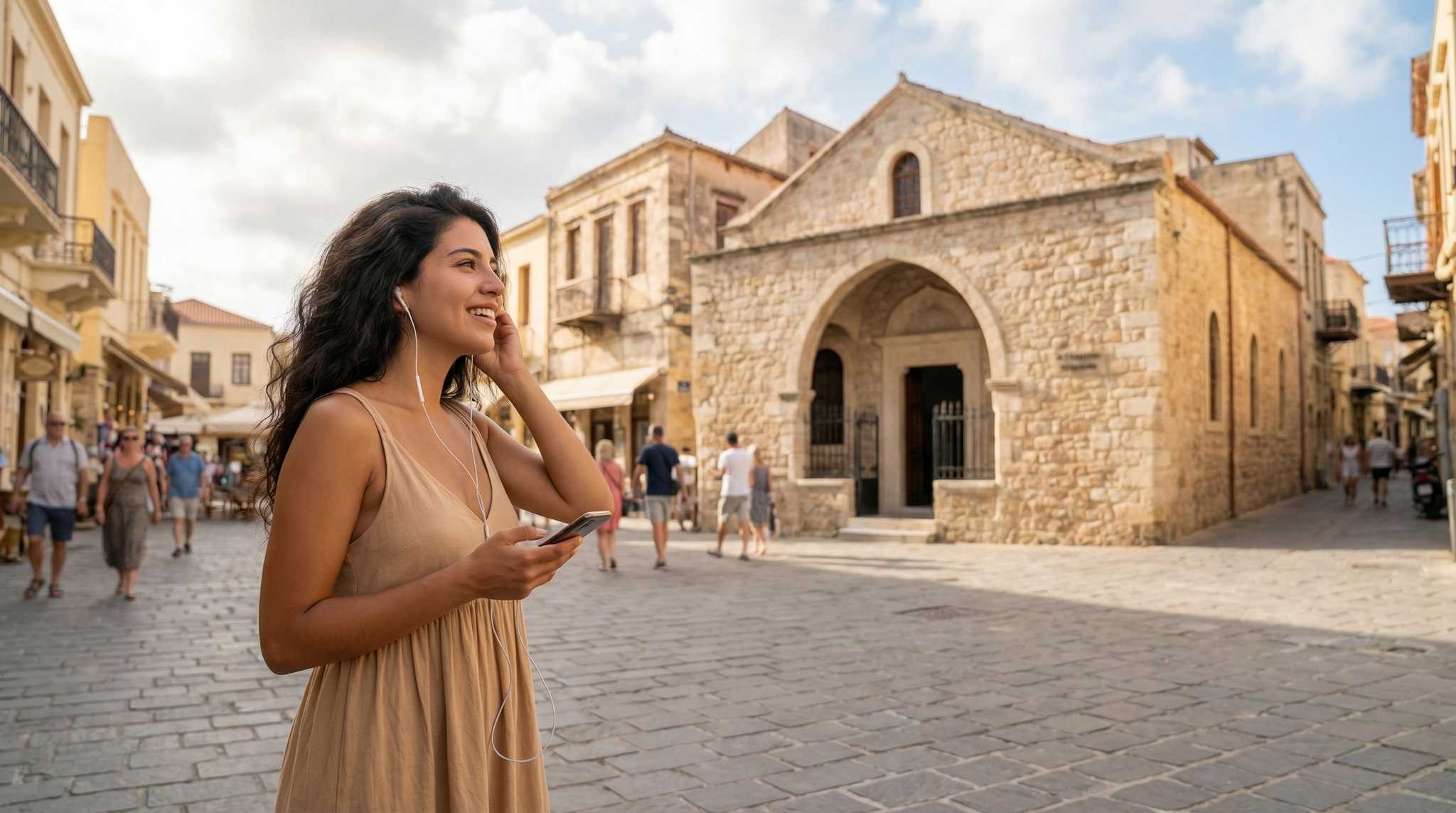
哈尼亚语音导览:圣徒、犹太教堂与老城秘密
踏上这次迷人的旅程,探索哈尼亚的迷人魅力!首先参观历史悠久的生命之树犹太教堂,这是一个宁静且充满历史与文化气息的地方。探索引人入胜的哈尼亚考古博物馆,那里古老的文物讲述着克里特岛充满活力的过去。漫步穿过热闹的斯普兰齐亚广场,这是一个感受当地生活、享受古朴咖啡馆、体验城市真实精神的绝佳地点。这段旅程融合了历史、文化和充满活力的街头生活,让您对哈尼亚独特的遗产留下难忘的印象。
导览预览
关于此导览
- schedule持续时间 30–50 mins按照自己的节奏
- straighten2.6 公里步行路线跟随引导路径
- location_on
- wifi_off离线工作一次下载,随处使用
- all_inclusive终身访问随时重播,永久有效
- location_on从 圣母玛利亚献堂都主教教堂 开始
此导览的景点
To spot the Presentation of the Virgin Mary Holy Metropolitan Church, look for the grand, pale stone building with a tall clock tower on your left and three large arched doorways,…阅读更多收起
To spot the Presentation of the Virgin Mary Holy Metropolitan Church, look for the grand, pale stone building with a tall clock tower on your left and three large arched doorways, standing proudly at the edge of the bustling Athinagora Square. Now, let’s travel back in time together-right where you’re standing! Imagine this square centuries ago: maybe you’d catch the faint scent of olive oil and hear the clatter of wooden barrels, not church bells. Originally, way back in the early 11th century, there was a humble little church here-tiny, tucked away, loved by the locals. Then came the Venetians, who apparently had a soft spot for warehouses, because they replaced the church with one! Later, in a true twist of fate, the Ottoman Turks turned it into... a soap factory! So, if the walls could talk, they’d probably tell you tales about bubbles and prayers in equal measure. Fast-forward to 1850, and something miraculous happened. The Turkish authorities donated the building back to Chania’s Christian community-soap out, spirituality in! With hammers clanging and sawdust flying, the people transformed this spot into the elegant church you see before you, which was solemnly inaugurated in 1861. Even more amazing-one of the original icons was rescued and has survived wars, empires, and soap-making to greet you from the narthex. As you step closer, peek inside and imagine golden sunlight dancing over brilliant icons by famous Cretan painters like Antonios Revelakis and Ioannis Stais. The centerpiece above the altar, “She who is Wider than the Heavens,” lifts your gaze straight up to a fresco of the Virgin Mary, painted by Nikos Giannakakis. If you had bird’s wings, you could even fly up and see the epigram inscribed on the pediment, which invites all who enter to find shelter-like frightened birds caught in a storm-under Mother Mary’s protective wing. The church was battered during the Greco-Turkish war of 1897, but (plot twist!) the Tsar of Russia paid for its repairs and even pitched in a bell. Today, every November, all of Chania celebrates its beloved cathedral on the official feast day of the Presentation of the Virgin, a local holiday that fills the square with music, cheers, and laughter. So, if you suddenly hear church bells ringing out above the historic square, remember-you’re standing in a spot that’s survived soap, war, and time, and is still the heart of Chania’s faith today.
打开独立页面 →To spot the Holy Church of Agioi Anargyroi, look for a small, salmon-pink church with stone corner blocks, a red-tiled roof, and a cozy, almost hidden entrance tucked between…阅读更多收起
To spot the Holy Church of Agioi Anargyroi, look for a small, salmon-pink church with stone corner blocks, a red-tiled roof, and a cozy, almost hidden entrance tucked between leafy bushes and neighboring buildings. Now, let me whisk you back in time! Imagine yourself centuries ago: the wind from the sea carries voices from narrow alleys, and the sandstone walls around you have watched as empires come and go. This little church-yes, the one right in front of you-was the true survivor of Chania’s shifting rulers. While many churches in the city were shut down or changed hands when the town passed from Venetian to Ottoman rule, Agioi Anargyroi just kept its doors open! In fact, it was the only one where local Christians could gather, pray, and keep their faith alive. It became the cathedral of the whole area during dark and uncertain days. As hope came back over the centuries, the church grew-extra aisles were added, first for Saint Savvas (now Saint Artemios), then for Saint Charalambos. Picture the Christian community bustling all around this spot, with children playing and women cooking just outside these walls. Step inside and you’ll find beautiful icons, including masterpieces like the Dormition of the Virgin and the Second Coming, painted by the talented local monk Ambrosios Emporos. So, when you hear the distant chiming of bells, remember: this humble spot once held the heart and hope of Chania’s Christian life! And don’t worry, the air conditioning unit on the wall is a much more recent miracle.
打开独立页面 →
再显示 5 个站点显示更少站点expand_moreexpand_less
If you look ahead, you’ll spot Splantzia Square by its giant, leafy plane tree standing right in the center, surrounded by benches and a ring of bustling cafes-just look for that…阅读更多收起
If you look ahead, you’ll spot Splantzia Square by its giant, leafy plane tree standing right in the center, surrounded by benches and a ring of bustling cafes-just look for that patch of deep shade and you’ve found it! Now, close your eyes for a second and let’s travel back across the centuries-welcome to Splantzia Square, officially known as 1821 Square, where Chania’s old city pulses with stories! Picture this place during the days of Turkish rule: Splantzia was the heart of the city’s Muslim community, the largest quarter of all, filled with the hum of markets and prayers mingling in the air. Walk a few steps to your left and you’ll find the Church of Saint Roch, quietly perched in the northwest corner. Built way back in 1630, probably after a nasty plague swept through town, this church was a beacon of hope-Saint Roch was known as the city’s plague-buster, basically the medieval version of an emergency hotline! Listen, can you imagine the military boots echoing here? During the Ottoman period, the church acted as a military post, and much later as a police station. Its long limestone walls have seen everything from whispered prayers to sharp orders. Now, swing your attention to the east-the Church of Saint Nicholas awaits with an even twistier tale. Raised just before 1320 as a Dominican monastery during Venetian times, it changed hands after the Ottomans rolled in. Overnight, it went from chapel to mosque, its new name: Hünkar Mosque, honoring the Sultan himself. The minaret, with its two elaborate balconies, soared up-taller than most in town, and a show-off even by today’s standards! Inside the mosque, there was a legendary sword belonging to the first dervish who climbed the bell tower and spun the blade, declaring, “There is one God, and his prophet is Muhammad!” This sacred sword was so admired that people believed it could heal illnesses and ease difficult births-imagine the queue for that miracle blade! When the populations exchanged in 1923, the Muslims packed it away in a glittering gold case, never to return. But the real king of the square is this-look up! This sprawling plane tree in the center, casting its shade like an enormous green umbrella. Underneath its leaves, Ottoman nobles once enjoyed their coffee in a fine octagonal kiosk. It was a place to see and be seen-unless you were a rebel. When revolution bubbled through Greece, the very tree above you became a place of both bravery and tragedy. Greek fighters met their fate here, and one day in 1821, Bishop Melchisedek of Kissamos was dragged under its boughs and hanged. His heavy death rope scraped against the wood as the city held its breath. A somber plaque now honors those lost lives. Before you leave, peer between the church and the tree-there’s an underground chamber behind iron bars. Once, 26 steps below, a Venetian cistern hid beneath your feet, big enough to water the city for six months! Later, the Ottomans turned it into a sacred fountain for their rituals. Who knows what secrets still echo in its dark well? Splantzia Square isn’t just a big shady plaza-it’s a living time machine, layered with tales of heroes, sultans, hidden waters, and maybe a few stray cats maintaining centuries-old traditions of sunbathing on a warm stone.
打开独立页面 →To spot the Assumption Cathedral, look for a bright white building with a series of arched windows along its side and an eye-catching bell tower topped with a vivid blue dome,…阅读更多收起
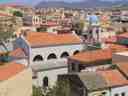
To spot the Assumption Cathedral, look for a bright white building with a series of arched windows along its side and an eye-catching bell tower topped with a vivid blue dome, standing out among the red-tiled rooftops. Now, imagine yourself back in 1879, wandering through these same winding streets, when a brand-new church suddenly sprang to life. That’s right, this is the Assumption Cathedral-the heart of Catholic life here in Chania, with a story as colorful as that blue dome above you. The first Catholic bishop of Crete, Aloisio Cannavo, oversaw its construction, determined to build a place for all the Catholics on the island to gather, sing, and celebrate. You can almost hear the excitement and perhaps a little bit of chaos as the local builders laid the last tiles, probably debating who could climb fastest up to the belfry (and who would get stuck ringing that first bell). Though it might look peaceful now, the cathedral has survived more than a few plot twists in its time. The community here has roots stretching way back to 1213, when the Roman Catholic Diocese of Crete was first founded-can you imagine centuries of prayers echoing off these walls? After a long pause in its story, Pope Pius IX himself restored the diocese in 1874, which means this place is as much about comebacks as it is celebrations. Still today, the Capuchin monks care for the cathedral, keeping ancient rituals alive while giving a warm welcome to visitors from all over the world. And if you’re lucky, you might just catch the scent of incense or the faint notes of a hymn drifting from inside-proof that history isn’t just something in the past, it’s still happening right here!
打开独立页面 →To spot the Etz Hayyim Synagogue, look for a pale stone gateway crowned with a blue tile set into a triangle above the door, nestled between whitewashed walls and shaded by…阅读更多收起
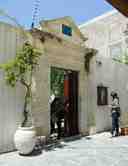
To spot the Etz Hayyim Synagogue, look for a pale stone gateway crowned with a blue tile set into a triangle above the door, nestled between whitewashed walls and shaded by greenery in a quiet side lane. Welcome to the Etz Hayyim Synagogue-Chania’s very own “Tree of Life,” and the last surviving synagogue on the entire island of Crete! Imagine stepping through this unassuming entrance off Kondylaki Street and being whisked back in time. What you see today hides centuries of extraordinary history, a tale packed with dramatic turns, courageous choices, and a hearty dose of Cretan spirit. Let’s set the stage: back in the 15th century, this very spot was home to a Catholic church, most likely dedicated to Saint Catherine. But after the Ottomans laid siege to Chania, that church was reduced to rubble-and, rumor has it, the Venetians handed the ruins to the local Jewish community. Around 1560, the synagogue you’re facing now began to take shape-built by people keen to create a new home for faith and tradition, and perhaps a bit relieved to have somewhere dry to pray during Chania’s rare rainy days! Fast forward to the bustling alleys of the old Jewish quarter. Before World War II, you’d find nearly 270 Jewish residents in Chania. Communities would gather here for prayer and festivities, and not just at Etz Hayyim-you would have also found the Beth Shalom Synagogue humming with life. But history threw dark shadows. On a quiet May morning in 1944, all the Jews of Chania, together with those from Heraklion, were arrested by German troops. Their journey ended in tragedy aboard the ship “Tanais,” torpedoed near Milos with no survivors-a heart-wrenching silence fell over these old streets. Bombings in 1941 destroyed Beth Shalom, and Etz Hayyim fell into ruin. For years, it wasn’t a place of worship, but a lonely storage shed, a dumping ground, even a stable-until the 1990s, when most people had given up hope, a certain Nikos Stavroulakis led a global effort to bring this “Tree of Life” back. By 1999, the synagogue was restored and alive again with prayer, reflection, and reconciliation. Of course, drama didn’t end there-a double arson attack in 2010 left scars, destroying rare books and artifacts but not breaking the community’s spirit. Today, you’ll find tranquil courtyards, ancient rabbi graves, and a beautiful sanctuary, echoing with thousands of years of hope, memory, and the quiet power of resilience. So step up, take a breath, and let this remarkable survivor tell you its story with every stone and shadow.
打开独立页面 →To spot the Archaeological Museum of Chania, look for a large, modern building with tan brick-like panels and a sleek glass and metal canopy right over the entrance straight ahead…阅读更多收起
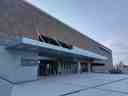
To spot the Archaeological Museum of Chania, look for a large, modern building with tan brick-like panels and a sleek glass and metal canopy right over the entrance straight ahead of you. Now imagine the buzz of the city behind you fading away as you stand here-the modern world at your back, but thousands of years of history waiting for you inside. The museum wasn’t always here, you know. Back in 1962, its treasures were stored in the heart of Chania, inside the old Venetian Monastery of Saint Francis. That ancient building had quite the dramatic life: built so long ago that nobody’s exactly sure when, it withstood the great earthquake of 1595, when the ground rumbled and buildings toppled. But the sturdy monastery held strong-so strong, in fact, that it became a mosque when the Ottomans took over, earning the grand title of the Yussuf Pasha Mosque. Then, after World War II, it got a rather less glamorous job as a storage house for military gear-imagine the poor ancient statues crammed in, side by side with rusty helmets and boots! Finally, in 1962, the place was transformed into the Archaeological Museum, where kings and emperors, pottery and coins, and even mosaics all gathered under one roof. But just like an ancient hero on a new quest, in 2022 the museum moved here to Halepa, with this new home, bright and spacious, designed to show off its wonders. Step inside and you’ll find the air cool and still, the kind of hush that invites you to whisper. The displays transport you everywhere from the ancient cities of Aptera and Kissamos to the mysterious necropolis of Armeni. Jewels that once glittered on Minoan nobility, mosaics where Dionysos and Ariadne still dance, a flask with a story no one has quite figured out-these are the voices of past ages, all gathered in one place. There’s even a bust of the Roman Emperor Hadrian that pokes out from the shadowy past, as if to say, “Hey, nice toga!” So as you stand here, remember: behind these doors, you’re not just entering a building. You’re stepping through a gateway to every era that shaped Chania. Not bad for your last stop, right?
打开独立页面 →
常见问题
如何开始导览?
购买后,下载 AudaTours 应用并输入您的兑换码。导览将准备好立即开始--只需点击播放并按照 GPS 引导的路线行驶即可。
导览期间我需要互联网吗?
不需要!开始前下载导览并完全离线享受。只有聊天功能需要互联网。我们建议在 WiFi 下下载以节省移动数据。
这是导游带领的团体游吗?
不是--这是自助语音导览。您按照自己的节奏独立探索,通过手机播放音频解说。没有导游,没有团体,没有时间表。
导览需要多长时间?
大多数导览需要 60-90 分钟才能完成,但您完全控制节奏。随时暂停、跳过站点或休息。
如果我今天无法完成导览怎么办?
没问题!导览具有终身访问权限。随时暂停和恢复--明天、下周或明年。您的进度已保存。
有哪些语言可用?
所有导览均提供 50 多种语言版本。在兑换代码时选择您的首选语言。注意:导览生成后无法更改语言。
购买后我在哪里访问导览?
从 App Store 或 Google Play 下载免费的 AudaTours 应用。输入您的兑换码(通过电子邮件发送),导览将出现在您的资料库中,准备下载并开始。
如果您不喜欢该导览,我们将退款。请联系我们 [email protected]
安全结账使用 


