
慕尼黑语音导览:慕尼黑历史艺术之旅
慕尼黑曾是一座玻璃宫殿如钻石般闪耀的城市,直到火焰将其从天际线抹去。这个自助语音导览将揭示连当地人都鲜少提及的被遗忘的角落和秘密历史。一座辉煌的水晶大教堂为何一夜之间在大火中消失?格里普托特克博物馆庄严的爱奥尼亚式石柱后方还隐藏着哪些古老宝藏?当褐衫军在街头行进并消失在阴影中时,谁又在策划致命的权力更迭? 穿梭于由创造力与冲突共同塑造的街道,从革命的萦绕回响走向令人惊叹的文化复兴。慕尼黑最引人入胜的景点背后,故事充满了野心、戏剧性和未解之谜。穿梭于记忆与大理石之间,聆听历史的层层叠叠在你身边升起。 准备好揭开慕尼黑失落的辉煌及其黑暗篇章了吗?立即开始您的旅程,让这座隐藏的城市在您眼前鲜活起来。
导览预览
关于此导览
- schedule持续时间 30–50 mins按照自己的节奏
- straighten4.7 公里步行路线跟随引导路径
- location_on
- wifi_off离线工作一次下载,随处使用
- all_inclusive终身访问随时重播,永久有效
- location_on从 玻璃宫 开始
此导览的景点
Alright, ready to start our adventure in Munich? Let's kick off this tour with the Glaspalast, or the Glass Palace! As you approach the area, you might imagine looking at an…阅读更多收起
Alright, ready to start our adventure in Munich? Let's kick off this tour with the Glaspalast, or the Glass Palace! As you approach the area, you might imagine looking at an expansive, elegant structure sparkling in the sunlight due to its glass and iron makeup. Although the original building no longer stands, I'll help paint the picture for you. Back in the day, it was like Munich's very own "Crystal Palace," just a tad bit shorter in comparison. The enormous two-story building stretched 234 meters - that's about the length of two and a half football fields! Picture yourself standing in a botanical garden with carefully laid out paths and patches of grass. Glaspalast would tower over you with its intricate iron framework filled with rows and rows of glass windows. The Glaspalast was the brainchild of King Maximilian II of Bavaria, modeled after its famous London counterpart. It was built swiftly in just six months, quite a record for the 1850s, using prefabricated iron parts and around 37,000 glass windows. Imagine the manpower and coordination it required! Initially, it housed the First General German Industrial Exhibition, showcasing the marvels of the industrial age. Over the years, it transitioned into a magnificent art exhibition hall where artists from around the world displayed their work. It also became home to some electrifying innovations-yes, literally. The first electrically lit international electrotechnical exhibition was held here in 1882, where an electric pump powered an artificial waterfall. Sadly, June 6, 1931, was a day marked by a tragic inferno that reduced the Glaspalast to ashes. The cause? Arson. Just like its London counterpart, the Glaspalast was no more, leaving behind only memories and photographs, like the one you're looking at today. Although you can't walk through its glass corridors anymore, the legacy of the Glaspalast lives on in Munich’s history. It's a tale of remarkable architecture, rapid industrial growth, and a significant cultural hub. Are you ready to move on to our next stop? We’re off to the Sturmabteilung next! Follow me! To delve deeper into the planning, construction or the uses, simply drop your query in the chat section and I'll provide more information.
打开独立页面 →As you walk, keep an eye out to your right and you’ll spot a grand building that looks straight out of ancient Greece. That’s the Glyptothek! Designed by Leo von Klenze in…阅读更多收起
As you walk, keep an eye out to your right and you’ll spot a grand building that looks straight out of ancient Greece. That’s the Glyptothek! Designed by Leo von Klenze in neoclassical style, the building features a majestic portico supported by twelve Ionic columns. Atop the gable you'll see a sculpture group of Athena, which signifies the protection of the arts. You'll also see sculptures adorning the niches along the outer walls, giving it an air of ancient grandeur. Now, let’s dive into the story of the Glyptothek-a museum with quite the royal endorsement! It was commissioned by Bavarian King Ludwig I, a man with a particular passion for all things Greek and Roman. Why? Because he wanted Munich to have its own "German Athens". He envisioned a place where culture and art from ancient Greece could be celebrated and remembered. Built between 1816 and 1830, the museum is the oldest public museum in Munich. Inside, you’ll find sculptures dating from the archaic period around 650 BC to the Roman era around 550 AD. Ludwig’s spectacular collection includes incredible pieces like the Medusa Rondanini and the Barberini Faun. On the outside, tucked into those niches I mentioned earlier, you’ll see 18 stunning original Roman and Greek sculptures. Bavaria’s ancient art collection didn’t escape unscathed from World War II. The museum itself was reconstructed, but sadly the vibrant frescoes inside didn’t survive. Post-war, the museum reopened in 1972 with simpler plastered walls, and has since undergone further renovations to preserve its magnificent structure. If you ever wondered what a blend of Greek style and Bavarian passion looks like, the Glyptothek is your answer! It’s a treasure trove of ancient art right in the heart of Munich’s Kunstareal.
打开独立页面 →Ah, you’ve made it to the infamous Sturmabteilung, better known as the SA or "Brownshirts!" Don't worry, no one's expecting you to don a brown shirt and start marching. This spot…阅读更多收起
Ah, you’ve made it to the infamous Sturmabteilung, better known as the SA or "Brownshirts!" Don't worry, no one's expecting you to don a brown shirt and start marching. This spot marks the chilling history of the original paramilitary organization under Adolf Hitler and the Nazi Party. Imagine it’s the 1920s and 1930s; these guys were the muscle behind Nazi rallies and assemblies, always ready to flex their uniforms and break up meetings of political opponents. Essentially, the SA were like the bouncers you never wanted to mess with, especially if you were a trade unionist, a Romani, or, heaven forbid, Jewish. The name "Brownshirts" came about amusingly-if you can use that word-because they had a surplus of brown shirts initially meant for German colonial troops. Talk about recycling! The SA not only protected party gatherings but also intimidated and attacked opposition groups. However, all this flexing of muscles couldn't save their leader, Ernst Röhm, during the "Night of the Long Knives" in 1934, where he was arrested and executed, resulting in the SA losing power to the much more sinister SS. The SA continued in a diminished role until the fall of Nazi Germany in 1945. While their story isn’t exactly uplifting, it's a sobering reminder of the dark chapters of history that one must never forget. All right, let’s shake off the chills and move on to a place with a bit more artistic flair in Munich. Off we go! Yearning to grasp further insights on the rise, fall or the night of the long knives? Dive into the chat section below and ask away.
打开独立页面 →

再显示 6 个站点显示更少站点expand_moreexpand_less
As you approach the Pinakothek der Moderne, look to your right. You'll see a striking modern building with a clean, rectilinear facade. It’s dominated by white and grey concrete,…阅读更多收起
As you approach the Pinakothek der Moderne, look to your right. You'll see a striking modern building with a clean, rectilinear facade. It’s dominated by white and grey concrete, large windows, and several tall, slender columns supporting a vast canopied roof. The entrance is easy to spot with its expansive glass panels and invitingly open design. Now, let’s dive into the interesting bits! The Pinakothek der Moderne, located in Munich's Kunstareal, is a powerhouse of modern art. Designed by the talented German architect Stephan Braunfels, this architectural beauty was inaugurated in September 2002, after seven years of meticulous construction. Imagine this: a $120 million, 22,000-square-meter building that took a decade to complete due to design debates and cost concerns, eventually made possible by the help of private financing. The result? A stunning blend of art, architecture, design, and works on paper. Each of the four corners of this grand structure, connected by a central domed rotunda, pays homage to a different collection. Picture this: the first floor is bathed in natural light, perfectly augmented by computer-controlled lamps to ensure a consistent, shadowless experience against grey floors and white walls. It's like an art lover’s heaven! Before this gem opened, 20th-century art was scattered around Munich. But now, it’s all unified under one roof, making the Pinakothek der Moderne one of Europe’s most significant and popular modern art museums. And it’s not just about paintings. The museum houses the "Sammlung Moderne Kunst" (National Collection of Modern and Contemporary Art), the "Staatliche Graphische Sammlung" (National Collection of Works on Paper), the "Neue Sammlung" (National Museum of Design and Applied Arts), and the "Architekturmuseum der Technischen Universität" (Munich Technical University’s Museum of Architecture). Oh, and don’t miss the Danner Jewelry Collection in the basement! Since 2004, it has showcased contemporary works from over a hundred international goldsmiths. With pieces from various art movements like Expressionism, Fauvism, Cubism, Surrealism, Pop Art, and many more, your art tour through time begins right here. Enjoy the modern masterpieces!
打开独立页面 →Ah, the Feldherrnhalle, our next stop on this Munich adventure! As you're walking towards it, look to your left and you'll spot a grand open-air hall with three majestic arches.…阅读更多收起
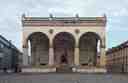
Ah, the Feldherrnhalle, our next stop on this Munich adventure! As you're walking towards it, look to your left and you'll spot a grand open-air hall with three majestic arches. It's like a regal stage set for the most important military parade you've ever seen. There are three statues under these arches - two on either side and a dramatic sculptural group in the center. Each arch is crowned with intricate detailing and carving. Allow me to share a bit more on this historical beauty. The Feldherrnhalle, or "Field Marshals' Hall," is not just any loggia. It's a monumental structure commissioned by fun-loving King Ludwig I of Bavaria back in 1841. Taking a page from the Loggia dei Lanzi in Florence, Ludwig had this built to honor the Bavarian Army's traditions. But this isn't just any army hangout spot. The Feldherrnhalle witnessed some high drama in 1923 during Hitler's Beer Hall Putsch. It's as if the building itself staged a brief but intense historical drama that ended with a real bang, a gunfight between Hitler's followers and the Bavarian State Police, marking the failure of Hitler's coup attempt. Back in the day, it commemorated military leaders with statues of Johann Tilly and Karl Philipp von Wrede. Yet, some witty Munich folk poked fun at them with a little jab courtesy of the writer Lion Feuchtwanger. He noted that Tilly was "never truly Bavarian" and Wrede was "never much of a field marshal." After some historical hijinks, including the dramatic Beer Hall Putsch, the Feldherrnhalle became a solemn memorial under Nazi rule, complete with its west wall once bearing the names of "martyrs" from the putsch. Fortunately, post-World War II, the locals tore down the Nazi memorial, restoring the hall's appearance to its former glory. So, next time you see those grand arches and solemn statues, remember the echoes of parades, coups, and witty city folks that give the Feldherrnhalle its lively past! Intrigued by the structure, site of the beer hall putsch or the nazi memorial? Make your way to the chat section and I'll be happy to provide further details.
打开独立页面 →Alright, you should be seeing the Munich Residenz on your right. It’s a sprawling complex with a real mix of architectural styles - quite the eye-catcher! Look for a vast, ornate…阅读更多收起
Alright, you should be seeing the Munich Residenz on your right. It’s a sprawling complex with a real mix of architectural styles - quite the eye-catcher! Look for a vast, ornate building with a combination of Renaissance, Baroque, Rococo, and Neo-Classical elements. It almost feels like you’re looking at the set of an architectural historical drama. The Residenz, once the palace of the Wittelsbach monarchs of Bavaria, holds the record as the largest city palace in Germany. Imagine having a home with 130 rooms, 10 courtyards, and whole wings dedicated to concerts and plays! The Residenz is divided into three main parts: 1. **Königsbau**: Located near Max-Joseph-Platz. 2. **Alte Residenz (Old Residenz)**: Positioned towards Residenzstraße. 3. **Festsaalbau**: This part faces the Hofgarten. Also part of this grand complex is the Cuvilliés Theatre, tucked into the Festsaalbau wing, which was lovingly reconstructed after World War II. And don't be surprised to find the Herkulessaal (Hercules Hall) here, known as the main concert venue for the Bavarian Radio Symphony Orchestra. A fascinating tidbit: the first buildings here were built way back in 1385 as a defensive structure financed by Munich’s citizens after a botched uprising. Responding to the need for ultimate security, the Wittelsbachs started the Neuveste - a castle surrounded by moats and positioned to evade the city’s meddlesome alleyways directly. Over four centuries of development later, it practically absorbed an entire city quarter. Fun fact: the Byzantine Court Church of All Saints peeks out on the east side of this massive complex, right by the former royal stables. So while you’re standing here, imagine dukes and duchesses sauntering through these grand halls, their lives a blend of opulence and medieval intrigue. It’s a real slice of history standing right in front of you! Ready to delve deeper into the history and architecture, inside the palace or the hofgarten? Join me in the chat section for an enriching discussion.
打开独立页面 →You're almost there! To spot the Hofbräuhaus am Platzl, look for a grand building with a striking white facade and distinctive stepped gables that resemble a castle's battlement.…阅读更多收起
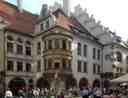
You're almost there! To spot the Hofbräuhaus am Platzl, look for a grand building with a striking white facade and distinctive stepped gables that resemble a castle's battlement. You'll see an ornate corner bay window extending from the second and higher floors. The building has a large "HB" logo in blue and gold at the top, a tell-tale sign you're at the right place. There's also a colorful beer garden sign adorned with various round plaques on a tall pole just outside the building, which often catches the eyes of thirsty visitors. Now, let’s dive into some fun facts! The Hofbräuhaus am Platzl is a legendary beer hall here in Munich, originally constructed in 1589 by Duke Maximilian I of Bavaria. It was initially an extension of the Staatliches Hofbräuhaus in München brewery. The doors were opened to the public much later, in 1828, thanks to King Ludwig I. The building got a major facelift in 1897, thanks to Max Littmann, as the brewing operations moved to the suburbs. While World War II bombings ravaged most of the building, the historic beer hall known as the "Schwemme" remained intact. The restoration work wrapped up in 1958, and the Festival Hall gleamed once more. The backstory goes that Duke William V wasn't pleased with the local brew, so he commissioned his royal court to craft a solution, which led to the inception of this brewery in 1589. But it’s not all about the beer - this place is soaked in history. Controversially, in February 1920, it hosted a pivotal speech by Adolf Hitler, marking the foundation of the Nazi Party. Despite being heavily damaged during WWII, it was restored by Munich’s 800th anniversary in 1958. Aside from being historic, the Hofbräuhaus am Platzl is a gastronomic haven. Here, you can feast on traditional Bavarian delights like Brezn (soft pretzel), Obatzda (cheese dip), Hax'n, and an assortment of sausages including Bratwurst and Weisswurst. Of course, no visit would be complete without trying some of their classic brews like Helles, Dunkles, and Weißbier. Whether you’re a tourist or a local with a personal mug stored here, the Hofbräuhaus am Platzl offers an authentic Bavarian experience paired with lively traditional music. And if you fancy a little sing-along, remember the Hofbräuhaus song by Wilhelm "Wiga" Gabriel, composed in 1935: "In München steht ein Hofbräuhaus, eine, zwei, g'suffa!" which translates to "There's a Hofbräuhaus in Munich-one, two, down the hatch!" Enjoy your visit and, as they say here, "Prost!"
打开独立页面 →As you're approaching the Marienplatz, you'll certainly notice it on your slight-left. Look for a large open square that's bustling with activity. The north side of this square is…阅读更多收起
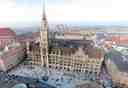
As you're approaching the Marienplatz, you'll certainly notice it on your slight-left. Look for a large open square that's bustling with activity. The north side of this square is dominated by a striking, elaborate gothic building with a tall, pointed clock tower; this is the New Town Hall (Neues Rathaus). The tower's intricate facade and the grand structure are hard to miss. The Old Town Hall (Altes Rathaus) is on the eastern side of the square, presenting a charming, historic contrast. Now let's dive into what makes this place so amazing: Der Marienplatz is the central square of Munich's inner city and part of the pedestrian zone. It lies in the old town at the intersection of two main axes: the East-West axis between Isartor and Karlstor, which was part of the salt road from Salzburg or Reichenhall via Landsberg am Lech to Switzerland, and the South-North axis between Sendlinger Tor and the Schwabinger Tor, which stood at what is now Odeonsplatz. Centrally situated with the New Town Hall to the north and the Old Town Hall to the east, the south and west sides are lined with department stores and other commercial buildings, often featuring gastronomy. The square is about 100 meters long and 50 meters wide. Since the founding of Munich in 1158 by Henry the Lion, Marienplatz has been the heart and center of the city. The two main roads met here, making it a crucial part of the city's development and life throughout the centuries. To this day, Marienplatz remains Munich's urban center. In 1315, Ludwig the Bavarian, later the Emperor, granted Munich trade freedom on the condition that the then marketplace, now known as Marienplatz, remain undeveloped "for eternity." As a result, various markets for eggs, grain, wine, and fish took place here, and the square was simply called "Markt" or "Platz" for centuries. When grain was the primary commodity sold, it was known as Schrannenplatz, with the northeast corner by today's Fish Fountain traditionally hosting the fish market. The square was also a site for executions and served as a venue for knight tournaments and festive receptions for the city, such as during the Emperor's visits in the 15th and 16th centuries. It wasn't until 1481 that buildings on the square, including a chapel, were demolished to create a rectangular open space. In 1566, the construction of the landscape houses, where representatives of estates and landscapes had their seat with the Bavarian Duke, made Marienplatz a political hub, which it remains to this day. The political significance of Marienplatz was also closely linked to religious motives. In 1638, Elector Maximilian I erected the Mariensäule (Column of Mary) on the then marketplace in gratitude for sparing the city during the Swedish occupation in the Thirty Years' War. This column is now a Munich landmark. In 1854, after the grain market moved to Schrannenhalle on Blumenstraße, Schrannenplatz was renamed Marienplatz as a gesture of dedication to Patrona Bavariae, seeking to protect the city from a cholera epidemic that broke out in July 1854. From 1888, trams ran through the square. The construction of the New Town Hall on the north side of the square between 1867 and 1909 brought significant change. A total of 21 bourgeois houses with their arcades and fine stucco facades, which had characterized Marienplatz, were replaced by the neo-gothic colossal building designed by Georg von Hauberrisser. The Second World War heavily damaged the buildings around Marienplatz, including the historic structures on the southern side, such as the "Peterhof" with its fine baroque gable facade. So, standing here, you are at the very epicenter of Munich's history and vibrancy, where tradition and modern life seamlessly blend together. Enjoy the bustling atmosphere and the rich historical tapestry of Marienplatz! Intrigued by the lage, geschichte or the mittelpunkt der entfernungsmessung? Make your way to the chat section and I'll be happy to provide further details.
打开独立页面 →
常见问题
如何开始导览?
购买后,下载 AudaTours 应用并输入您的兑换码。导览将准备好立即开始--只需点击播放并按照 GPS 引导的路线行驶即可。
导览期间我需要互联网吗?
不需要!开始前下载导览并完全离线享受。只有聊天功能需要互联网。我们建议在 WiFi 下下载以节省移动数据。
这是导游带领的团体游吗?
不是--这是自助语音导览。您按照自己的节奏独立探索,通过手机播放音频解说。没有导游,没有团体,没有时间表。
导览需要多长时间?
大多数导览需要 60-90 分钟才能完成,但您完全控制节奏。随时暂停、跳过站点或休息。
如果我今天无法完成导览怎么办?
没问题!导览具有终身访问权限。随时暂停和恢复--明天、下周或明年。您的进度已保存。
有哪些语言可用?
所有导览均提供 50 多种语言版本。在兑换代码时选择您的首选语言。注意:导览生成后无法更改语言。
购买后我在哪里访问导览?
从 App Store 或 Google Play 下载免费的 AudaTours 应用。输入您的兑换码(通过电子邮件发送),导览将出现在您的资料库中,准备下载并开始。
如果您不喜欢该导览,我们将退款。请联系我们 [email protected]
安全结账使用 


