
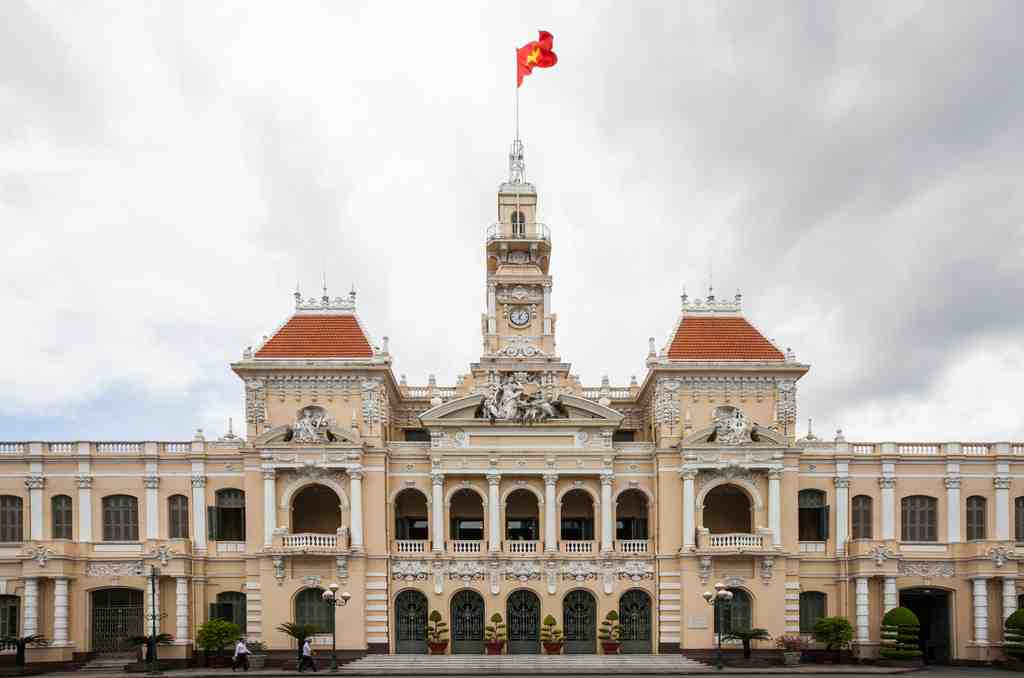
In front of you is a grand, cream-yellow building with a tall central clock tower, red-tiled roofs, a flurry of ornate white decorations, and the bright red Vietnamese national flag flying high above-just look straight ahead, and you can’t miss its stately elegance towering over the beginning of Nguyen Hue boulevard.
Now, take a second to absorb this architectural gem-it’s like a slice of European history baked right into the heart of Ho Chi Minh City! This, my friend, is the Ho Chi Minh City People’s Committee Building, once known as the Hôtel de Ville. Imagine it’s the early 1900s. Paris is in vogue, and Saigon is buzzing with colonial ambitions. The French, eager to stamp their personality on the city, brought in architect Fernand Gardès, who must have thought, “Let’s give Saigon a City Hall worthy of a Parisian postcard... but with a tropical twist!”
As stones were stacked and columns raised from 1898 to 1908, the locals would have gawked at this Baroque and Rococo extravaganza slowly growing at the head of Nguyen Hue street-its white Corinthian columns and lavish decorations almost daring the humid air to tarnish them. There’s a clock up there, high above, flanked by a goddess and two little angels wrangling mythical beasts. If you squint, you might almost hear the tick-tock of time piling up underneath the grand spectacle.
Don’t forget to check out the flag atop the sharp central tower, fluttering in the breeze. That flag isn’t just decoration-it’s a symbol of resilience and change. This building has seen more name tags than a conference attendee! Under the French, it was the elegant Hôtel de Ville or “Dinh Xa Tay” in Vietnamese: a classy address for colonial officials. Later, as the Republic of Vietnam took hold, it became “Tòa đô chánh Sài Gòn,” the center stage for the local government. After the city’s liberation, it settled into its current important role, but trust me, it still loves a dramatic parade on national holidays. On April 30th, 2023, for the first time ever, the doors swung open for visitors, as if the old walls finally whispered, “About time, isn’t it?” Up until then, only birds and the iconic city clock got a peek inside!
Walk a little closer and you’ll spot the five arched gates at the front-each one crowned with swirling ironwork like icing atop a wedding cake. Imagine the rumble of 1940s Saigon cars breezing through those very portals. Fancy a shortcut? Well, back then, the side gates let government cars swoosh straight into the inner courtyard.
If the exterior seems almost too lavish for mere paperwork, it’s because the building originally drew inspiration from northern French bell towers-and it certainly was designed to impress! The center tower reaches up with pomp and a giant smile, and below, its façade parades a mix of baroque flair: roses, garlands, and sculpted lion faces guard the balconies. The triad of female figures above symbolize Marianne, representing France’s ideals of liberty, equality, and fraternity. Quite literally, the French left their sculpted fingerprints everywhere-maybe just in case anyone forgot who was in charge!
Peek through the windows and try to imagine the hum of activity: bureaucrats bustling, columns of sunlight slanting over art nouveau railings, and walls decorated in classic Louis XV motifs-waves of laurel leaves and geometric patterns, gleaming in all directions. Somewhere on a staircase, two cherubs hold the original Saigon city seal. The spirit of the place is part grandeur, part playful-a little like a stately town hall caught winking at a cathedral as the noon bell rings.
But even these regal walls have changed to keep up with the city’s rapid pace. New wings sprouted in the 1960s and 1990s-security posts here, extra offices there, and later an underground parking garage for the motorbikes that claim every inch of Saigon’s streets. In recent years, experts from faraway Lyon lit up the façade, so at night this old building glows like the chandelier at a grand ball.
Step into the garden at the front and you’ll see a memorial stone, hinting at another bit of drama from August 25th, 1945: the unveiling of the Southern Vietnam Provisional Administration Committee-a day when revolutionaries stirred the city and hope was in the air.
So, as you stand before these walls, remember: over a century of stories are carved into every arch and statue. The stately facade hides layers of political plot-twists, a whole cast of historical characters, midnight decisions, and perhaps one or two curious officials who wished those lions could talk. If these walls could giggle, they’d probably say, “Bienvenue, traveler! The party-and the paperwork-never ends at City Hall.”


