
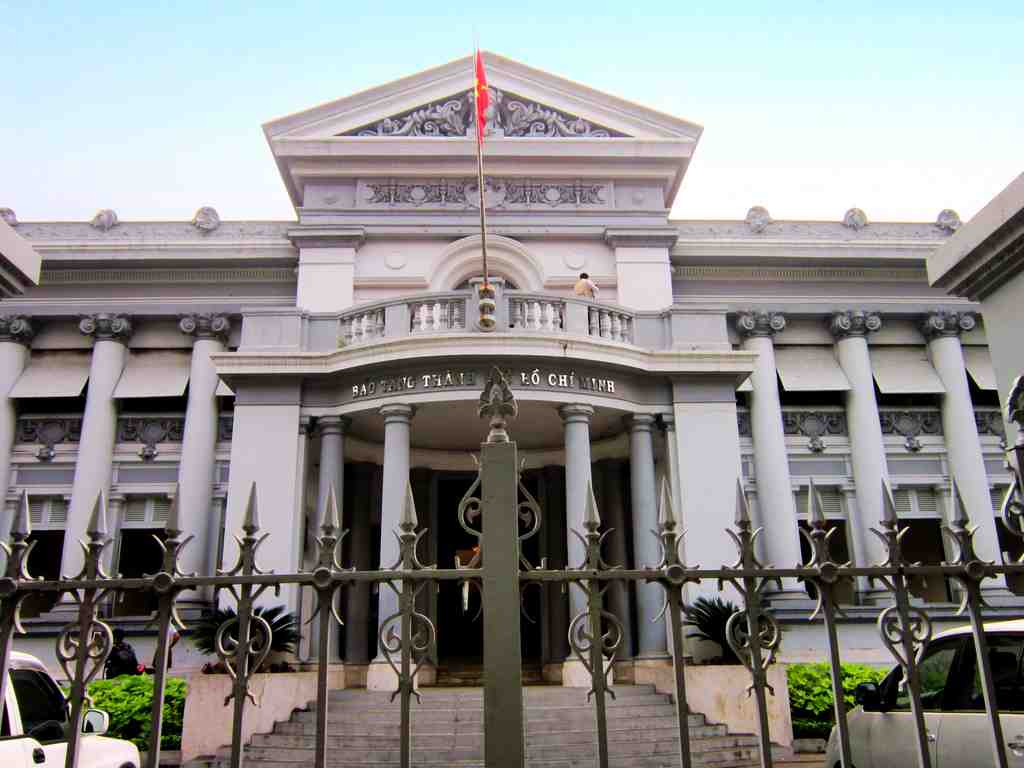
Look straight ahead for a grand, elegant mansion gleaming in white and grey, guarded by a spiky fence and framed by tall columns and intricate carvings-if you see a building that looks like it's ready for both a history lesson and a fancy party, you've found the Ho Chi Minh City Museum!
Welcome, explorer, to one of the most storied corners of Ho Chi Minh City. If these walls could talk, they'd probably start with a dramatic sigh, do a little costume change, and then launch into a decades-long soap opera with more twists than a bowl of noodles. Picture this: it's the late 1800s, Saigon is abuzz with the clatter of colonial ambition, and a French architect by the name of Alfred Foulhoux gets the not-so-small task of designing a museum to show off goods from southern Vietnam. By 1890, he unveils this majestic structure before you, a mix of Western classical lines and Asian rooftops, complete with mysterious statues and carvings-you might even spot a chicken and an owl tucked into the designs, representing day and night. It was like the original 24-hour museum, just quieter!
But here’s the plot twist: before anyone could even show off a single coconut grater, Henri Éloi Danel, the Deputy Governor of Indochina, says, “Merci, I’ll take that as my house!” Voila! It becomes the deputy governor’s palace. And what a house party it was-no less than 14 French officials took turns living here before 1911, probably all arguing about who left crumbs on the marble floors. Then came the era of the Governors of Cochinchina, another parade of hats, each one dreaming of ruling southern Vietnam from these very halls.
Yet the house’s drama was only just beginning. Come 1945, World War II throws the whole city into chaos-Japanese forces take over, a new governor moves in, then a Vietnamese imperial official, then revolutionary Viet Minh, then… wait for it… the British Army! It’s like speed dating for governments. By October that year, the French sweep back in, turning this place into the temporary residence of high-ranking commissioners. Each time you hear the clack of your shoes on these steps, imagine the shuffle of boots, sandals, and hurried whispers plotting the region’s fate.
Fast forward, and the building changes names like a rockstar changing costumes. It’s been called the “Gia Long Palace,” “Commissioner’s Palace,” even the “Residence of the Chief of State.” In 1950, this site becomes etched in the memory of generations: over 6,000 students and teachers gather outside to protest for justice, leading to fierce clashes and the tragic death of young Trần Văn Ơn-a moment that drew tens of thousands to his funeral. The palace was at the center of more than one revolution.
Jump again to the early sixties-an attempted assassination rocks the grand old Independence Palace, sending President Ngô Đình Diệm scurrying here for safety. Imagine the hush of secret tunnels being dug beneath your feet, a maze of escape passages built in the dead of night to keep the President and his family safe from bombs above. If you feel a chill, don’t worry-it’s just the ghosts of secrets past brushing by!
And then, when Vietnam’s whirlwind history finally begins to settle, the palace becomes home to the Supreme Court of South Vietnam, until the momentous spring of 1975. After the city’s reunification, this storied building stands empty for a while-a pause to catch its breath-before being reimagined in 1978 as the Revolutionary Museum, finally opening to the public as the Ho Chi Minh City Museum in 1999.
Step inside, and you’ll see not just the city’s greatest hits, but its heart and soul, told through 1,700 square meters crammed with relics: ancient bronze drums, stone axes, traditional wedding outfits, and models of night markets buzzing to life. There’s the clink of old coins, scenes of joyful festivals, and somber displays of heroic struggles-each one a thread in the wild tapestry of Saigon.
Outside, don’t miss the planes and military vehicles quietly resting in the garden, reminders of decades of battle and peace. And next time someone says history is boring, you can just laugh and tell them about the museum that survived empires, bombs, and-unlike your last houseplant-never gave up on its next act!


