
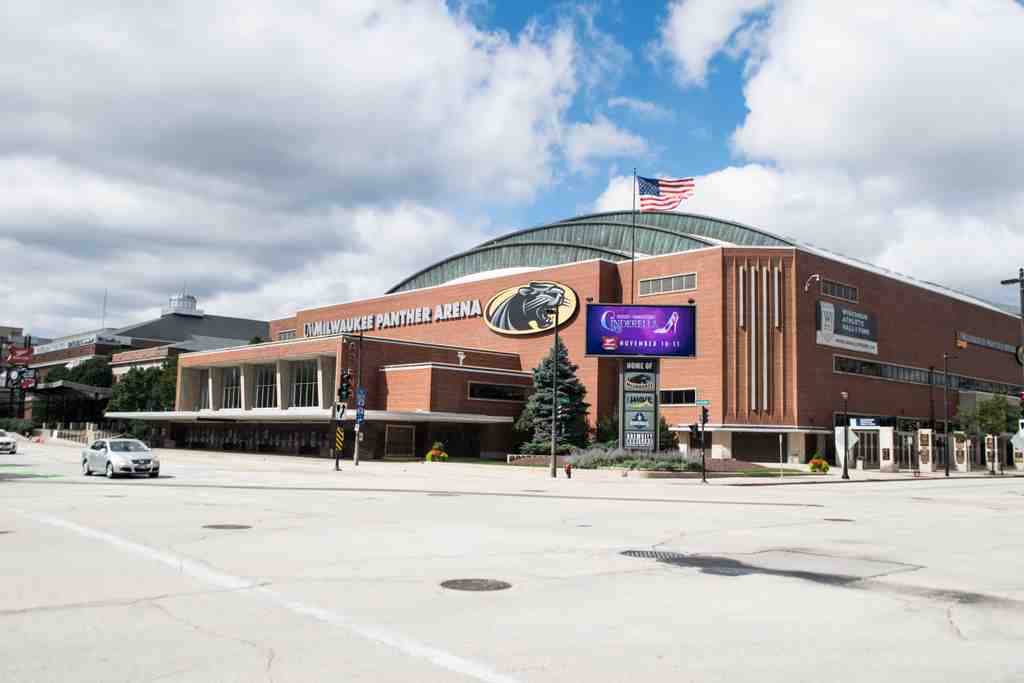
You are looking at a massive red brick building crowned by a sweeping arched roof, easily identified by the large black and yellow panther head mounted right on its facade.
For a long time, locals just knew this place as the MECCA Arena, a building that became the unlikely canvas for a chaotic forty thousand pound basketball floor painted in blazing orange. Back in 1978, the city hired famous pop artist Robert Indiana to design a new basketball court for the Milwaukee Bucks. The result was absolutely wild. He painted massive, vibrant orange letter M's covering both half courts.
The initial public reaction was completely hostile. The city spent twenty seven thousand five hundred dollars in public funds on the project, which is roughly a hundred and thirty grand in today's money. Locals felt it was a ridiculous waste of their hard earned taxes. But that community outrage shifted pretty quickly when the Bucks actually started playing on it.
The court was so intensely bright and visually jarring that opposing players would completely lose their bearings. They would accidentally step out of bounds or wander blindly into the three second lane, which is the restricted painted area near the basket where offensive players are legally only allowed to stand for a few moments at a time. Even the Bucks head coach, Don Nelson, joked that he thought his team had to wear sunglasses because the floor was so blinding. It was pure pop art weaponized for a home court advantage.
But nothing lasts forever. After the Bucks moved out in 1988, this massive wooden masterpiece was unceremoniously abandoned. Fast forward to the early two thousand tens, and the legendary floor mysteriously ended up listed on a random architectural salvage website. If you check out your screen you can see the arena's very tidy modern exterior, a sharp contrast to the messy, colorful drama of its history.
A local fan named Andy Gorzalski spotted that internet listing and panicked. Refusing to let the iconic court be chopped into scrap wood, he threw a twenty thousand dollar hold straight onto his personal credit card. He frantically tracked down a local flooring company owner named Greg Koller, who officially stepped in to buy it.
But tragically, Greg died unexpectedly in July of twenty eleven, right after acquiring the wood. Just before his passing, he urged his son Ben to come back home from Los Angeles to preserve the artwork. Greg told his son that the MECCA was not just a basketball floor, but an idea that represented going after your dreams.
Honoring his father's final wish, Ben partnered with Andy to restore the floor, eventually transforming that crazy orange puzzle into a celebrated public art installation. It is a fantastic story of how this city constantly tears down and rebuilds its identity, taking huge artistic risks that spark fierce community arguments, only for passionate locals to step up and rescue the pieces.
And speaking of places where bold modern ambition meets deep local roots, we are moving on. Make your way toward our next stop at the Baird Center, which is about a six minute walk away.




