
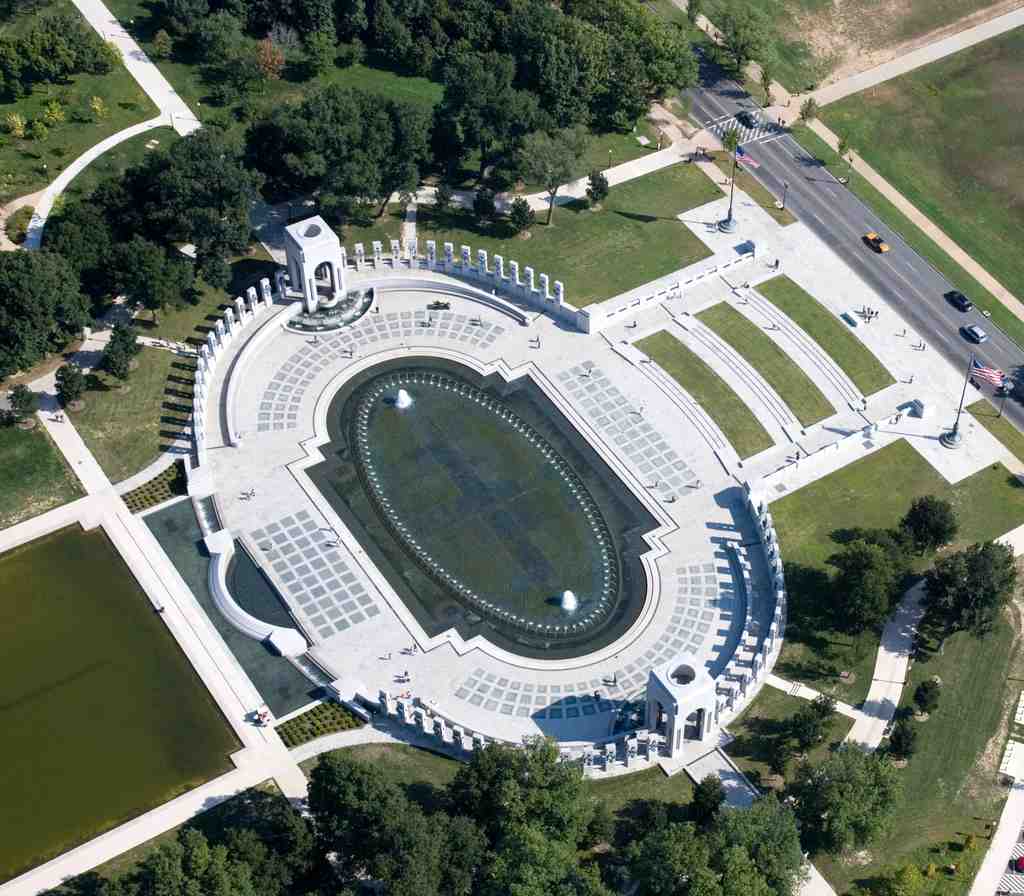
Before you lies a vast sunken plaza ringed by fifty-six tall granite pillars and anchored at each end by a towering triumphal arch.
This is the World War II Memorial. It feels... heavy, doesn't it? When Austrian-American architect Friedrich St. Florian designed this, he intended it to be a classical shrine to democracy. But when the plans were revealed, the reception was complicated. Critics called the design "bombastic" and "authoritarian," arguing that its imposing granite and bronze wreaths felt uncomfortably similar to the style of the very regimes the Allies had fought against. They complained it interrupted the historic, open view between the Washington Monument and the Lincoln Memorial, essentially muscling its way into the most sacred corridor of the capital.
But strip away the architectural debates, and you find the human heart of the design. St. Florian wasn't just thinking about abstract columns. He grew up in Austria and was a young boy when American troops arrived to liberate his town from Nazi control. He famously remembered a G.I. kicking open his classroom door. He ran home shouting that school was out, and his mother corrected him, saying, "No, the war is over." That memory of liberation is what built this place.
If you look to the west side, you’ll see the Freedom Wall. It is covered in four thousand and forty-eight gold stars. Each star represents one hundred American lives. A foundry worker named Dave Jackman, who cast these stars, recalled seeing buckets of them moving through the factory and feeling overwhelmed by the sheer magnitude of the loss. That is the true price of the power we have been discussing on this tour.
It is strange to think this massive complex began with a simple fish fry in Ohio. In 1987, a rural letter carrier and veteran named Roger Durbin cornered his Congresswoman, Marcy Kaptur. She pointed out the famous Iwo Jima statue as a tribute to the war, but Durbin, a former tank mechanic, shot back, "That's for the Marines. What about the rest of us?" He refused to let it go. It took seventeen years of lobbying and fundraising to get this built. Tragically, Durbin died of pancreatic cancer just before the groundbreaking. At the dedication, his empty chair was draped with his jacket, a silent witness to the long struggle for recognition.
We have seen a lot of grand structures today. We have seen the institutions that project authority and the buildings that house the gears of government. But I want you to look for one small, hidden detail here that captures the spirit of the citizenry better than any pillar.
Walk toward the service gates tucked behind the triumphal arches. Hidden in the shadows of the alcoves, there is an engraving. It is not an eagle or a laurel wreath. It is a cartoon. A bald man with a long nose peering over a wall, captioned with the phrase "Kilroy was here."
Kilroy was the ultimate inside joke of the war. Soldiers drew him on bathroom walls, on crates of ammunition, and even on captured enemy bunkers. He was a symbol that no matter how dark the situation, or how far from home they were, an American had been there. He was watching. The architects included these hidden engravings as a secret nod to the humor that sustained the troops.
And that seems like the right place to leave you. We have walked past the White House, the banks, and the massive departments that run the state. We have seen the architecture of power. But here, scratched into the stone, is a reminder of who actually bears the weight of it all. Not the institutions. But the people. The Kilroys. The Roger Durbins. You.
Thank you for walking with me.




