
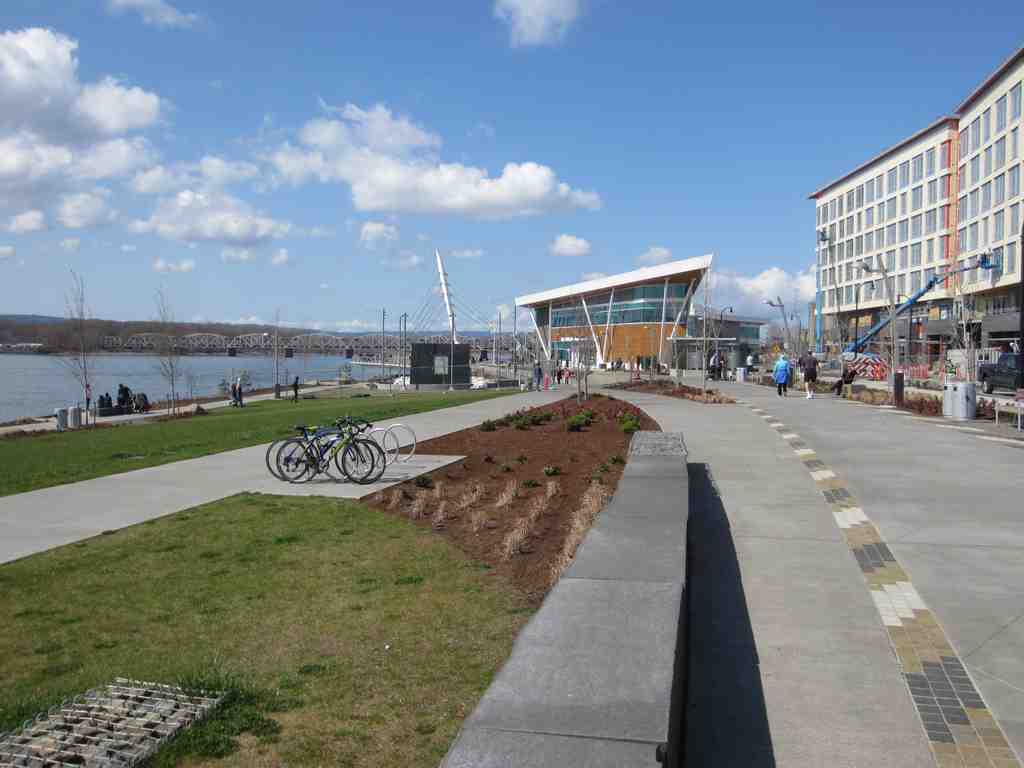
Look out across the wide concrete promenade that curves gently past the manicured green lawns, leading your eye straight toward that striking modern building with a slanted wood-and-glass roof and a towering white mast reaching into the sky.
Standing here looking out at the Columbia River, you are witnessing the end of a fight that lasted well over a century. It actually started way back in 1855, when a local civic leader named Esther Short donated this very property to the city. She laid down a strict condition for the gift, demanding the land be used for economic development while forever preserving public access to the waterfront. But her dream was completely hijacked. For generations, heavy industry, including the massive Boise Cascade paper mill, took over the shore, contaminating the ground and totally blocking the community from their own river until the mill finally closed in 2005.
But reclaiming this shore was an absolute rollercoaster. When developers finally bought the site in 2008, the timing was terrible because they slammed right into the Great Recession. Developer Barry Cain was suddenly staring down a massive forty-four million dollar infrastructure bill just to build an earthen wall, or berm, under the railroad tracks to connect the city streets, and he nearly abandoned the whole project. He took his concerns to Mayor Royce Pollard, who boldly guaranteed the city would find the money. Then, just as things got moving, a massive oil terminal was proposed just three miles downriver in 2013. Cain had to fight tooth and nail, warning the media that safety fears surrounding an oil terminal would completely scare off financing for his one point three billion dollar vision, and thankfully, the terminal was defeated.
Now, look at that incredible focal point suspended over the water, the Grant Street Pier. It stretches one hundred feet out over the river, held up by cables attached to a striking seventy-five foot tall beam designed to look like a sailboat mast. Remarkably, they engineered it entirely without putting support columns in the water, ensuring local fish could migrate safely below. If you walk up to the base of the pier, you will see actual structural engineering math etched into the stone, along with an image of the Columbia Rediviva, the famous American ship that gave this mighty river its name in 1792.
Nearby is the Headwaters Wall, a stunning twelve foot stone and bronze water feature with a cast bronze map of the Columbia Basin. Right after it opened in 2019, city officials panicked when unsightly white chalky stains appeared on the polished black granite. They had already spent fifteen years battling similar stubborn stains on a bell tower in town! Fortunately, smooth granite is easier to clean than porous brick.
When this park finally opened to an emotional crowd of thousands, the mayor proudly declared that Vancouver had grown up. The community finally clawed back its shoreline. So, let us trace this resilience back to its roots. Our next stop is a ten minute walk away, where we will visit Captain George Vancouver Monument Plaza, honoring the man who supposedly started it all.




