
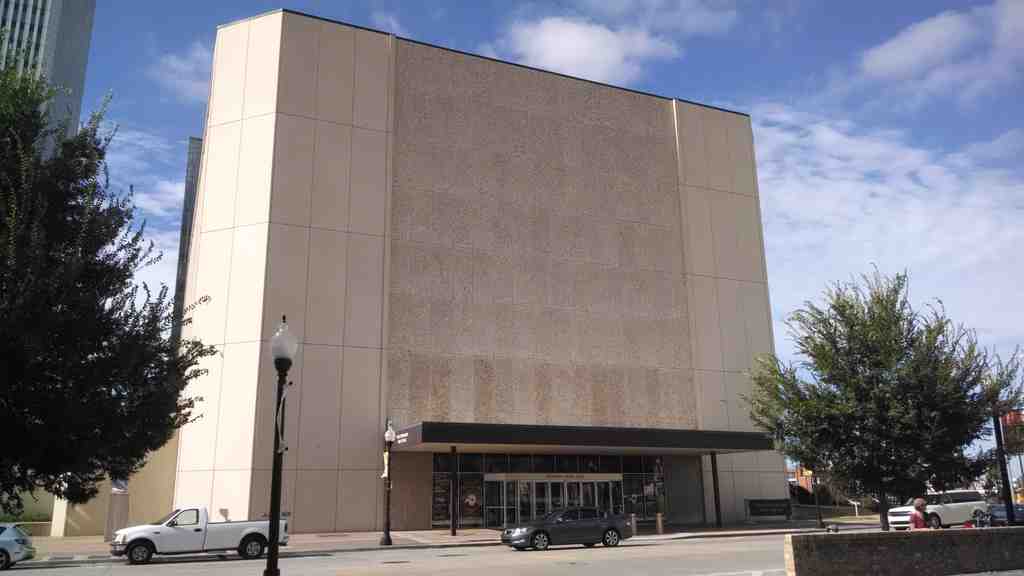
On your left, look for the big, blocky cream-and-tan building with a wide dark entrance canopy and glass doors sitting low against a nearly windowless wall.
You’re standing at the Tulsa Performing Arts Center, and from the outside it has that “serious business” look-like it’s politely holding all its drama, music, and jazz hands on the inside where it belongs. This place opened in 1977, built with a mix of public and private money, and it’s been Tulsa’s main indoor gathering spot for the performing arts ever since.
But getting here wasn’t automatic. In the early 1970s, Tulsa realized the older venue downtown-the old Municipal Theatre-wasn’t cutting it anymore. A Theatre Advisory Committee formed, led by Charles E. Norman, and they studied a bunch of options: fix up the old 1914 theater, use the Akdar Shrine theater from the 1920s…or do the scary thing and build something new.
Then a major opportunity landed: John H. Williams of The Williams Companies had bought up a huge nine-block area for development. Plans shifted, as plans do, and land between 2nd and 3rd became available. Williams donated that parcel to the city for a performing arts center, and in 1973 he teamed with philanthropist Leta Chapman with a very Tulsa-style challenge: if the voters funded half, they’d raise the other half. The bond vote passed big-about 69%-and the project was originally set at $14 million at the time, roughly around $100 million in today’s dollars, give or take depending on whose inflation calculator you trust.
The architect was Minoru Yamasaki-yes, the same guy who designed the former World Trade Center towers. That connection adds a little gravity to the story, even if what you’re looking at right now feels more “stoic arts bunker” than “soaring skyline icon.” Inside, though, it’s a whole complex: four main theaters, studio space, an art gallery, and room for receptions. The largest space is Chapman Music Hall with 2,365 seats, and on opening night-March 19, 1977-Ella Fitzgerald helped christen the place. Not a bad way to say “welcome to the neighborhood.”
This center runs on variety. Local anchors like Tulsa Ballet, Tulsa Opera, and Tulsa Symphony keep the calendar packed, and big names have rolled through too-Michael Bublé, Kelly Clarkson, Steve Martin, even Anthony Bourdain. And because Tulsa passed an ordinance requiring 1% of public building costs to go to art, the PAC ended up with a permanent collection-76 works-mixing local, national, and international artists, with significant Native American representation.
It also evolved: a major accessibility retrofit in the early 1990s, then a big expansion in 2000 that added more space and, mercifully, lots more restrooms.
When you’re ready, BOK Tower is next-just walk northeast for about 4 minutes.




