
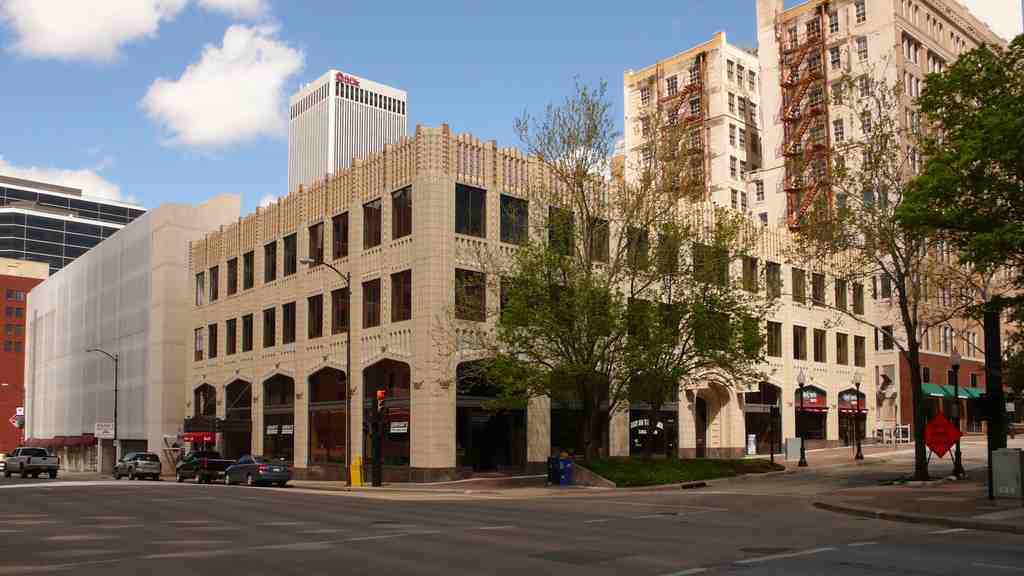
On your right, look for the low, cream-colored Art Deco building with a jagged, “stepped” crown along the roofline and tall, arched openings at street level.
This is the Pythian Building, and it’s basically downtown Tulsa in one snapshot: big ambition, a hard economic left turn, and then a stubborn decision to finish the job anyway. Construction kicked off in 1929-timing that, in hindsight, feels almost like a prank. Two local oilmen, J. M. Gillette and H. C. Tyrrell, started it with a bold plan: an office building topped by a ten-story hotel. Then the Great Depression hit, and the dream stalled out at the third floor. Tulsa wasn’t alone-across the country, projects froze mid-stride-but it’s still something to picture: cranes quiet, cash tight, and this half-finished shell waiting at the corner.
In 1931, the Knights of Pythias bought the place and decided they weren’t in the mood for an architectural shrug. They completed it as an office building and gave it the name it still carries. It later landed on the National Register of Historic Places in 1982, thanks to its Art Deco mix-sleek “Modern” lines with those punchy “Zig Zag” details that feel like the building is lightly clenching its jaw.
Now, take in the facade. See those thin vertical strips running upward? They’re like ribs, and they’re decorated with back-to-back diamond patterns-little zigzags that repeat all over, including in the lobby tile work inside. The accents pop in blue terra cotta, and along the roofline you’ll catch bands of blue, green, and burnt sienna, like someone finally let the color back into the budget. At street level, the openings have a Tudor-arch shape, but the framing is very 1930s: steel and geometric, more machine-age than medieval.
Even in modern times, it’s had its plot twists-listed for a sealed-bid sale in 2012 with a minimum of $1.4 million (about $1.9 million today), then absorbed into a major downtown portfolio a few years later.
Ready for First Place Tower? Just walk southeast for 5 minutes.




