
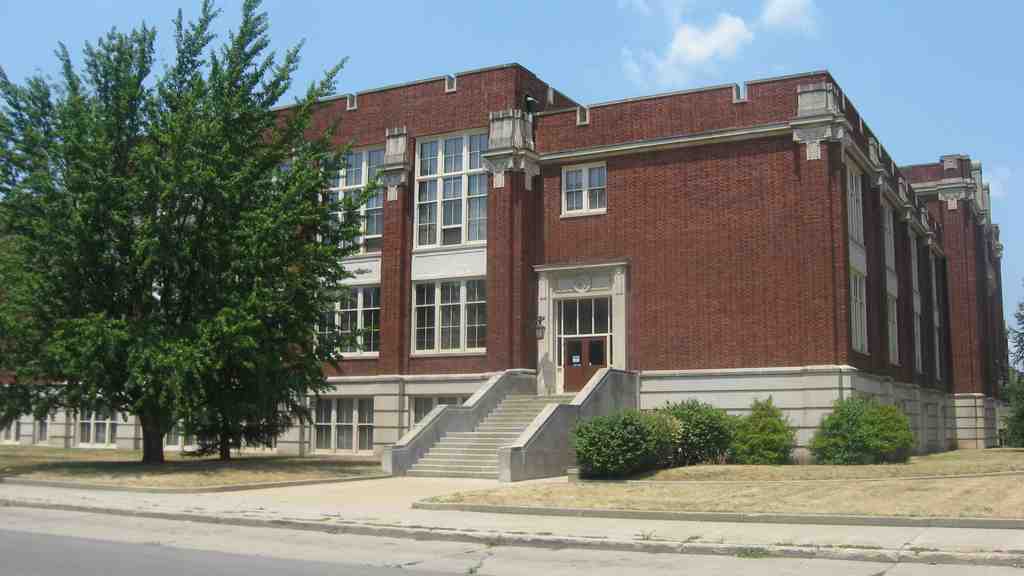
Look to your right to spot an immense, flat-roofed red brick building sitting solidly on a raised limestone foundation, anchored by a wide set of concrete stairs leading to a stone-framed entryway.
When this institution handed out its first diplomas in 1872, the graduating class was exactly four students, two boys and two girls. Yet, over the decades, this school adapted to a changing world, expanding into the sprawling complex you see today and eventually welcoming nearly two thousand students by the early nineteen fifties. It became a vital center of progressive integration, educating Black and white students together during a time when the rest of the nation was fracturing over segregation.
Melvin Holmes, a nineteen fifty-eight graduate, later noted that inside these walls, color was secondary. That forward-thinking environment reached beyond race. Decades before federal laws mandated equal opportunities for women's sports, the Girls Athletic Association was thriving here in 1905. Young women earned letter sweaters for field hockey, table tennis, and water ballet, and the girls volleyball team went completely undefeated from 1948 to 1955.
The school was famously competitive, and for nine years, its athletic programs were run by the legendary John Wooden. He was a strict disciplinarian, though his version of a fiery, foul-mouthed tirade was to simply yell, my goodness gracious. On one occasion, a few players stopped for ice cream on their walk to practice. Wooden's response was swift. He ordered the entire team to run the bases ten times. During a 1940 team photo, two players, John Hickey and Eddie Ehlers, stuffed their cheeks to look like they had large wads of chewing tobacco in their mouths. Wooden gave them a firm scolding, but clearly trusted them anyway, as he frequently made those same two boys babysit his kids in the backseat of his car during away games.
The basketball team was formidable, winning two state championships, and even served as the inspiration for the fictional powerhouse opponents in the 1986 film Hoosiers. But by 1970, the high school closed.
In 1995, developers took an enormous financial risk to save the property. They poured twelve point three million dollars into transforming the sprawling two hundred and nineteen thousand square foot complex into apartments. They committed to adaptive reuse, an architectural practice where an obsolete historic building is completely updated for modern living while carefully preserving its structural soul. The gamble succeeded beautifully. Today, residents live with original chalkboards in their living rooms, and one unit even features the original sunken indoor pool with its depth markings still intact.
If you need to speak with the building staff, they maintain opening hours Monday through Friday from 8:00 AM to 3:20 PM. Now, let us direct our attention toward a site of genuine artistic and spiritual grandeur, just a one-minute walk away, at the Cathedral of St. James.




